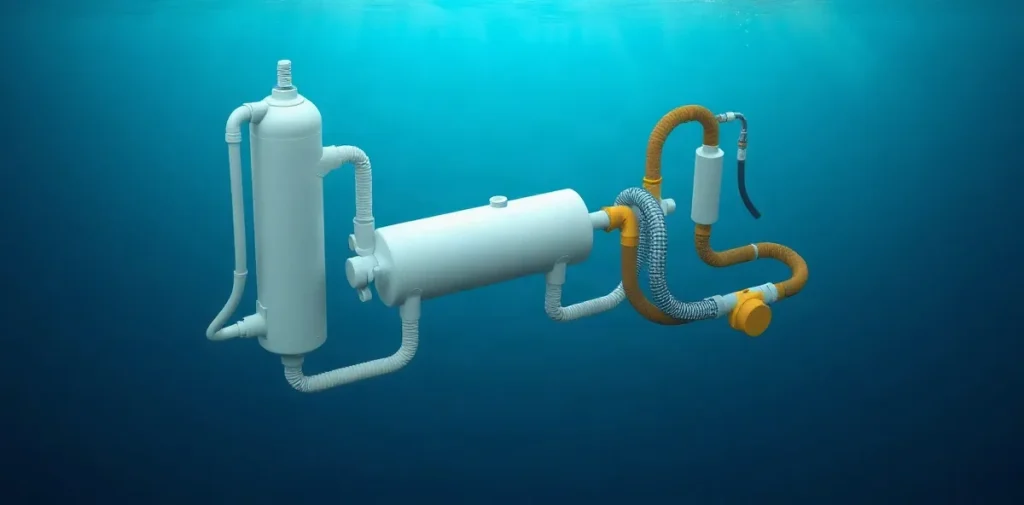
Underwater oxygen breathing equipment lets a diver breathe without releasing a continuous stream of bubbles, but its usefulness depends on more than breathing gas. Naval evaluation must consider oxygen delivery, carbon-dioxide removal, depth limits, reliability and the diver’s workload. Those questions connect equipment design directly to physiology and operational safety.
What does an oxygen breathing system need to do underwater?
An oxygen breathing apparatus supplies oxygen to the diver and removes exhaled carbon dioxide from the breathing loop. In a closed-circuit system, gas is recirculated rather than exhausted with every breath. A chemical absorbent in the loop binds carbon dioxide, while the oxygen supply replaces what the body consumes and compensates for losses.
That arrangement can reduce bubbles, an important operational feature where a visible exhaust could compromise a task. But a bubble-suppressing system is not simply an air set with a different gas. Its breathing circuit, gas supply, absorbent, valves and facepiece must work together, and a fault in any part can affect the diver’s ability to breathe safely.
Why does depth change the risk of breathing oxygen?
Oxygen’s effects depend on its partial pressure: the pressure contributed by oxygen in the breathing mixture. As ambient pressure rises with depth, the partial pressure of oxygen rises too. A system that supplies oxygen suitable near the surface can therefore expose a diver to a hazardous oxygen partial pressure at depth.
Oxygen toxicity can affect the central nervous system and may cause a seizure underwater, where loss of control can quickly become life-threatening. Oxygen exposure also has a pulmonary component when exposure is prolonged. Safe use consequently depends on the gas, depth, exposure time and operating procedure together—not on the name of the apparatus alone.
What does equipment evaluation examine?
Evaluation of underwater breathing equipment typically treats the apparatus as a complete system and asks how it performs under the conditions in which it is intended to be used. The central concerns include whether the diver receives adequate gas, whether exhaled carbon dioxide is removed, and whether breathing resistance remains manageable as workload and depth change.
- Oxygen delivery: whether the supply and control arrangements maintain an appropriate breathing mixture within intended operating limits.
- Carbon-dioxide control: whether the absorbent and breathing loop remove carbon dioxide effectively, including as the diver’s exertion increases.
- Breathing mechanics: how resistance, dead space and the position of the breathing components affect ventilation.
- Reliability and usability: whether seals, valves and controls function consistently and can be operated under water.
- Operating envelope: the depth, duration, workload and environmental conditions for which the system is intended.
Laboratory checks can isolate components and measure gas or breathing characteristics; controlled trials can examine the integrated system with a diver. The method matters because a bench result cannot by itself establish how equipment behaves during movement, changing posture, cold exposure or an unexpected fault. Evaluation is strongest when the test conditions match the intended task.
How does this work fit into diving research?
Oxygen apparatus belongs to a wider field concerned with matching breathing gas and equipment to depth, duration and mission. Its questions differ from those of decompression research: decompression work addresses inert-gas uptake and elimination during pressure changes, whereas oxygen equipment research focuses on the breathing loop and the hazards of the gas supplied. Both fields shape the limits within which a dive can be planned.
The naval setting makes operational constraints especially relevant. Low bubble output may be useful, but it does not remove physiological limits or the need for dependable equipment and clear procedures. A device’s suitability is therefore a question about the diver, the task and the operating conditions as well as the hardware.
What should divers and clinicians take from the subject?
For divers, the key distinction is between an apparatus that functions mechanically and a system that can be used safely within a defined envelope. Oxygen partial pressure, carbon-dioxide retention, breathing resistance and equipment failure are linked hazards; assessing one in isolation can miss how the others compound risk.
Diving physicians and hyperbaric clinicians encounter the consequences when gas exposure or equipment problems contribute to an emergency. Questions about an individual’s fitness, exposure limits or return to diving require assessment by a diving-medicine physician, with the specific apparatus and planned operating conditions taken into account.
Frequently asked questions
Why use an oxygen breathing apparatus underwater?
What is the main physiological concern with oxygen at depth?
Why test the full breathing system rather than its parts alone?
An original research-library explainer written by the Rubicon editors. It is not a summary of a specific publication.
Related reading on Rubicon
- The Diving Reflex: What Happens Underwater
- Diving Safety: Key Insights into Underwater Exploration
- Scuba Diving Equipment: Essential Gear for Every Diver
- Diving: Exploring Underwater Activities, Science, and Safety
- Oxygen-Enhanced Breath-Hold Diving: Research Summary
- Oxygen-Enhanced Breath-Hold Diving: Research Summary
- More on Equipment
- Browse the Research Library