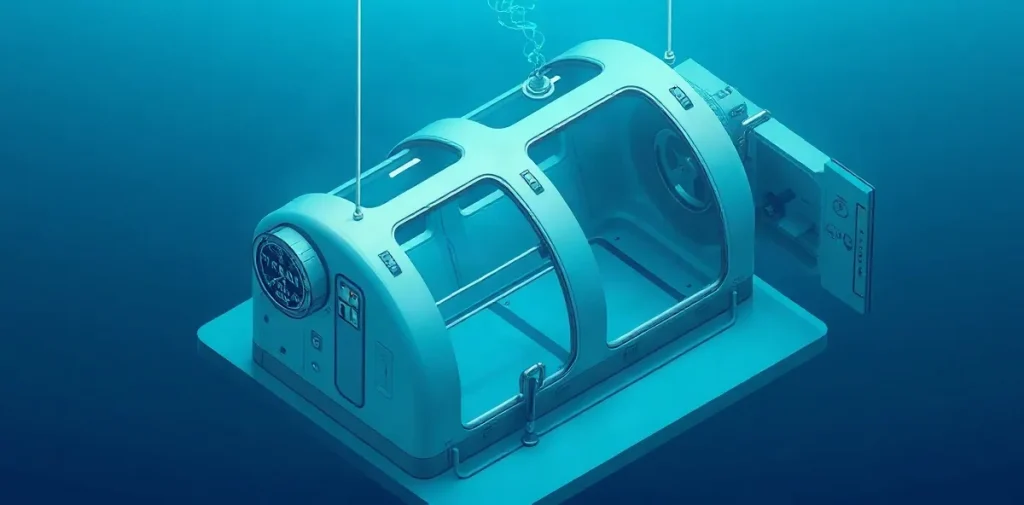
Undersea-laboratory research examines how people, equipment and scientific work function during prolonged residence underwater. It matters because saturation diving changes the practical conditions of research: pressure, habitat life support and repeated exposure shape both the work divers can do and the risks they manage.
What makes an undersea laboratory different?
A submerged habitat is both a workplace and a life-support system. In saturation diving, the body’s tissues become saturated with the inert gas in the breathing mixture; returning to the surface then requires controlled decompression rather than a routine ascent after each excursion.
That arrangement lets divers remain at depth between work periods, but it makes habitat operations central to the research. Scientists and support teams must consider pressure, breathing gas, thermal comfort, moisture, carbon dioxide removal, communications and the reliability of the habitat itself.
The research area therefore joins human physiology to engineering and field science. An undersea laboratory is not simply a place to observe the ocean: it is an environment whose conditions affect the people collecting observations.
Which questions guide this research?
Studies of undersea laboratories can ask how prolonged exposure affects work capacity, sleep, alertness and coordination, and how crews adapt to living in a confined habitat. They can also examine whether environmental conditions or operational routines make particular tasks harder to perform safely.
Other questions concern the interface between divers and the habitat: how breathing-gas systems perform, how teams communicate, and how equipment behaves when it is used repeatedly in a demanding setting. The exact question depends on the operation, the scientific task and the conditions being studied.
- Pressure and gas: the depth environment and breathing mixture affect exposure and decompression planning.
- Human performance: fatigue, sleep and workload can influence attention and task execution.
- Habitat conditions: life support, temperature, humidity and carbon dioxide control shape the working environment.
- Operations: communication, equipment use and emergency procedures connect the habitat to the outside worksite.
How can scientists study work underwater?
Methods may combine environmental monitoring with observation of tasks and records of habitat operations. Researchers can compare conditions inside the habitat with the demands of excursions, while noting how the scientific work is organised and what equipment it requires.
Human-factors research treats a task as more than a physical action. Workload, communication, fatigue and the layout of controls can all affect whether a procedure remains usable when a diver is under pressure and working in restricted space.
These methods need to account for interacting influences. A change in performance cannot automatically be assigned to pressure alone: sleep, workload, temperature, gas exposure and the task itself may also matter. Careful observation is most useful when those conditions are recorded alongside the outcome being assessed.
Why does habitat research matter beyond the habitat?
Undersea-laboratory research belongs to a wider effort to understand diving as a system: the diver, breathing apparatus, environment, procedures and support team. Its lessons can inform scientific diving and other operations where people work underwater for extended periods, even when the equipment and mission differ.
For diving physicians and hyperbaric clinicians, the relevant questions include how exposure, decompression and the diver’s condition interact. For scientific divers, the same research helps frame decisions about task demands, rest, communications and emergency readiness. A habitat’s operating procedures and medical arrangements should be checked for the specific mission rather than assumed to transfer unchanged.
What should readers keep in mind?
Saturation diving is a specialised mode of diving, not a general template for recreational practice. Its decompression requirements and dependence on habitat life support make planning and supervision distinct from ordinary short-duration dives.
Research findings from one habitat or operation may not apply directly to another. Depth, breathing mixture, equipment, crew routines and the scientific task can all change the conditions; when a health concern arises, a physician experienced in diving medicine should assess it.
Frequently asked questions
What is saturation diving?
Why use an undersea laboratory?
Does habitat research apply to recreational diving?
An original research-library explainer written by the Rubicon editors. It is not a summary of a specific publication.
Related reading on Rubicon
- The Diving Reflex: What Happens Underwater
- Scuba Diving Regulators: Balanced vs. Unbalanced
- Scuba Diving Buddy Checks: Catch Problems Early
- Scuba Diving: Why Immersion Can Dehydrate You
- Thesis Research in Diving and Hyperbaric Medicine
- HPNS Suppression in Deep Human Dives: Research Summary
- More on Diving Science
- Browse the Research Library