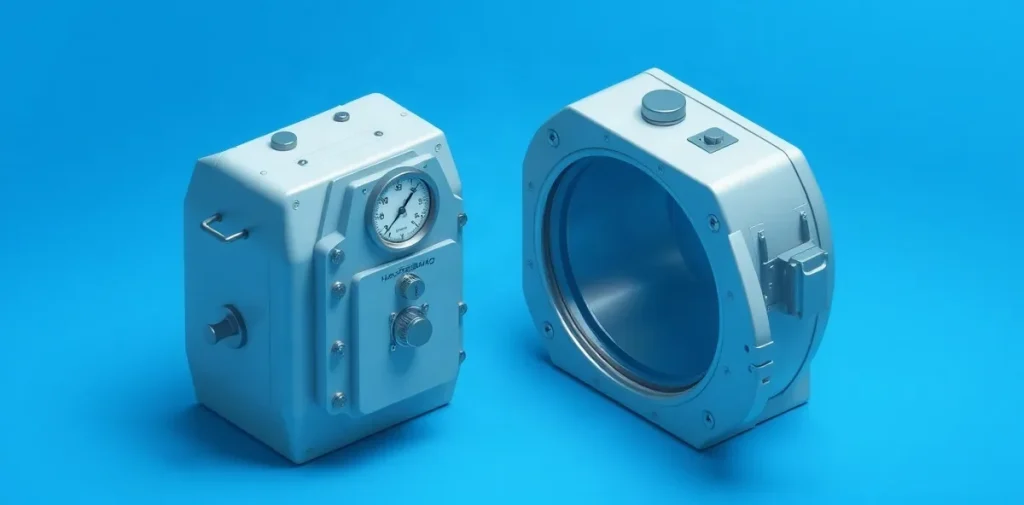
Recompression treatment tables are structured protocols for managing decompression illness in a hyperbaric chamber. They specify how pressure, breathing gas and time are combined during treatment. Comparing tables used across government and industry helps frame a central clinical problem: how to apply pressure-based treatment consistently while accounting for different cases, equipment and operating practices.
What does a recompression table prescribe?
A treatment table is a sequence of chamber conditions, not simply a target pressure. It sets a pressure exposure and a schedule for breathing gases and returning to surface pressure. The prescribed steps are intended to guide a controlled treatment rather than leave each phase to improvisation.
Recompression means increasing ambient pressure around the patient in a hyperbaric chamber. Treatment commonly combines pressure with oxygen breathing, using planned periods and intervals; exact procedures depend on the selected protocol and clinical setting. The table gives the team a shared framework for delivering those exposures and monitoring the patient.
- Pressure: the chamber exposure used during each treatment phase.
- Breathing gas: the gas breathed during specified periods, including oxygen where prescribed.
- Time: the duration and order of exposure, breathing periods and pressure changes.
- Operational controls: the chamber capability, staffing and procedures needed to carry out a schedule safely.
Why can treatment protocols differ?
Decompression illness is not one uniform condition. Decompression sickness can involve gas bubbles forming in tissues or circulation after a reduction in pressure; arterial gas embolism can occur when gas enters the arterial circulation, including after lung overexpansion. Symptoms, timing, severity and response to treatment can vary, so a table must be used within clinical assessment rather than as a diagnosis.
Protocols also develop in different operational settings. Government and industrial diving can involve distinct chamber resources, procedures and working environments. A comparison of treatment tables therefore raises questions about how schedules are organised and how their assumptions relate to the conditions under which clinicians and chamber teams work.
How are treatment tables studied and compared?
Research in this area can examine the structure of protocols: pressure levels, treatment duration, oxygen-breathing periods and the order of decompression. It can also compare how different organisations express treatment steps, identify common features and consider where schedules diverge. Such analysis is about the design and use of protocols, not a substitute for evaluating an individual patient.
The wider field connects treatment schedules with decompression physiology. Researchers study how inert gas is taken up and eliminated, how bubbles may form, and how pressure changes affect the body. Work on decompression models and table calculation addresses prevention during ascent; recompression research addresses treatment after illness is suspected. Both depend on translating complex physiology into procedures people can apply.
Why does this matter to divers and clinicians?
For divers, treatment tables matter because suspected decompression illness needs prompt medical assessment and access to appropriate hyperbaric care. A table is a clinical tool, not a self-treatment plan. If symptoms occur after diving, seek emergency medical care and contact a diving-medicine physician; do not attempt to choose or reproduce a chamber schedule yourself.
For diving physicians and hyperbaric clinicians, a protocol provides an organised basis for treatment while leaving room for clinical judgement and patient monitoring. Chamber teams must understand the schedule, the equipment’s operating limits and the procedure for managing interruptions or changes. Scientific divers and operators also benefit from knowing that emergency planning includes access to trained personnel and suitable facilities.
What questions remain central to the field?
Comparative work on recompression schedules sits at the intersection of physiology, clinical medicine and operational practice. Its enduring questions include how treatment phases should be structured, how protocols can be used consistently across settings, and how a prescribed schedule interacts with the patient’s evolving condition. These questions require clinical evidence as well as practical knowledge of chamber operations.
Tables should be interpreted as part of a wider system: diagnosis, medical assessment, chamber capability and ongoing observation all matter. For a real incident, follow local emergency procedures and seek advice from a diving-medicine physician and a hyperbaric service.
Frequently asked questions
What is recompression treatment?
Are recompression tables the same as decompression tables?
Can a diver select a treatment table independently?
An original research-library explainer written by the Rubicon editors. It is not a summary of a specific publication.