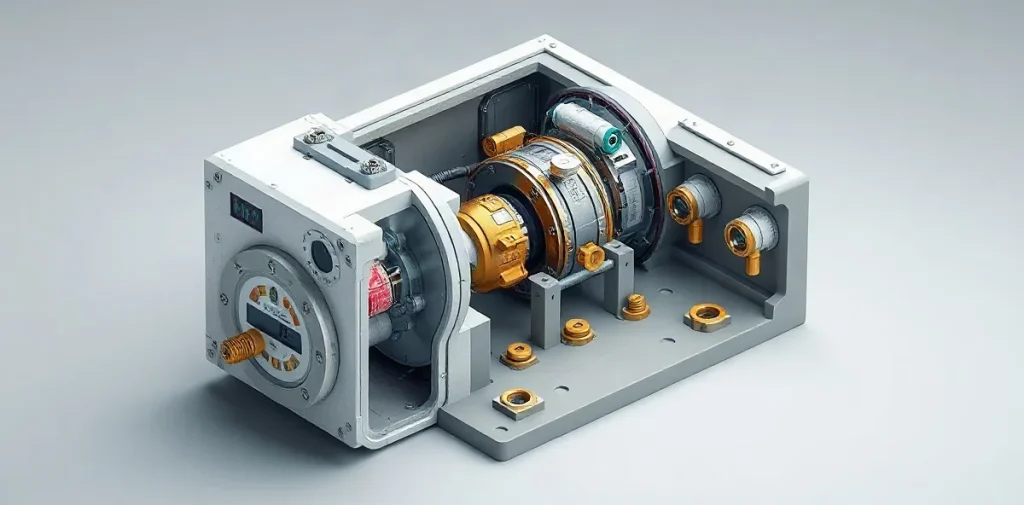
Oxygen monitoring in a hyperbaric carbon dioxide system concerns how to measure oxygen reliably in a pressurised environment where carbon dioxide is also being analysed. In dry deck shelter operations, that capability matters because a gas reading is useful only when the instrument, sampling path and operating conditions support a trustworthy measurement.
Why monitor oxygen alongside carbon dioxide?
Oxygen and carbon dioxide answer different questions about the breathing environment. Oxygen is needed for metabolism, while carbon dioxide is produced by the body and must be managed to prevent accumulation. Measuring one does not establish the level of the other.
In a confined or pressurised space, gas monitoring supports decisions about environmental control and operational safety. A carbon dioxide analyser adapted to monitor oxygen therefore raises a practical engineering question: can one measurement system provide meaningful readings for two different gases under the conditions in which it is used?
What makes measurement under pressure different?
Hyperbaric conditions change the physical environment in which an instrument operates. Pressure can affect sensor response and gas-sampling behaviour; temperature, humidity, leaks, contamination and changes in gas composition can also influence readings. A system designed for ordinary ambient conditions cannot simply be assumed to behave identically under pressure.
Measurement also depends on the path from the atmosphere being monitored to the sensor. Flow, delays, mixing and sample handling can shape how quickly a reading reflects a change in the actual environment. For operators, a stable display is not enough: the instrument needs to respond to the gas of interest in the relevant pressure range.
What does a development programme need to examine?
Work on adding oxygen monitoring to an existing hyperbaric carbon dioxide analyser belongs to the broader field of instrument adaptation and validation. The central tasks are to establish what the sensor measures, how its output behaves under pressure, and whether the complete sampling and display system gives a dependable representation of the surrounding gas.
- Sensor response: whether the sensing element responds specifically and consistently to oxygen.
- Pressure effects: whether calibration and response remain appropriate at the operating pressure.
- Sampling integrity: whether leaks, flow or delays distort the gas reaching the sensor.
- Calibration and checks: whether readings can be compared with a suitable reference and verified during use.
- Operational integration: whether the additional measurement works with the existing analyser and its procedures.
These are engineering questions, not merely questions of sensor choice. A component can perform well on a bench and still require careful assessment when installed in a working system.
Why does this matter to divers and clinicians?
For divers working in or around a dry deck shelter, gas monitoring is part of understanding and controlling the environment. Reliable oxygen measurements can inform operational awareness, while carbon dioxide measurements address a separate hazard. Neither replaces established procedures, equipment checks or competent supervision.
Hyperbaric clinicians and diving-medicine teams also need to understand how instruments behave when readings inform care or operational decisions. A measurement should be interpreted in context: what gas was sampled, at what pressure, through which system, and with what calibration. If a health concern arises during or after diving, consult a diving-medicine physician rather than relying on an instrument reading alone.
How does this fit into diving research?
Diving research spans physiology, decompression, breathing equipment and the systems that make underwater operations possible. Oxygen monitoring in a pressurised carbon dioxide analyser sits at the intersection of instrumentation and environmental safety: it asks how to obtain meaningful gas measurements in a specialised operational setting.
That concern connects to a wider principle in diving technology. Equipment must be assessed as a system, in the conditions where it will be used, and its readings must be understood alongside their limitations. For any specific analyser or operation, check the applicable technical documentation and operating procedures.
Frequently asked questions
Why measure oxygen if carbon dioxide is already monitored?
Can pressure affect an oxygen sensor?
What makes a gas-monitoring reading useful?
An original research-library explainer written by the Rubicon editors. It is not a summary of a specific publication.
Related reading on Rubicon
- How Carbon Dioxide Buildup Affects Rebreather Safety
- The Science Behind Dive-Induced Immune System Modulation
- The Physiology Behind Oxygen Toxicity in Deep Dives
- How Rebreather Systems Optimize Gas Use and Extend Dive Time
- Oxygen Measurement in Hyperbaric Delivery Systems
- Hyperbaric Oxygen Therapy for Lyme Disease
- More on Equipment
- Browse the Research Library