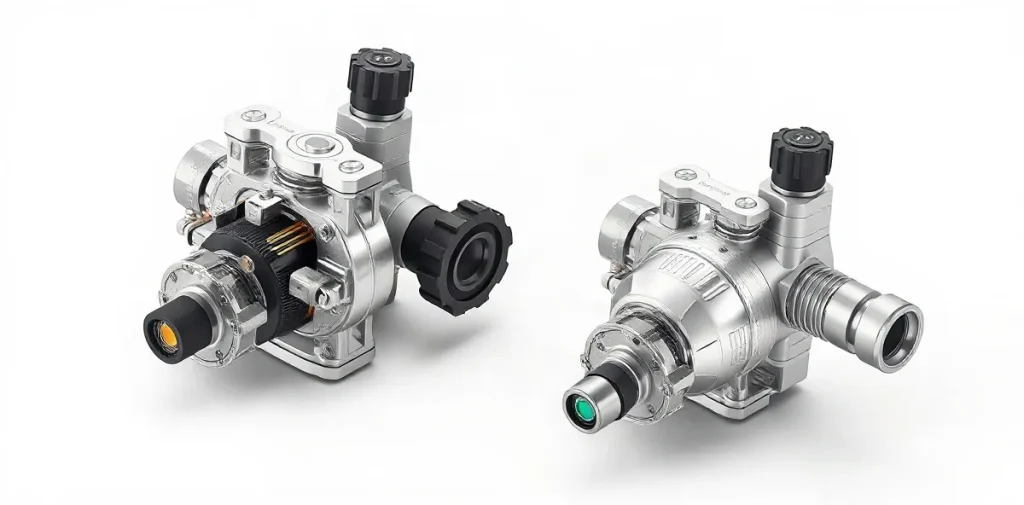
A balanced scuba regulator is designed to keep breathing effort more consistent as cylinder pressure falls, while an unbalanced regulator’s effort may change more noticeably. That distinction describes a design tendency, not a guarantee of comfort: the regulator’s performance also depends on its specific design and the conditions in which it is used.
For divers comparing balanced vs. unbalanced regulators, the practical question is how each feels across a dive—not simply which label sounds better. Understanding what balancing changes can help make sense of the trade-offs and choose equipment suited to the dive.
| Criterion | Balanced | Unbalanced |
|---|---|---|
| High-pressure effect | Incoming air does not directly act on the piston valve | Tank pressure acts directly on the high-pressure seat |
| As cylinder pressure falls | Breathing effort is designed to remain more consistent | Breathing can become harder |
| Price tendency | Generally pricier | Generally cheaper |
| Separate mechanism label | May be piston or diaphragm; balance does not specify this | May be piston or diaphragm; balance does not specify this |
- 2 first-stage balance categories The comparison covered here: balanced and unbalanced
- 2 mechanism types Piston and diaphragm, a separate distinction from balance
- 0 model-specific prices supplied The source material gives no regulator price figures
How does scuba diving regulator balance affect breathing?
A scuba regulator’s balancing design affects how consistently the first stage supplies intermediate pressure to the second stage as cylinder pressure changes. The first stage reduces high cylinder pressure to intermediate pressure; in a balanced piston design, incoming high-pressure air does not act directly on the piston valve, so falling cylinder pressure has less effect on breathing effort.
Balanced and unbalanced first stages
- Balanced piston: Incoming high-pressure air does not act directly on the piston valve. This helps keep the effort required to breathe more consistent as cylinder pressure falls.
- Unbalanced: Cylinder pressure acts directly on the high-pressure seat. As that pressure drops, breathing resistance can rise, making each breath feel harder.
The practical comparison is consistency across changing cylinder pressure, not a promise that every balanced regulator feels the same. Individual models can differ in how they breathe; balancing describes how the first stage responds to cylinder pressure, rather than guaranteeing an identical breathing feel across all regulators.
What is different inside a balanced and an unbalanced first stage?
A balanced first stage arranges its chamber and pressure paths so incoming tank air does not act directly on the piston valve; an unbalanced first stage lets tank pressure act directly on the high-pressure seat. That difference concerns pressure compensation, not whether the mechanism uses a piston or a diaphragm.
Mechanism is not the same as piston versus diaphragm.
“Piston” and “diaphragm” identify two first-stage mechanisms, while “balanced” and “unbalanced” describe how tank pressure affects the valve. These are separate distinctions: the terms should not be treated as interchangeable labels.
- Balanced piston: the chamber arrangement separates incoming high-pressure air from its direct effect on the piston valve.
- Unbalanced first stage: tank pressure acts directly on the high-pressure seat.
- Piston versus diaphragm: this names the mechanism; it does not, by itself, say whether the first stage is balanced.
The available source material describes this pressure-path difference but gives no model-specific chamber dimensions or intermediate-pressure figures. It therefore supports a comparison of how pressure reaches the valve, not a numerical comparison of particular regulator models.
When does a balanced regulator make a noticeable difference?
A balanced first stage makes the most noticeable difference when cylinder pressure falls or ambient pressure rises, because it is designed to keep breathing performance more consistent under those changing conditions. An unbalanced first stage may feel harder to breathe from as tank pressure declines, and greater ambient pressure can add to the demand on the regulator.
How to compare breathing effort
Compare the same regulator at different cylinder pressures rather than judging it only with a full cylinder. The relevant distinction is whether breathing effort stays relatively consistent as pressure drops, or becomes heavier; the provided material does not specify a pressure level at which that change begins.
- Balanced first stage: designed to maintain more consistent breathing performance as cylinder pressure changes.
- Unbalanced first stage: may require more effort as cylinder pressure declines, particularly when ambient pressure is higher.
No depth threshold or test protocol is provided, so there is no supported figure for the depth at which a diver will notice a difference. Treat depth and remaining cylinder pressure as conditions to consider during a comparison, not as a precise pass-or-fail threshold.
What do divers pay for balanced first-stage performance?
Balanced first stages usually cost more than unbalanced ones, but the available source material gives no price, currency, model or brand from which to calculate the premium. What the extra cost buys is more consistent breathing effort as tank pressure changes—not a stated increase in maximum depth, lower gas consumption or a quantified safety benefit.
Compare the whole regulator, not one label
Unbalanced first stages are generally the cheaper choice, and can suit divers willing to accept breathing resistance that changes as tank pressure falls. “Balanced” alone is not a complete buying specification: compare the actual first-stage configuration and the availability of service support before deciding what the price difference is worth.
- Balanced: the relevant benefit is steadier breathing effort as tank pressure changes; no price premium or performance figure is provided here.
- Unbalanced: generally cheaper, with the trade-off of changing breathing resistance as tank pressure falls.
When is a balanced regulator not automatically the right choice?
A balanced first stage is not automatically the right choice if the complete regulator or its intended configuration does not suit the dive: the second stage matters too. Balance describes how the first stage responds as cylinder pressure changes; it does not, on its own, establish how the assembled regulator will breathe in every setup.
Check the whole regulator, not just the mechanism
- First stage: Balanced and unbalanced describe pressure response. A balanced design is more consistent as cylinder pressure falls; an unbalanced design can become harder to breathe from as pressure drops. Balance does not guarantee identical breathing at every depth or pressure.
- Mechanism: Piston versus diaphragm is a separate distinction. Either term alone does not tell you whether a first stage is balanced or unbalanced.
- Complete configuration: Consider the second stage alongside the first stage and the setup in which you plan to use them. A balanced first stage alone cannot confirm that the full regulator is suitable for that configuration.
Product-specific details need checking rather than assuming: the supplied material establishes no particular model, price, maintenance interval or environmental rating. Verify those details for the regulator under consideration, and assess balance as one feature—not as a guarantee of performance across every dive condition.
How should a diver compare regulator types before buying?
Compare scuba regulators by checking whether the first stage is balanced or unbalanced, then separately whether its mechanism is piston or diaphragm. These are two different classifications: “balanced” does not tell you whether the first stage uses a piston or a diaphragm.
- Breathing effort: Ask how it changes as cylinder pressure falls. An unbalanced first stage can become harder to breathe from as tank pressure drops; a balanced design is intended to keep breathing effort more consistent across tank pressures.
- Mechanism: Identify piston or diaphragm separately from the balance label. The supplied information describes both as first-stage mechanisms but does not establish that one is inherently better for every diver.
- Whole-regulator value: Compare the complete regulator and its stated price. The balance label alone does not supply a price or a quantified performance advantage.
Regulator models, companies, prices and standards are not named in the supplied material, so a current model-by-model ranking would be unsupported. Use the maker’s stated price and specifications for the specific complete regulator you are considering, and compare those details alongside the two first-stage classifications.
FAQ
Does a balanced regulator breathe the same at every tank pressure?
Why can an unbalanced regulator become harder to breathe from?
Are piston regulators always balanced?
Does a balanced regulator cost more?
What this piece draws on
- Scuba Diving — “How a Scuba Diving Regulator's First Stage Works”
- divingsquad.com — “ALL Types of Scuba Regulators – FULL Breakdown (2026)”
- scubaservicetools.com — “First stage regulators and their differences”
- divers-supply.com — “Regulator Buying Guide”
- scubaboard.com — “Balanced vs Unbalanced: First and Second Stage Options”
