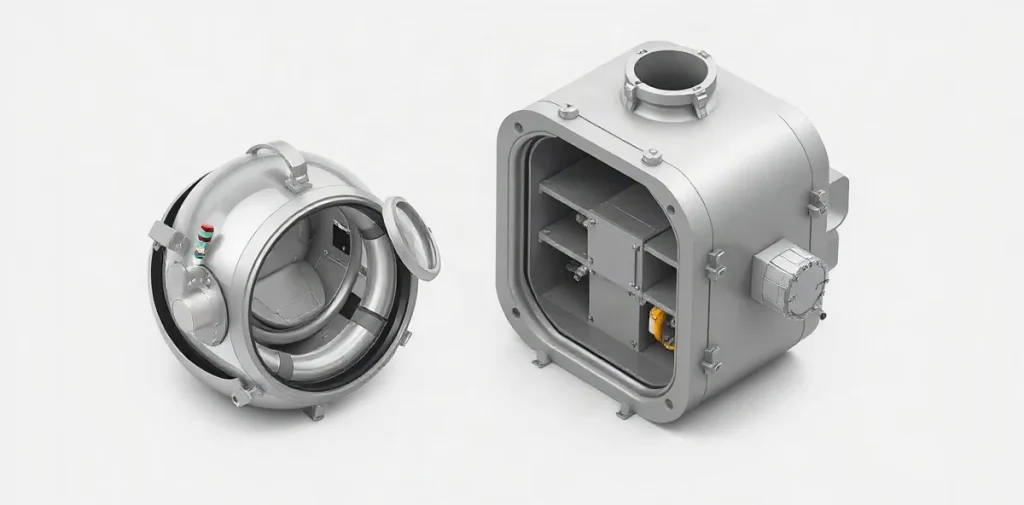
Use of the Monoplace vs. Multiplace Chamber in the Treatment of Diving Diseases is a 1988 journal article by Kindwall and colleagues in the Journal of Hyperbaric Medicine 3(1). It addresses how two types of hyperbaric chamber are used to treat diving diseases—a choice that shapes pressure delivery, patient care and the practical work of a treatment team.
Why does chamber type matter in diving medicine?
Diving diseases can arise when pressure changes affect gas in the body. Decompression illness includes decompression sickness, associated with inert gas coming out of solution, and arterial gas embolism, in which gas obstructs blood flow after a pressure-related lung injury. These conditions can require prompt assessment and recompression in a hyperbaric chamber.
Recompression exposes a patient to increased ambient pressure, commonly while breathing oxygen as part of a treatment protocol. The aim is to address the underlying gas problem and support recovery; the chamber is the environment in which pressure and breathing gas are controlled. Choosing a chamber is therefore a clinical and operational question, not simply a matter of room size.
For divers, clinicians and scientific diving teams, access to an appropriate treatment setting can affect how care is organised. The question also belongs to the wider history of hyperbaric medicine, where treatment protocols must work within the capabilities of available equipment and staffing.
How do monoplace and multiplace chambers differ?
A monoplace chamber is designed for one patient at a time. A multiplace chamber can accommodate more than one person and can allow trained staff to accompany a patient inside, depending on the chamber and its operating procedures. Both types can provide a pressurised environment, but their layout and ways of managing a treatment differ.
Chamber design influences how clinicians observe and communicate with a patient, how equipment is used during treatment and how the care team divides its work. The details depend on the specific chamber, its controls and the facility’s procedures. A comparison must therefore consider the treatment setting as well as the physical structure.
- Pressure control: how the chamber is pressurised, maintained and brought back to ambient pressure.
- Breathing gas: how oxygen or other prescribed gases are delivered and monitored.
- Patient access: how staff observe, communicate with and support the patient during treatment.
- Operational needs: staffing, equipment, preparation and the ability to manage complications.
What does hyperbaric treatment require?
Pressure is only one part of treatment. A clinical team must also assess the patient, select an appropriate protocol and monitor the response throughout the chamber exposure. The patient’s symptoms, medical condition and ability to tolerate treatment all matter, as does the team’s capacity to manage an emergency.
Breathing oxygen under pressure can increase the amount of oxygen dissolved in blood and tissues. It also requires attention to oxygen exposure and the risks associated with oxygen in a pressurised environment. Chamber systems and clinical procedures must support controlled gas delivery rather than treating oxygen as an ordinary, unrestricted breathing gas.
In a chamber with staff inside, clinicians may have more direct access to a patient, while the chamber’s capacity and procedures shape how that access works. A single-occupant design has a different arrangement for observation and intervention. Neither label alone determines the quality of care; equipment, protocols and trained personnel are central.
What questions should a chamber comparison address?
A useful comparison asks how each chamber supports the treatment that a patient needs. It considers whether the facility can deliver the prescribed pressure and breathing gas, monitor the patient, communicate effectively and respond to changes during treatment. It also examines how staffing and equipment affect the practical delivery of care.
The question is relevant beyond a single chamber choice. Diving medicine must connect field recognition and evacuation with hospital assessment and hyperbaric treatment. A chamber that fits one facility’s resources and patient-care model may not suit another’s; local capability and clinical circumstances matter.
Kindwall and colleagues’ article sits within this practical discussion of chamber use for diving diseases. Readers considering its place in the field should distinguish the general problem of chamber selection from any specific protocol, which should be checked in current clinical guidance and with a diving-medicine physician.
Frequently asked questions
What is a monoplace chamber?
What is a multiplace chamber?
Who should decide whether hyperbaric treatment is appropriate?
Citation details
- Title: Use of the Monoplace vs. Multiplace Chamber in the Treatment of Diving Diseases
- Authors: Kindwall, E. P; Goldmann, R. W; Thombs, P. A
- Year: 1988
- Published in: Journal of Hyperbaric Medicine 3(1)
- Record type: Journal article
- Repository record: Rubicon Research Repository, handle 123456789/4359
This page is an original summary written by the Rubicon editors from the publication’s bibliographic record. It does not reproduce the paper, its abstract or its data; consult the publication itself for its methods and findings.