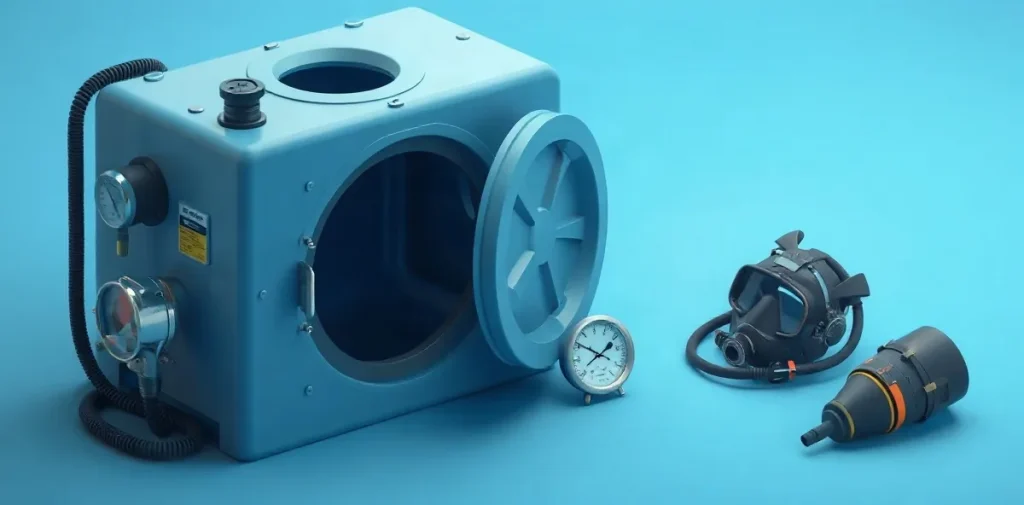
Initial analysis of diving accidents treated at the Catalina hyperbaric chamber is a 1988 publication by Ryan addressing diving accidents managed in a hyperbaric chamber. Its subject connects dive incident care with pressure-related illness and the clinical role of recompression, topics that matter to divers, scientific diving teams and clinicians responsible for treatment.
What does the title place under study?
The title identifies a clinical subject: diving accidents treated at the Catalina hyperbaric chamber during the period named in the publication. It places attention on incidents that reached chamber care, rather than on diving hazards in the abstract. That perspective makes the work relevant to how medical services encounter and manage diving-related problems.
“Initial analysis” signals an examination of a defined clinical topic, while the venue situates the publication in a scientific-diving symposium proceeding. The subject therefore sits where operational diving, accident recognition and hyperbaric medicine meet. It is of interest both to people planning scientific dives and to those studying the medical response to underwater incidents.
Why can diving lead to pressure-related illness?
During a dive, increased ambient pressure changes how gases behave in the body. Inert gas dissolves into tissues in amounts influenced by depth and exposure time. As pressure falls during ascent, that gas must leave the body; if pressure reduction and gas elimination do not remain in balance, decompression illness can occur.
Decompression illness is a broad clinical term that includes decompression sickness and arterial gas embolism. Decompression sickness involves gas bubbles forming in tissues or circulation after a pressure reduction. An arterial gas embolism can occur when expanding gas enters the arterial circulation, often in connection with lung overexpansion during ascent. Symptoms can vary, so a diver’s history and clinical assessment are important.
What role does a hyperbaric chamber play?
A hyperbaric chamber can raise ambient pressure in a controlled setting, allowing clinicians to use recompression as part of treatment for selected diving-related conditions. Treatment may involve breathing oxygen at pressure and then reducing pressure in a planned way. The precise approach depends on the clinical situation and should be directed by trained medical personnel.
Chamber treatment is one part of a wider response. Initial assessment, first aid, oxygen when available and appropriate, transport, and communication with a diving-medicine service can all matter. Suspected decompression illness or gas embolism requires urgent medical evaluation; this general information is not a substitute for care from a diving-medicine physician.
What can case-focused work help the field examine?
Studies of accidents reaching a treatment facility can help frame practical questions about how diving incidents present in clinical care. Researchers and clinicians may examine the kinds of reported symptoms, the circumstances surrounding a dive, how care is initiated, and the relationship between an incident and chamber treatment. These are general questions that make clinical case material valuable to the field.
- Exposure: dive profile, ascent circumstances and relevant environmental conditions.
- Recognition: symptoms, their onset and changes over time.
- Response: first aid, oxygen use, transport and clinical assessment.
- Treatment context: why chamber care is considered and how it fits into broader management.
Such work belongs to a long-standing effort in diving medicine to connect the physics of pressure and gas exchange with real clinical problems. Careful interpretation matters: experience at one chamber reflects cases that reached that service, not necessarily every accident experienced by divers. The distinction helps readers understand the value and scope of facility-based clinical inquiry.
Why is the publication relevant to scientific divers?
Scientific diving often involves specialised tasks, equipment and team procedures, but its medical risks still include the fundamental hazards of pressure exposure and ascent. Understanding how accidents are considered in a chamber-care setting can support informed safety planning, incident recognition and communication between dive teams and medical services.
Ryan’s 1988 publication appears in Advances in Underwater Science…88, the proceedings of the American Academy of Underwater Sciences Eighth annual scientific diving symposium, held September 29–October 2, 1988 at Scripts Institution of Oceanography, LaJolla, California. Its place in a scientific-diving forum underscores the relevance of clinical care to underwater research practice.
Frequently asked questions
What is the publication about?
What is recompression?
What should someone do if decompression illness is suspected?
Citation details
- Title: Initial analysis of diving accidents treated at the Catalina hyperbaric chamber (1985 – 1988)
- Authors: Ryan, RJ
- Year: 1988
- Published in: Lang, MA (ed). Advances in Underwater Science…88. Proceedings of the American Academy of Underwater Sciences Eighth annual scientific diving symposium. Held September 29 – October 2, 1988 at Scripts Institution of Oceanography, LaJolla, California
- Repository record: Rubicon Research Repository, handle 123456789/9462
This page is an original summary written by the Rubicon editors from the publication’s bibliographic record. It does not reproduce the paper, its abstract or its data; consult the publication itself for its methods and findings.
Related reading on Rubicon
- How Hyperbaric Chambers Aid Recovery from Dive Injuries
- Ear Barotrauma in Diving: Pain, Risks and Care
- Scuba Diving: Why Immersion Can Dehydrate You
- Why Scuba Diving Tanks Feel Empty Before They Are
- Thesis Research in Diving and Hyperbaric Medicine
- Oxygen in Diving and Hyperbaric Medicine
- More on Dive Medicine
- Browse the Research Library
