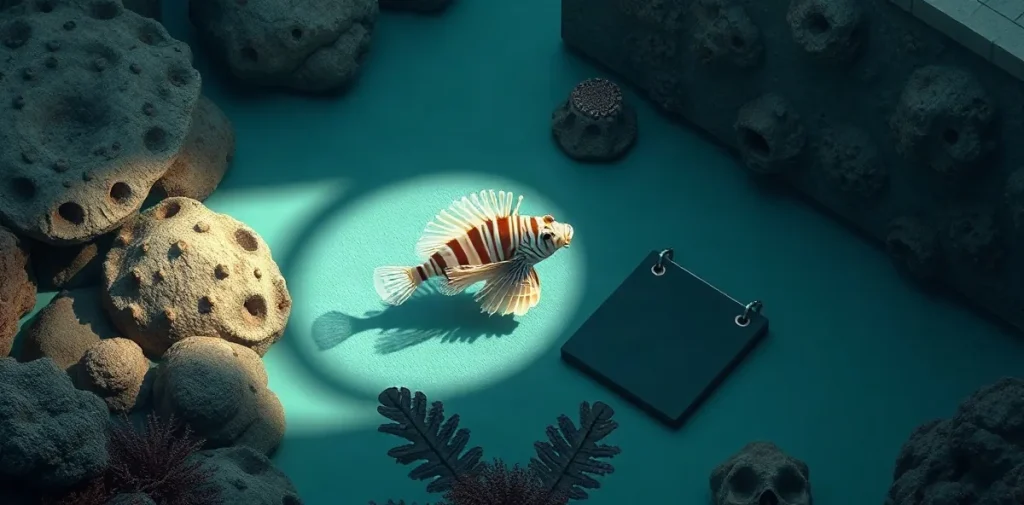
The Introduction and Dispersal of the Indo-Pacific Lionfish (Pterois volitans) Along the Atlantic Coast of North America is a 2003 publication by Whitfield and colleagues about the appearance and spread of this reef fish in the Atlantic. Presented in scientific-diving proceedings, its subject connects marine ecology with the practical realities of observing and documenting changing underwater environments.
What does the subject of this publication involve?
The title points to two linked questions: how an Indo-Pacific species became present along North America’s Atlantic coast, and how it dispersed through that region. These are central concerns in the study of introduced marine species, where researchers examine pathways of arrival, distribution, habitat use and changes in occurrence over time.
Lionfish are conspicuous, spiny fishes. Their appearance can make them relatively easy to recognise underwater, but documenting a range or spread requires more than noting an isolated sighting: observations need a location, a reliable identification and context about the habitat and survey conditions.
Why is lionfish dispersal relevant to divers?
Divers may encounter marine species before their presence is well represented in other observation systems. Scientific divers can contribute useful records by conducting planned surveys and recording observations consistently, while recreational divers may also notice unfamiliar organisms and changes at familiar sites.
Introduced species matter because they can become part of ecological communities in which they did not evolve. Their presence may raise questions about interactions with native species, competition, predation and ecosystem change. These are questions for ecological research; a sighting alone cannot establish what effects a species is having.
What should underwater observers consider?
Good field observation depends on separating what was directly seen from what is inferred. Identification, location, habitat, survey effort and the conditions in which an observation was made all shape how useful a record may be when researchers compare sites or dates.
- Identification: distinguish a confident species identification from a tentative resemblance.
- Place and habitat: record where an observation occurred and the underwater setting.
- Survey context: note whether an observation came from a structured survey or an incidental encounter.
- Change over time: interpret distribution as a pattern requiring repeated, comparable observations.
These considerations also help explain why scientific diving is more than underwater access. It combines observation with methods for making records interpretable, repeatable and useful to ecological questions.
How does this topic connect with diving science?
Scientific diving brings researchers into the environment they are studying, where visibility, depth, currents, temperature and bottom time can affect what is observed and how a survey is carried out. The work therefore sits at the intersection of field ecology and diving practice: sound observations depend both on biological knowledge and on a safe, workable survey plan.
In the wider study of marine change, tracking an introduced species is part of a broader effort to understand how organisms move, establish themselves and interact with existing communities. The subject also highlights a practical distinction important in research: documenting presence and distribution is not the same as establishing ecological impact or cause.
What are the diving and medical considerations?
Lionfish have venomous spines, so close inspection or handling can present an injury hazard. Scientific and recreational divers should avoid touching unfamiliar marine life and should follow appropriate local procedures for encounters and any permitted collection activity.
A suspected marine envenomation or other dive-related injury warrants prompt assessment. Because symptoms and appropriate care depend on the circumstances, a diving-medicine physician should be consulted; general information about the species is not a substitute for individual medical advice.
Frequently asked questions
What is the publication about?
Why might scientific divers study an introduced fish?
Is it safe to handle a lionfish?
Citation details
- Title: The Introduction and Dispersal of the Indo-Pacific Lionfish (Pterois volitans) Along the Atlantic Coast of North America
- Authors: Whitfield, P; Gardner, T; Vives, SP; Gilligan, MR; Courtney Jr, WR; Ray, GC; Hare, JA
- Year: 2003
- Published in: SF Norton (ed). 2003. Diving for Science…2003. Proceedings of the 22nd Annual Scientific Diving Symposium, American Academy of Underwater Sciences. Greenville, North Carolina.
- Repository record: Rubicon Research Repository, handle 123456789/4766
This page is an original summary written by the Rubicon editors from the publication’s bibliographic record. It does not reproduce the paper, its abstract or its data; consult the publication itself for its methods and findings.
Related reading on Rubicon
