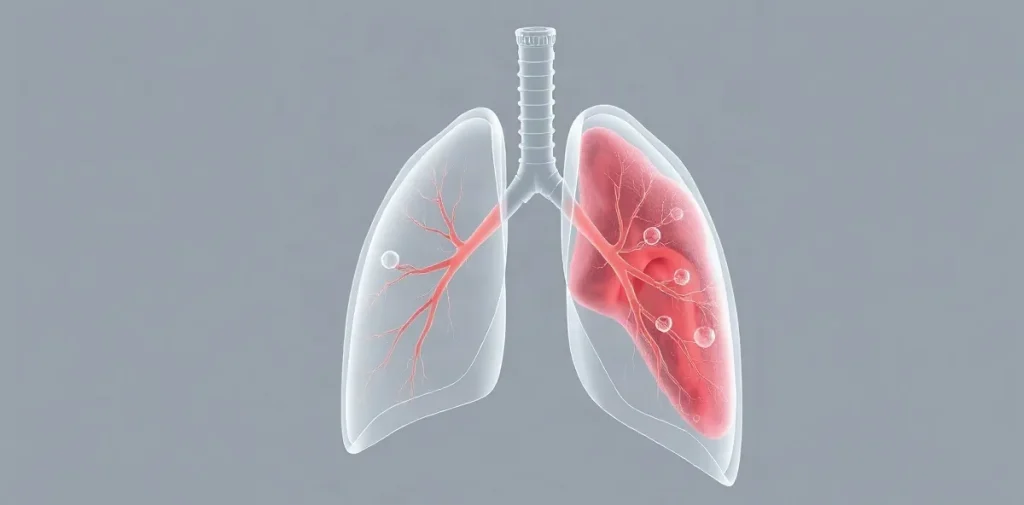
Pneumomediastinum after lung packing is a 2006 journal article by Jacobson FL and colleagues in Undersea Hyperb Med 33(5). Its subject is the relationship between lung packing and pneumomediastinum, a condition in which air enters the central space of the chest. The topic matters because diving exposes the lungs to changing pressure.
What are lung packing and pneumomediastinum?
Lung packing is a breathing manoeuvre that uses the mouth and throat to move additional air into the lungs beyond a normal inhalation. It is associated with attempts to increase lung volume, including in activities that involve breath-holding. The added air can stretch lung tissue and raise pressure within the chest.
Pneumomediastinum means air is present in the mediastinum, the space between the lungs that contains the heart, major blood vessels, windpipe and oesophagus. Air may reach this space after escaping from the lungs and travelling along tissue planes. It is distinct from pneumothorax, in which air collects between a lung and the chest wall.
The title brings together a deliberate lung-volume manoeuvre and a recognised form of extra-alveolar air. The central physiological concern is whether pressure and tissue strain associated with packing can contribute to air escaping from the lung into surrounding structures.
Why does this matter in diving?
Water pressure increases with depth, compressing gas in flexible spaces according to the surrounding pressure. During ascent, gas expands as pressure falls. For a diver breathing compressed gas, a failure to exhale normally during ascent can cause lung overexpansion injury; escaped gas may then enter the mediastinum or other parts of the body.
Lung packing raises a different but related concern: the lungs are deliberately filled beyond an ordinary breath. In diving contexts, any manoeuvre that increases lung volume or pressure deserves attention because lung tissue has limits. The risk depends on the activity, the breathing technique and the pressure conditions; the mechanisms should not be treated as interchangeable.
For clinicians, distinguishing pneumomediastinum from other pressure-related injuries matters when assessing symptoms and possible complications. For divers, the broader lesson is that a breathing technique can have consequences beyond its immediate effect on breath-hold or lung volume.
Which physiological concepts help frame the subject?
Several basic concepts help explain why lung packing and chest air can be considered together:
- Alveolar stretch: the tiny air sacs in the lungs expand as they fill; excessive distension can injure delicate tissue.
- Pressure gradients: gas moves from higher pressure toward lower pressure, including through tissue when a barrier is disrupted.
- Extra-alveolar air: escaped gas can track beyond the air sacs into the mediastinum or other anatomical spaces.
- Changing ambient pressure: during a dive, pressure changes alter gas volume and can affect the stresses on the lungs.
These mechanisms describe general pulmonary and diving physiology, not a diagnosis in an individual case. Chest discomfort, breathing difficulty or other concerning symptoms after diving or a lung-volume manoeuvre warrant prompt assessment by a qualified clinician; a diving-medicine physician should be consulted when diving exposure is involved.
How does the topic fit into diving-medicine research?
Diving medicine has long examined injuries caused by pressure changes, including pulmonary barotrauma and the movement of gas into tissues or blood vessels. Research on specific breathing practices adds another question: how does deliberate alteration of lung volume affect the possibility of injury, especially when pressure exposure is also relevant?
A publication focused on pneumomediastinum after lung packing sits at the intersection of respiratory physiology, clinical assessment and diving safety. Work on such a subject can help clinicians think about mechanisms and presentations, while reminding divers and researchers to distinguish a practice-related pressure load from the changing ambient pressure of a dive.
The practical relevance depends on the context in which lung packing occurs and the person’s exposure. A clinician evaluating a possible pressure-related injury needs the history of both the breathing manoeuvre and any diving or other pressure exposure.
Frequently asked questions
What is pneumomediastinum?
Is lung packing the same as holding a breath?
Why does a diving history matter when assessing chest symptoms?
Citation details
- Title: Pneumomediastinum after lung packing
- Authors: Jacobson FL; Loring SH; Ferrigno M
- Year: 2006
- Published in: Undersea Hyperb Med 33(5)
- Identifiers: PMID 17091828
- Record type: Journal article
- Repository record: Rubicon Research Repository, handle 123456789/5045
This page is an original summary written by the Rubicon editors from the publication’s bibliographic record. It does not reproduce the paper, its abstract or its data; consult the publication itself for its methods and findings.