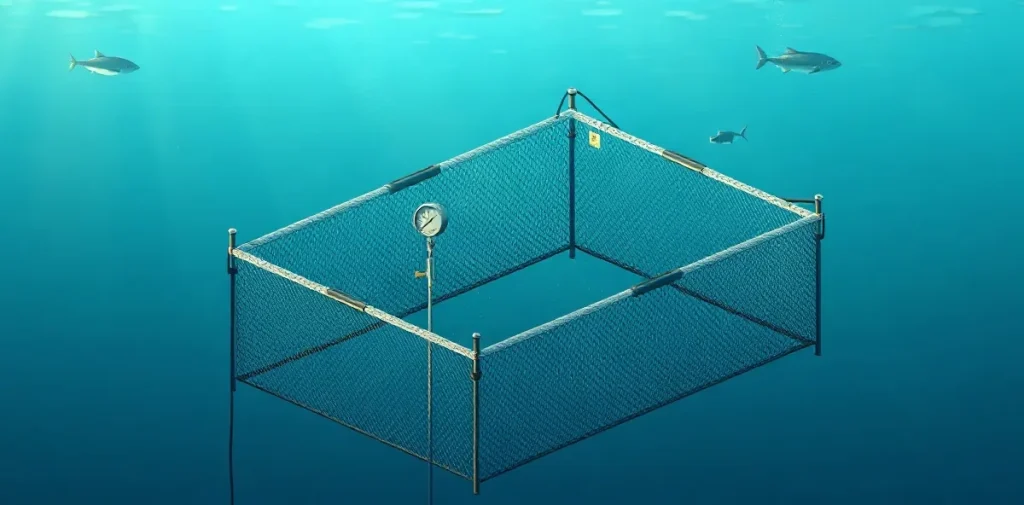
Tuna farm diving in South Australia is a 1999 journal article by Doolette and Craig, published in South Pacific Underwater Medicine Society Journal 29(2). Its subject is diving associated with tuna farming: an occupational setting where underwater tasks meet the practical demands of dive planning, worker health and decompression safety.
What makes tuna farm diving a distinct occupational setting?
Tuna farming depends on work carried out in and around submerged facilities. Diving can be required to inspect, maintain or manage underwater structures and equipment. The title places the article at the intersection of aquaculture and occupational diving, rather than recreational diving alone.
For a working diver, the relevant exposure is not simply time spent underwater. Depth, duration, breathing-gas choice, water conditions, workload, access to the surface and the ability to repeat a task all shape the dive profile. Work demands can also affect how closely a diver can follow a planned schedule.
The setting matters because the dive plan must fit both the underwater task and the operation around it. A job that requires repeated descents or sustained physical effort raises practical questions about cumulative exposure, recovery and whether the work can be interrupted safely.
Which physiological concepts help explain the risks?
During a dive, the increased ambient pressure changes the amount of inert gas that dissolves in body tissues. On ascent, that gas must leave the body in a controlled way. Decompression planning aims to manage this process and reduce the risk of decompression sickness, which can occur when bubbles form and cause injury.
Workload is another important factor. Exercise increases the body’s demand for oxygen and can alter circulation; cold and fatigue may also affect a diver’s capacity to work and recover. These factors do not act in isolation: a demanding task may be more consequential when combined with a long or repetitive exposure.
Breathing-gas delivery and equipment also matter. A diver needs reliable gas, buoyancy control and a workable route back to the surface. In occupational settings, the equipment and procedures must support the task without allowing the task itself to erode basic safety margins.
What should diving teams consider when planning work?
Occupational dive planning starts with the job, not just the depth. Teams need to consider what the task requires, how long it may take, what could prevent a normal ascent and what support is available at the surface. A plan also needs to account for the possibility that underwater work takes longer than expected.
Useful considerations include:
- Exposure: depth, duration, ascent profile and the pattern of repeated dives.
- Workload: the physical effort needed to complete the task and the effects of cold or fatigue.
- Equipment: breathing-gas supply, communications where used, buoyancy and access to the surface.
- Emergency readiness: a response plan for equipment problems, injury or suspected decompression illness.
- Recovery: time and conditions between dives, especially when work is repeated.
These are general planning principles, not a substitute for a site-specific risk assessment. The procedures must match the actual operation, the divers’ training and the available emergency support.
Why does this subject matter to dive medicine?
Occupational diving connects physiology to decisions made by employers, supervisors, divers and clinicians. A medical problem underwater can become an operational emergency, while a demanding work pattern may complicate the assessment of symptoms after a dive. Understanding the work helps clinicians interpret exposure and advise on fitness, treatment and return to diving.
Decompression illness is not diagnosed from a dive profile alone. Symptoms, timing, examination and the full exposure history matter. Suspected decompression illness requires urgent assessment through appropriate emergency and diving-medicine pathways; a diving-medicine physician should guide individual medical decisions.
Research on particular working environments also broadens the field beyond standard recreational dive profiles. It helps frame questions about how real tasks, equipment and repeated exposures interact, while keeping the core concerns familiar: gas uptake and elimination, workload, injury prevention and emergency response.
How does the article fit into diving research?
The article belongs to the occupational side of diving medicine and science. Its title identifies a specific industry and location, making the work setting central to the subject. That focus is useful because diving hazards are shaped not only by pressure and breathing gas, but also by what a diver must accomplish underwater.
For readers, the broader value is the way such work connects operational practice with physiology. Dive physicians can use occupational context when considering exposure and symptoms; scientific and commercial divers can use it to examine how task demands should inform planning. The article’s bibliographic record places it in the 1999 volume 29, issue 2 of the journal.
Frequently asked questions
What is the subject of the article?
Why is occupational diving different from recreational diving?
When should a diving-medicine physician be consulted?
Citation details
- Title: Tuna farm diving in South Australia
- Authors: Doolette, DJ and Craig, D
- Year: 1999
- Published in: South Pacific Underwater Medicine Society Journal 29(2)
- Record type: Journal article
- Repository record: Rubicon Research Repository, handle 123456789/6006
This page is an original summary written by the Rubicon editors from the publication’s bibliographic record. It does not reproduce the paper, its abstract or its data; consult the publication itself for its methods and findings.