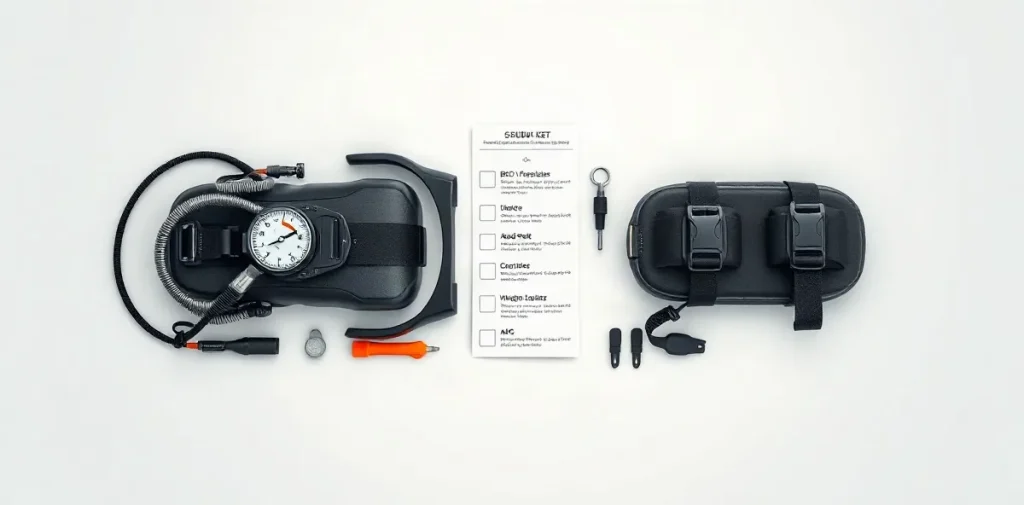
Buddy checks catch problems early by giving both divers a final chance to spot loose, missing or incorrectly configured equipment before entering the water. A deliberate check of each other’s gear can reveal an issue that is harder to notice once a dive has begun.
A buddy check is more than a routine before descent: it is a shared safety step, not a substitute for either diver checking their own equipment. This article explains what scuba diving buddy checks are meant to catch and why taking the time to do them carefully matters.
| Step | What to verify | Practical check |
|---|---|---|
| Air | Cylinder gas and breathing equipment | Read the pressure gauge; breathe from the regulator |
| Buoyancy | BCD operation | Check the hose and test inflate and deflate controls |
| Clearance | Equipment access and releases | Locate and operate weight-system and BCD releases |
| Depth gauge | Readable depth information | Check the gauge or dive computer is visible and working |
| Emergency | Shared response plan | Confirm alternate air source and agreed actions |
- 5 letters ABCDE sequence: Air, Buoyancy, Clearance, Depth gauge and Emergency
- 3 BCD checks Air retention, secure low-pressure inflator connection, and functioning inflate and deflate buttons
- 2 divers The pair who confirm equipment and readiness in a buddy check
What does a scuba diving buddy check verify?
A scuba diving buddy check verifies that both divers’ air supply, buoyancy controls, equipment clearance, depth instruments and emergency plan are ready before entry. The ABCDE sequence gives buddies a shared order for checking these items rather than relying on memory.
ABCDE: a repeatable sequence
- Air: Confirm the cylinder valve is open, breathe from the regulator and check the pressure gauge for usable gas for the planned dive.
- Buoyancy: Check that the low-pressure inflator hose is connected; use the BCD controls to confirm it inflates and deflates.
- Clearance: Make sure equipment releases are reachable and not obstructed.
- Depth gauge: Confirm the depth gauge or dive computer is readable.
- Emergency: Agree on the emergency plan, so both divers know what to do if a problem occurs.
The check is useful only if both divers can verify the other’s gear and understand the agreed plan. For example, a connected inflator hose does not confirm that the BCD controls work; operating both inflate and deflate controls checks their function. Reading the instrument together also confirms that the depth display is visible before the dive begins.
How should buddies check gas, releases and buoyancy?
Look, touch and confirm
Check the gas system together: have your buddy read the pressure gauge directly, then breathe from the regulator to confirm the cylinder valve is open and breathing gas is available. Do not treat “the cylinder is full” as confirmation; the gauge is the checkable reading. Make sure the alternate air source is visible and reachable.
- Pressure gauge: the buddy reads the displayed pressure rather than relying on a verbal claim.
- Regulator and valve: breathe from the regulator and confirm the valve is open.
- Alternate air source: check that it is accessible, not trapped beneath a strap or other equipment.
Have the diver demonstrate how to release the weight system and BCD, and check that the buckles and closures are secured afterward. Then test BCD inflation and deflation; inspect the low-pressure inflator hose to confirm it is snugly connected, and press both controls to ensure neither button sticks. These hands-on checks address gas access, release operation and buoyancy before entering the water.
Why does each diver still need an individual equipment check?
Each diver still needs an individual equipment check because a buddy’s second look cannot replace personally assembling and testing the gear. The diver who set it up is best placed to notice an unfamiliar configuration, a loose connection or a control that feels different from normal.
The DAN predive safety-check guidance calls for checking that the BCD holds air, that its low-pressure inflator hose is snugly connected, and that the inflate and deflate buttons work without sticking. These are hands-on checks: look at the connection, operate the controls and confirm the BCD retains air rather than relying on a verbal “all good.”
A buddy check is most useful when it is a physical inspection, not a quick exchange of questions and answers. A buddy can miss a fault in a rushed check, while the equipment owner may recognise that a familiar control feels abnormal; both divers should inspect, and each should personally verify their own setup.
When should the buddy system be adapted to the dive?
Adapt the buddy arrangement to diverters’ experience and the demands of the dive, rather than giving every pair the same level of supervision. On a Discover Scuba experience, a participant learning underwater breathing, balance and movement is normally kept close to an instructor; that close pairing matches the task of learning basic skills underwater.
Certified divers still need an explicit plan
Certified divers on a boat dive should agree with their buddy how they will locate each other and what to do if they become separated. Certification does not remove the need for that conversation: the pair should settle the separation response before entering the water, not improvise it after losing contact.
A trained rescue diver can help recognize stress and manage an emergency, but rescue training is not a substitute for checking equipment before the dive. Both buddies should still make a deliberate pre-dive check; an ABCDE check—Air, Buoyancy, Clearance, Depth gauge, Emergency—is one structured way to cover key items. The plan and check serve different purposes: one clarifies how the pair will work together, while the other helps catch equipment problems before they become emergencies.
What common mistakes can a buddy check fail to catch?
A check reduces risk; it cannot guarantee a problem-free dive.
A buddy check can miss an empty or underfilled cylinder, an unusable release, or a BCD problem if divers accept appearances or assurances instead of testing the equipment. The ABCDE sequence—Air, Buoyancy, Clearance, Depth gauge, Emergency—gives buddies a structure, but it only helps when each item is actually checked.
- Air: Read the pressure gauge yourself; “recently filled” does not verify the cylinder’s current pressure.
- Clearance: Locate each release and operate it, rather than confirming only that it is present. Check that you can reach it and that it opens.
- Buoyancy: Test the BCD controls and confirm the low-pressure inflator hose is connected. A stuck inflate or deflate button, or a disconnected hose, can compromise buoyancy control even if the rest of the kit looks ready.
Rushing through ABCDE, or assuming a buddy has already checked every item, can create false confidence. If a reading, connection or control is uncertain, pause and repeat that check with your buddy before entering the water; a completed check reduces avoidable risk but cannot guarantee a problem-free dive.
What should both divers confirm before entering the water?
Before entering the water, both divers should complete a shared ABCDE check, confirm the dive plan and emergency response, and resolve any uncertainty on the surface. This final pass gives each buddy a chance to catch a problem while there is still time to correct it.
Run the check together
- Air: Each diver should identify the other’s air supply and alternate air source, and confirm the equipment is working as expected.
- Buoyancy: Check the buoyancy compensator and make sure both divers can locate each other’s weight releases.
- Clearance: Check that equipment is secured and does not obstruct movement or access to controls.
- Depth gauge: Confirm each diver can locate and read their depth gauge.
- Emergency: Agree on the planned dive and what each buddy will do if a problem arises.
ABCDE is useful only when both divers can point out the relevant equipment on their buddy and understand the agreed response; completing the sequence silently is not a shared check. If a release, alternate air source or other item is unclear, stop and settle the question before entering. If equipment behaves unexpectedly, or either diver is not ready, pause the entry and fix the issue rather than trying to sort it out underwater.
FAQ
What does ABCDE mean in a scuba buddy check?
Does a buddy check replace my own scuba equipment check?
What should I check on a BCD before a dive?
Should beginners and certified divers use the same buddy arrangement?
What this piece draws on
- scubalifecozumel.com — “Top 10 Scuba Diving Safety Tips for Every Diver”
- divingwithnic.com — “Why You Should Never Skip a Buddy Check Before Diving”
- divevolkdiving.com — “Scuba Diving Safety: Essential Guide for Every Diver”
- blog.padi.com — “The Proper Dive Buddy Check – How Do You Say BWRAF?”
- dan.org — “The Importance of a Predive Safety Check – Divers Alert Network”
