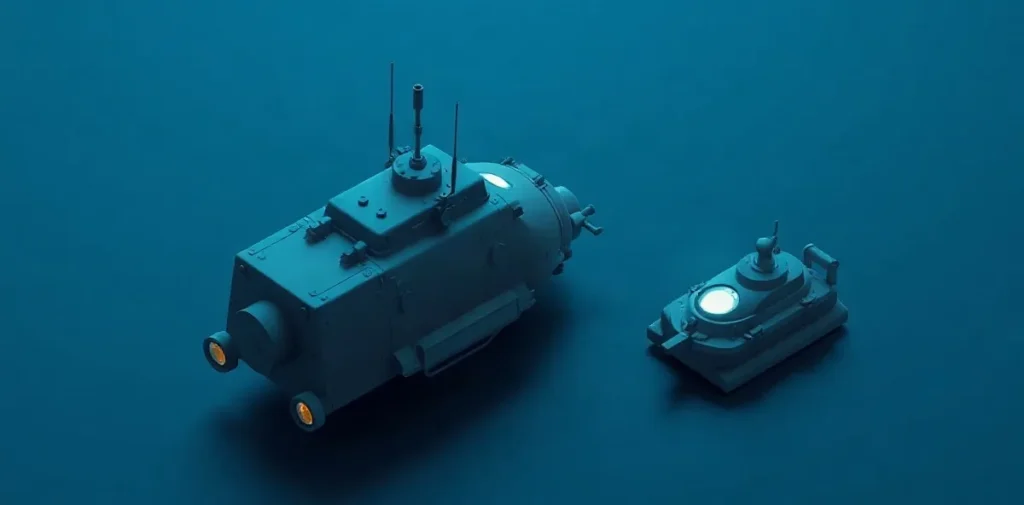
Submersibles – Manned and Unmanned is a 1977 journal article by Brand, published in South Pacific Underwater Medicine Society J 7(3). Its subject is the use of underwater vehicles with people aboard and vehicles operated without occupants—a distinction central to managing pressure, life support, human exposure and the risks of underwater work.
What separates manned and unmanned submersibles?
A manned submersible carries people inside a pressure-resistant compartment. The hull and its systems must protect occupants from the surrounding water pressure while providing a suitable internal environment for the mission. The people inside are not exposed to ambient water pressure in the way an open-circuit diver is.
An unmanned vehicle has no onboard crew. It may be remotely operated or function with some degree of autonomy, but those operating modes are not interchangeable: one depends on a live control link, while the other relies on programmed or onboard control. Both types of vehicle can extend observation and work underwater without placing an operator in the water.
The distinction is practical as well as technical. An occupied vehicle makes the human environment part of the machine; an unoccupied vehicle shifts the immediate task of observation and control to instruments, software and operators outside the vehicle.
Why does pressure matter inside an underwater vehicle?
Water pressure rises with depth. A diver breathing compressed gas is exposed to the pressure of the surrounding water, so gas density, breathing effort and the uptake of inert gases become relevant to planning and physiological risk. In a pressure-resistant submersible, the hull separates the occupants from that ambient pressure.
That separation changes the medical problem; it does not remove it. Occupants still depend on the vehicle to maintain breathable air, remove carbon dioxide, control temperature and humidity, and support communication and monitoring. A failure in any of these functions can become a medical emergency, especially when the vehicle is far from immediate assistance.
For diving physicians and hyperbaric clinicians, the key distinction is whether a person is breathing gas at ambient pressure or living in a controlled cabin. The relevant exposure and response depend on the actual operating system and mission profile.
What technical and human factors shape a submersible mission?
Vehicle design links structural engineering to human physiology. Pressure boundaries, power, propulsion, navigation and communication must work alongside systems that keep occupants alive and allow them to monitor the mission. On an unmanned vehicle, sensors and control arrangements take on the work of direct human observation.
- Pressure boundary: the hull and closures that isolate an occupied cabin from ambient water pressure.
- Life support: breathable-gas supply and management of carbon dioxide, temperature and humidity.
- Control and communication: the means by which a vehicle is piloted, monitored and directed.
- Human factors: the effects of confinement, workload, visibility and the ability to respond to faults.
- Recovery and contingency: the arrangements for returning the vehicle and responding when normal operation is disrupted.
These considerations interact. A communications problem can limit remote intervention; a confined cabin can make a small equipment fault more consequential; and a delayed recovery can extend exposure to a worsening environment. Mission planning therefore has to consider the whole system, not just the vehicle’s ability to reach a location.
How does this subject connect to diving medicine?
Submersibles sit alongside, rather than replace, scuba, surface-supplied diving and saturation diving. Each approach puts people and equipment in a different relationship with pressure. Comparing them helps clarify which hazards arise from direct exposure to ambient pressure and which come from confinement, life-support dependence or the limits of remote operation.
The topic also belongs to the wider history of underwater science and engineering. Submersibles make it possible to observe or work below the surface without requiring a diver to perform every task in the water. For scientific divers, the choice between a person in the water and an occupied or unoccupied vehicle affects access, observation, communications and the way a task is supervised.
For a medical assessment, the vehicle name alone is not enough. Clinicians need the person’s pressure exposure, breathing environment, mission duration, symptoms and any equipment or life-support incident. If symptoms follow an underwater mission, seek assessment from a diving-medicine physician.
What should readers look for when assessing a vehicle?
Start with whether the vehicle carries occupants and how it is controlled. Then consider the operating depth, pressure environment, life-support design, communications, emergency procedures and recovery plan. The answers determine whether the main concern is a diver’s physiological exposure, the safety of an occupied cabin or the reliability of an unoccupied system.
A submersible is not simply a way to go deeper. It is a complete system for managing the underwater environment, the task and—when people are aboard—their continued physiological support. For any particular mission, consult the vehicle’s operating documentation and involve a diving-medicine physician when human exposure or health is at issue.
Frequently asked questions
What is a submersible?
Do occupants of a submersible experience the same pressure as divers?
Why are unmanned vehicles useful in underwater science?
Citation details
- Title: Submersibles – Manned and Unmanned
- Authors: Brand, V
- Year: 1977
- Published in: South Pacific Underwater Medicine Society J 7(3)
- Record type: Journal article
- Repository record: Rubicon Research Repository, handle 123456789/6154
This page is an original summary written by the Rubicon editors from the publication’s bibliographic record. It does not reproduce the paper, its abstract or its data; consult the publication itself for its methods and findings.