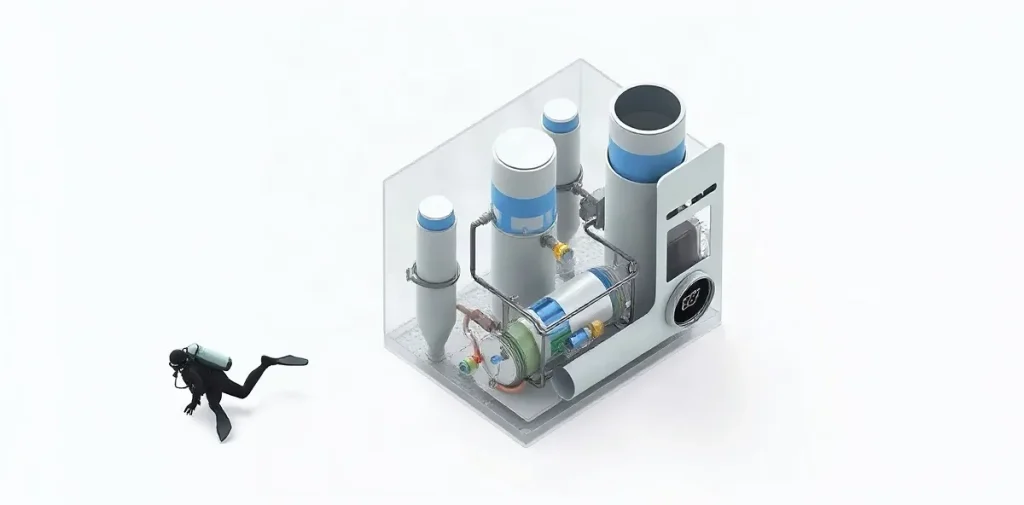
How do rebreather systems optimize gas usage and extend dive times?
Rebreather systems optimize gas usage by continuously recycling the diver’s exhaled breath, scrubbing out carbon dioxide and replenishing oxygen, which reduces gas consumption by approximately 50–80% compared to open circuit scuba. This recycling mechanism allows divers to extend their underwater time significantly, often doubling or tripling standard dive durations while maintaining safe partial pressures of oxygen and controlling inert gas buildup.
The technology behind rebreathers enables gas efficiency through closed or semi-closed loops, where the diver’s exhaled gases are filtered and reconditioned, minimizing waste. As a result, rebreather divers can carry smaller gas volumes or undertake longer or deeper dives without the logistical burden of large gas cylinders.
What are the main types of rebreather systems and how do they differ in gas efficiency?
The two primary rebreather categories are Closed-Circuit Rebreathers (CCR) and Semi-Closed Circuit Rebreathers (SCR). CCRs recycle 100% of the exhaled gas by scrubbing carbon dioxide and adding oxygen to maintain a set partial pressure, offering the highest gas efficiency. SCRs vent a portion of the gas continuously, mixing fresh gas with exhaled breath, resulting in less efficiency but simpler operation.
Key differences between CCR and SCR
- CCR: Complete gas recycling, precise oxygen control, longer dive times, higher initial cost.
- SCR: Partial gas venting, simpler design, moderate dive extension, lower cost.
| Feature | Closed-Circuit Rebreather | Semi-Closed Circuit Rebreather |
|---|---|---|
| Gas Consumption Reduction | Up to 80% | Up to 50% |
| Typical Cost (USD) | $8,000 – $15,000 (e.g., AP Diving Inspiration, rEvo) | $3,000 – $6,000 (e.g., Ambient Pressure CCR, Dräger Dolphin) |
| Typical Dive Time Extension | 2 to 3 times longer than open circuit | 1.5 to 2 times longer than open circuit |
| Operational Complexity | High: requires training and monitoring | Moderate: simpler but less precise |
How does carbon dioxide removal work in rebreathers to enable longer dives?
Carbon dioxide removal is fundamental to rebreather function. Exhaled gas passes through a canister containing a chemical absorbent, typically soda lime, which chemically binds and removes CO2. This prevents CO2 buildup, which otherwise would cause hypercapnia and limit dive durations.
The efficiency and volume of the scrubber material dictate the maximum safe dive time. Typical scrubber durations range from 60 to 180 minutes, depending on canister size, diver workload, and water temperature. Advances in absorbent materials have improved CO2 removal rates and extended operational times.
Important factors affecting CO2 scrubbing
- Scrubber volume and shape — larger canisters provide longer duration.
- Water temperature — colder water slows chemical reaction rates.
- Diver metabolic rate — higher exertion produces more CO2.
What are the operational and safety considerations when using rebreathers?
While rebreathers offer gas savings and extended dive times, they come with increased operational complexity and safety risks compared to open circuit systems. Divers must carefully monitor oxygen partial pressures (PO2) using electronic sensors and manual checks to avoid hypoxia or oxygen toxicity.
Regular pre-dive checks, including leak testing and scrubber packing, are essential. Divers must also be trained to respond to potential failures such as sensor errors or scrubber breakthrough. The use of backup open circuit bailout systems is standard practice for emergencies.
Essential safety features and protocols
- Redundant oxygen sensors and alarms.
- Manual or automatic oxygen addition controls.
- Pre-dive checklists and routine maintenance.
- Emergency bailout gas supply.
How do rebreathers impact decompression obligations and dive planning?
Rebreathers influence decompression primarily through the precise control of oxygen partial pressure and reduced inert gas consumption. By maintaining higher and stable PO2 levels, rebreathers accelerate inert gas elimination, potentially reducing decompression times relative to open circuit dives at the same depth.
Dive computers designed specifically for rebreathers incorporate algorithms that account for variable PO2, allowing more accurate decompression planning. This results in safer, longer dives with optimized decompression stops, but requires specific training and equipment calibration.
Decompression implications
- Variable PO2 control reduces nitrogen loading.
- Allows longer bottom times with similar decompression stress.
- Necessitates advanced dive computers with CCR-compatible algorithms.
- Planning must consider scrubber duration and bailout contingencies.
What are the leading rebreather models available in 2026 and their price ranges?
Several manufacturers offer rebreathers optimized for recreational, technical, and commercial diving. The AP Diving Inspiration and rEvo CCR remain popular among technical divers, priced between $8,000 and $15,000. These units feature sophisticated electronics, modular scrubbers, and extensive user programmability.
Semi-closed options like the Ambient Pressure CCR and the Dräger Dolphin are available from around $3,000 to $6,000, targeting divers seeking simpler operation and moderate dive time extensions. Commercial rebreathers, often custom-built, can exceed $20,000 depending on configuration.
- 80% maximum gas consumption reduction with CCRs
- 180 minutes scrubber duration under optimal conditions
- $15,000 approximate top-end price for advanced CCR units
- 2 to 3 times longer dive durations than open circuit
Frequently asked questions
How much training is required to use a rebreather safely?
Can rebreathers be used for recreational diving?
What maintenance do rebreathers require?
Are rebreathers heavier than traditional scuba gear?
What gases are used in rebreathers?
Key takeaways
- Rebreathers recycle exhaled gases, reducing consumption by up to 80% and significantly extending dive times.
- Closed-circuit rebreathers (CCR) provide more gas efficiency and precise control than semi-closed systems but require more training and maintenance.
- Carbon dioxide removal through chemical scrubbers is essential for safe extended dives and typically lasts up to 180 minutes.
- Rebreather diving involves complex operational safety protocols, including oxygen monitoring and emergency bailouts.
- Advanced dive computers tailored for rebreathers optimize decompression planning by accounting for variable oxygen levels.
- Leading rebreather models in 2026 range from $3,000 for semi-closed units to $15,000+ for sophisticated CCRs.
Conclusion
Rebreather systems represent a transformative technology in diving, enabling significantly longer and more efficient underwater excursions by recycling breathing gas and managing oxygen precisely. While the initial cost and operational complexity exceed those of conventional open circuit scuba, the benefits in gas savings and decompression control are compelling for technical and serious recreational divers. Understanding the types of rebreathers, their mechanisms for carbon dioxide removal, and the necessary safety protocols is essential for maximizing their advantages while maintaining diver safety. In 2026, advances in materials, electronics, and dive computer integration continue to enhance rebreather performance, making them an increasingly accessible and attractive option for extended, efficient diving experiences.