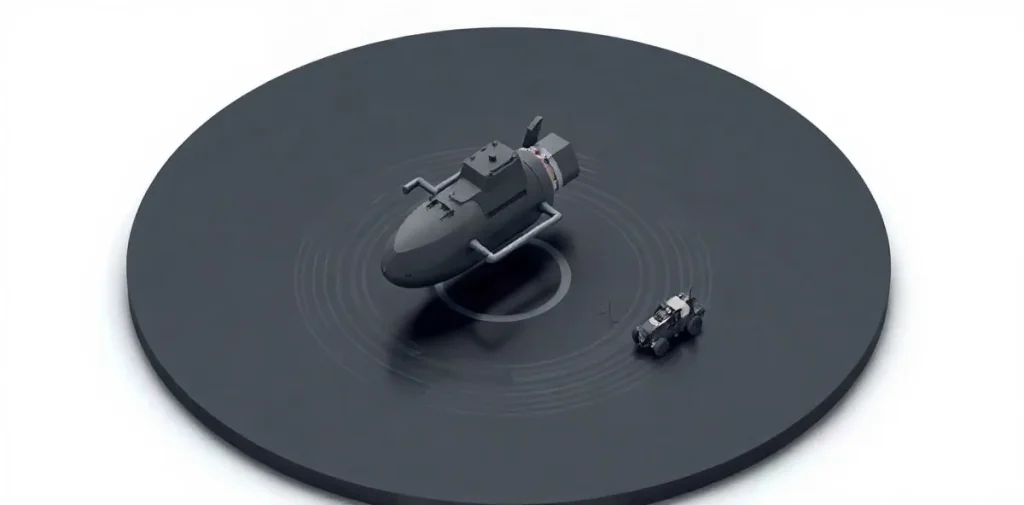
Manned and unmanned submersibles are vehicles designed to operate underwater, either carrying people or controlled without a crew on board. Their research area brings together vehicle engineering, underwater operations and human physiology. It matters to divers because these vehicles work in the same demanding environment, while changing how people reach, observe and study it.
What distinguishes crewed and uncrewed submersibles?
A manned submersible carries people inside a pressure-resistant compartment. Its occupants are separated from the surrounding water and breathe an atmosphere maintained within the vehicle. An unmanned submersible has no onboard crew; it may be remotely operated or designed to perform tasks with limited direct control.
The distinction changes the main engineering and operational questions. A crewed vehicle must protect occupants and support their life inside the hull; an uncrewed vehicle must carry sensors, power and control systems suited to its mission. Both depend on reliable navigation, communication and recovery in an environment where access and visibility can be limited.
How does pressure shape vehicle design?
Water pressure rises with depth, placing increasing loads on a submersible’s hull, penetrations, viewports and seals. A pressure hull must resist collapse, while its openings and joints must remain sound. Design therefore involves the whole vehicle, not just the material or shape of its outer shell.
For occupants, the pressure inside a sealed submersible is distinct from the pressure in the surrounding water. This is different from scuba diving, where the diver breathes gas at approximately ambient pressure. It is also different from saturation diving, in which people live in a pressurised environment and return to surface pressure through a controlled decompression process.
That separation does not make human factors irrelevant. Crewed missions raise questions about life support, atmosphere quality, temperature, workload, communication and emergency response. The vehicle must support people as well as withstand pressure.
What do researchers examine during underwater missions?
Studies of submersibles can examine how vehicle systems perform under operational conditions and how people interact with those systems. For scientific work, researchers may also consider how the vehicle affects observation and sampling: the platform must reach the study area and allow its instruments or occupants to gather useful information.
- Pressure integrity: how the hull, seals and viewports handle the external load.
- Life support: how a crewed vehicle maintains a breathable, workable cabin environment.
- Control and navigation: how operators or onboard systems steer and monitor the vehicle.
- Mission access: how the vehicle reaches, observes or samples an underwater site.
- Recovery and emergencies: how a vehicle and, where present, its occupants can be brought back safely.
Methods depend on the question. Engineering assessment can consider structural loads and system reliability; operational evaluation can examine controls, communications and recovery; scientific missions can use cameras and sensors to observe underwater conditions. Each approach addresses a different part of the problem.
Why does this research matter to divers and clinicians?
Submersibles and divers encounter pressure, restricted access and the need for dependable equipment, but their exposure is not the same. A diver’s breathing gas and surrounding pressure are central to decompression physiology. In a sealed submersible, the hull separates occupants from ambient water pressure, so the relevant medical concerns centre on the cabin environment, mission demands and what happens if the vehicle is compromised.
For diving physicians and hyperbaric clinicians, understanding the distinction helps frame an incident. Decompression illness cannot be assumed simply because an event occurred underwater; the exposure history and the way occupants experienced pressure matter. When a medical concern arises, assessment should involve a diving-medicine physician familiar with the circumstances.
For scientific divers, submersibles can offer another way to observe or reach underwater locations. Choosing a platform depends on the research task, conditions at the site and the risks each method brings. The useful comparison is not which platform is universally safer, but which one fits the mission and its safeguards.
How does the subject fit into diving science?
Submersible research sits alongside work on diving equipment, underwater operations, decompression and human exposure to pressure. It shares the broader aim of making underwater activity technically reliable and medically informed, while asking a distinct question: how can a vehicle carry people or instruments into an environment that is difficult to access?
The subject also reflects a longstanding change in underwater research: scientists need not enter the water themselves to study it. Crewed and uncrewed platforms each offer different forms of access, control and observation. Their value depends on matching the vehicle’s capabilities to the scientific question and planning for the conditions of the mission.
Frequently asked questions
Is a submersible the same as a submarine?
Do occupants of a sealed submersible need decompression?
When might an uncrewed vehicle be useful?
An original research-library explainer written by the Rubicon editors. It is not a summary of a specific publication.
Related reading on Rubicon
- Diving: Science, Practice, and Destinations
- Diving Science: Key Physiological and Environmental
- Diving: Exploring Underwater Activities, Science, and Safety
- The Science of Diving SSI: Education and Physiology Insights
- Rebreathers: Diving Science Research Summary
- Submersibles in Scientific Diving
- More on Diving Science
- Browse the Research Library