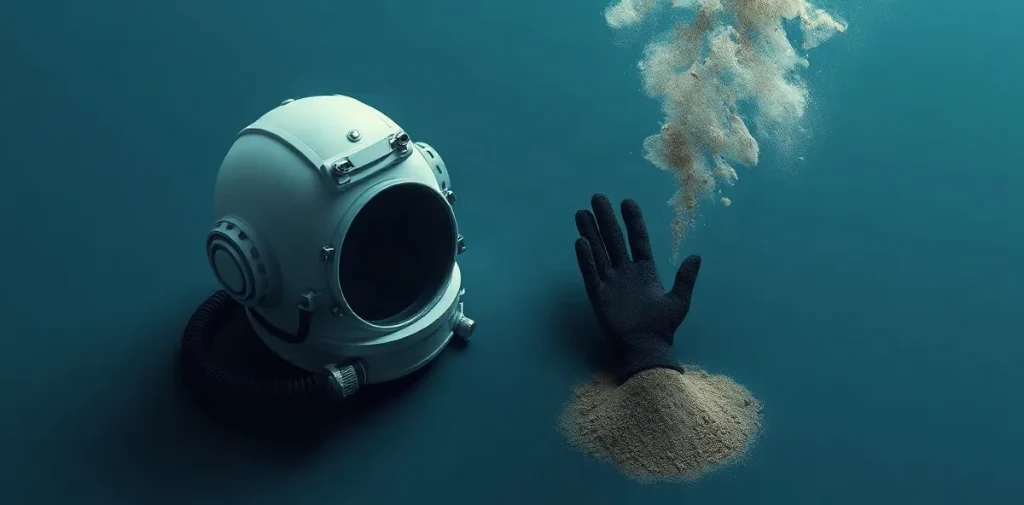
Diving in contaminated water is the problem of carrying out underwater work where water, sediment or submerged surfaces may expose divers to chemical or biological hazards. The field asks how contaminants reach the body, how protective systems perform underwater, and how teams can control exposure without losing the ability to work safely.
What makes contaminated-water diving different?
In ordinary diving, equipment separates the diver from the water mainly to support breathing and manage pressure. In contaminated environments, the water itself may be a source of harm. Chemicals can contact skin or enter through damaged equipment; biological agents may pose infection risks, while contaminated particles can be stirred up from sediment.
Exposure depends on more than the presence of a hazardous substance. Its properties, concentration, route into the body, duration of contact, water conditions and the diver’s protective equipment all matter. A hazard that is limited in one setting may become more significant when work disturbs sediment or involves repeated contact.
How do hazards reach a diver?
Risk assessment starts by considering the route of exposure. Inhalation is a concern if contaminated water or vapour enters a breathing system; skin and eye contact may occur through suit damage, imperfect seals or handling contaminated gear. Ingestion can happen indirectly when a diver touches the mouth or eats before decontamination.
Underwater work also changes how hazards behave. Currents can carry contaminants beyond their apparent source, while low visibility makes it harder to avoid polluted material or inspect equipment. The diver’s breathing apparatus, suit, gloves, helmet and communications system therefore need to be considered as a connected barrier, not as separate items.
- Hazard: the chemical, biological or particulate agent that may cause harm.
- Exposure: contact with that agent by inhalation, skin, eyes or ingestion.
- Barrier: protective equipment and procedures that interrupt exposure.
- Decontamination: steps to remove contaminants from people and equipment after the dive.
What does research in this area examine?
Studies of contaminated-water diving bring together toxicology, occupational medicine, diving physiology and equipment engineering. They examine how substances behave in water, how protective materials and seals resist contact, and how breathing and communications systems can be protected from contamination. Field assessment may also consider the task, site conditions and ways to limit disturbance.
Methods depend on the question. Laboratory testing can assess material compatibility or barrier performance; environmental sampling can help identify hazards at a site; and operational evaluation can examine whether protective procedures remain workable during underwater tasks. These approaches address different parts of the problem, so a test of a material alone cannot establish that an entire dive operation is safe.
Why do protection and decontamination matter?
Protective equipment can reduce contact, but it can also affect movement, dexterity, heat loss and the diver’s ability to communicate or complete a task. Those trade-offs matter because a barrier that cannot be used properly may fail in practice. Suit integrity, equipment checks, controlled entry and clear emergency procedures are therefore part of exposure control.
Decontamination extends the safety boundary beyond the water. Contaminants on a suit, helmet or tool can be carried to the support area or expose other workers during equipment removal. Plans need to account for the sequence of leaving the water, removing protective equipment, handling contaminated items and managing waste; the appropriate process depends on the hazard.
Where does this fit in diving medicine?
Contaminated-water diving sits alongside, rather than inside, the familiar research on decompression, pressure injury and breathing-gas physiology. A diver may face those established underwater stresses while also encountering a toxicological or infectious hazard. Medical planning must therefore consider both the dive itself and the possibility of exposure before, during or after it.
For scientific and occupational divers, the central question is how to complete necessary underwater work while controlling contact with hazards. Site assessment, equipment selection, task design, monitoring and post-dive procedures all contribute. If a possible exposure occurs or symptoms develop, a diving-medicine physician should be consulted, with details of the substance and circumstances where available.
Frequently asked questions
Is contaminated-water diving only a chemical hazard?
Does a dry suit eliminate exposure?
What should be considered before a contaminated-water dive?
An original research-library explainer written by the Rubicon editors. It is not a summary of a specific publication.
Related reading on Rubicon
- Diving Safety: Training, Gear, Sites, Risk
- Risks and Prevention of Shallow Water Blackout
- Understanding Hypoxia Risks in Recreational Diving
- Understanding Oxygen Toxicity Risks and Prevention in Diving
- Scuba Diving: Physiology, Risks and Safety
- Repetitive Diving: Physiology, Risk and Planning
- More on Safety
- Browse the Research Library