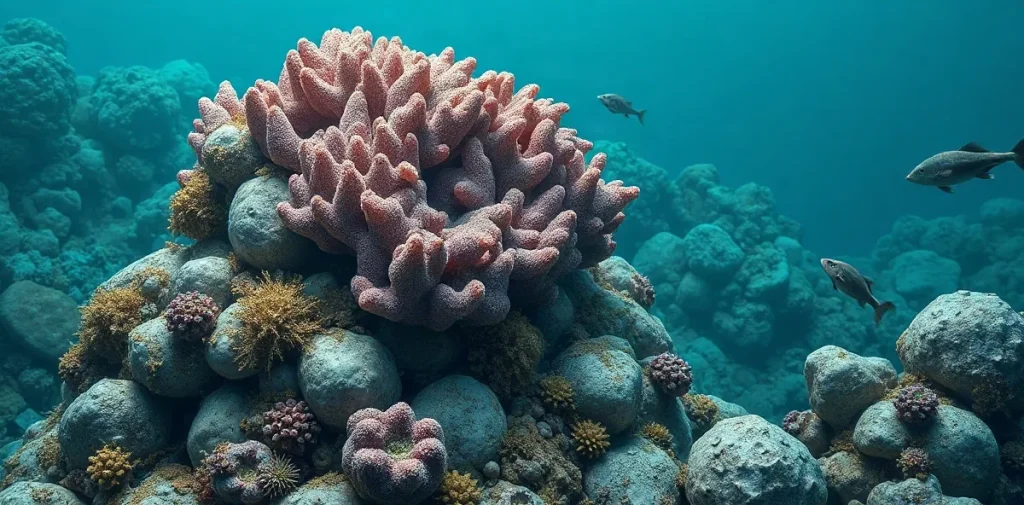
Black Band disease research examines how a visible band of microbial activity affects coral, and how behaviour, chemistry and conditions in the reef environment relate to disease. Field and laboratory approaches connect observations underwater with controlled investigation—a useful model for scientific divers working where living systems and dive conditions meet.
What is Black Band disease research asking?
Black Band disease is a coral disease associated with a dark, moving band of microorganisms that damages living coral tissue as it advances across the colony. Research into it asks how the microbial community, its chemical environment and the coral’s responses interact. The questions span both the visible pattern on the reef and processes that are not apparent to a diver looking at the surface of a colony.
The behavioural dimension concerns how the disease and coral interact over time: how a band moves, which parts of a colony it affects, and how the surrounding organism responds. Chemical investigation examines the substances and local conditions associated with the microbial community. These strands are linked; behaviour observed in the field can prompt laboratory tests of possible mechanisms.
Why combine reef observations with laboratory work?
On a reef, researchers can observe disease in its natural setting and record its relationship to the coral and surrounding environment. But field observations alone may not distinguish cause from coincidence. Laboratory work gives researchers a more controlled setting to examine chemical and biological processes, while fieldwork tests whether those processes make sense in the reef context.
Each setting has limits. A laboratory can simplify conditions in ways that do not capture the changing environment of a reef; field conditions, in turn, make it harder to isolate one factor at a time. Combining the approaches helps researchers frame stronger questions without treating either setting as a complete substitute for the other.
- Field observation: where the disease occurs on a colony and how the visible band changes.
- Behaviour: the relationship between the band’s movement and the coral’s response.
- Chemistry: the local substances and conditions associated with microbial activity.
- Laboratory investigation: testing biological or chemical questions under more controlled conditions.
What does this mean for scientific divers?
Scientific divers may be the observers who make underwater patterns available for study. Clear, repeatable records matter: the condition of the colony, the position of the affected area and the surrounding setting all help researchers interpret what they see. Careful observation is especially important when a study compares underwater observations with laboratory examination.
Work on coral disease also makes the dive itself part of the research method. Time underwater, depth, task demands and the need to handle or record samples can affect how a survey is conducted. A sound protocol must protect both the diver and the reef, and keep collection or measurement procedures consistent enough for observations to be useful.
How does coral disease fit into diving science?
This research sits where marine biology meets scientific diving: divers provide access to organisms and processes that are difficult to study from the surface, while laboratory methods help investigate what cannot be seen directly. The central concern is not decompression illness or treatment in a chamber, but the reliability and safety of underwater research as a way to study marine life.
For diving medicine, the connection is practical rather than disease-specific. Scientific diving combines environmental exposure with focused work, and its planning must account for both. Questions about coral pathology do not change the physiology of decompression, but a field study still depends on divers being fit for the task, using appropriate procedures and consulting a diving-medicine physician when health concerns affect participation.
What should readers keep in mind about the evidence?
A visible disease pattern can establish what is happening at the level of observation, but identifying the underlying mechanism requires further evidence. Chemical association, microbial activity and coral response are related questions, not interchangeable answers. The field advances by separating them, then testing how they fit together across observation and experiment.
For divers, the broader lesson is methodological: underwater work can reveal important patterns, but interpretation depends on disciplined observation and suitable comparisons. If you are planning scientific diving, use the project’s approved procedures and consult a diving-medicine physician about personal health questions.
Frequently asked questions
What is Black Band disease?
Why study both behaviour and chemistry?
Why does this topic matter to scientific divers?
An original research-library explainer written by the Rubicon editors. It is not a summary of a specific publication.
Related reading on Rubicon
- Diving Techniques, Science, Safety, and Specialized Fields
- The Diving Reflex: What Happens Underwater
- Scuba Diving Regulators: Balanced vs. Unbalanced
- Scuba Diving Buddy Checks: Catch Problems Early
- Underwater Coral Disease Treatment and Diving Science
- Thesis Research in Diving and Hyperbaric Medicine
- More on Diving Science
- Browse the Research Library