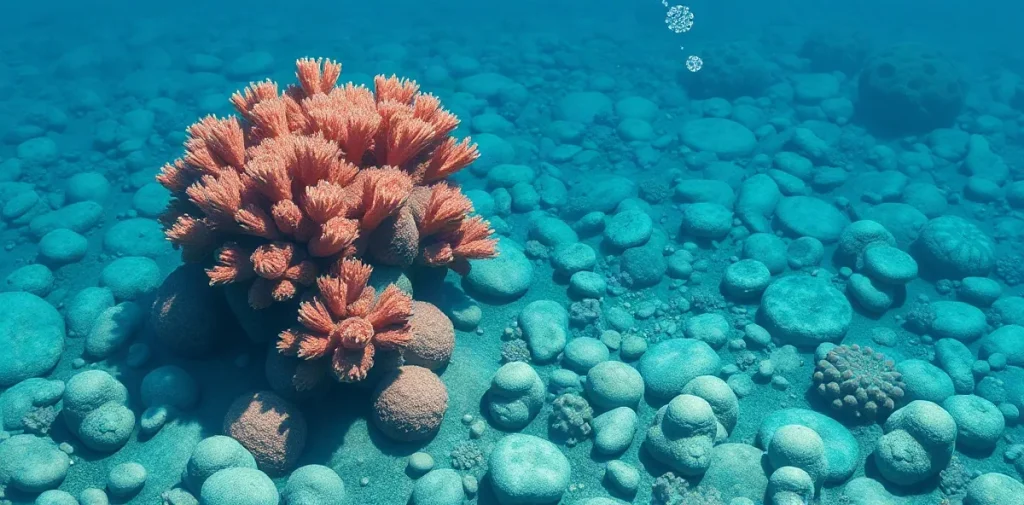
Underwater treatment of coral disease is a field of marine science concerned with identifying infection, limiting damage to living reef structures and testing whether interventions can be applied safely in place. It matters to divers because scientific work happens in the same underwater environment that shapes observation, tool use and exposure.
What does black band disease involve?
Black band disease is a coral disease associated with a dark microbial band that advances across coral tissue. The disease name identifies a visible pattern, but diagnosis and management require attention to the affected coral, the surrounding reef and the conditions at the site.
Massive corals have broad, solid growth forms. When tissue is lost, the exposed skeleton may be colonised by algae and other organisms, changing the local competition for space. Disease research therefore considers both the affected animal and what happens to the surface left behind.
How can an underwater intervention be tested?
Field studies of treatment begin with observation: researchers locate affected colonies, assess the disease boundary and record the coral’s condition. They then consider whether an intervention can remove or contain diseased material without causing additional harm to healthy tissue.
An underwater aspirator is a tool for drawing material into a collection system. In this research area, the relevant technical questions include how precisely it can be used at the disease margin, whether removed material can be contained, and how the device performs while divers work underwater.
A sealant applied after treatment raises a different question: whether covering the treated area can reduce reinfection or limit renewed exposure. That possibility must be assessed alongside effects on the coral and the practical demands of application; a treatment concept is not, by itself, proof of effectiveness.
Why does diver physiology shape the research?
Scientific divers are part of the experimental setting. Buoyancy, visibility, current, depth and time underwater affect how steadily a diver can position a tool, observe a small target and document a treatment. These conditions can also influence how consistently field procedures are carried out.
Underwater work adds physiological constraints. Immersion and pressure affect the body, while breathing-gas supply and the need to return safely limit the duration and complexity of a task. Research planning must account for the diver’s workload as well as the biological question.
For diving physicians and hyperbaric clinicians, the connection is operational rather than a claim that coral disease is a human disease. Their expertise concerns the health and fitness of people undertaking underwater work, including how a scientific task fits within an individual’s diving plan. Medical decisions belong with a diving-medicine physician.
What makes treatment evidence useful?
A treatment needs more than an immediate visual effect to be useful. Researchers ask whether the disease progresses after intervention, whether nearby tissue remains healthy and whether the treated colony can be followed over time. They also need to distinguish treatment effects from natural variation in reef conditions.
- Targeting: Can the intervention be applied to the affected area without unnecessary disturbance?
- Containment: Can removed material be managed without spreading it elsewhere?
- Reinfection: Does disease return at the treated margin, and over what observation period?
- Field feasibility: Can divers carry out and document the procedure reliably under site conditions?
These questions connect a local intervention to broader concerns in reef ecology: disease transmission, coral survival and the limits of hands-on management. A method that works at one colony or site may not transfer unchanged to another, because coral condition and underwater conditions differ.
Why does this belong in a diving research library?
Diving research includes more than human physiology, decompression and equipment. Scientific diving also provides access to biological processes that cannot be studied in the same way from shore. Coral disease treatment sits at that intersection: the study subject is marine life, while the method depends on controlled work underwater.
That makes the area relevant to divers who collect observations, scientists planning field procedures and clinicians supporting underwater research. It also illustrates a wider principle: a sound intervention must be considered as both a biological treatment and an underwater operation, with follow-up and diver safety built into the research question.
Frequently asked questions
What is black band disease?
Why use an underwater aspirator?
Why is follow-up important after coral treatment?
An original research-library explainer written by the Rubicon editors. It is not a summary of a specific publication.
Related reading on Rubicon
- Diving: Exploring Underwater Activities, Science, and Safety
- Science Diving: Protocols and Techniques for Underwater
- The Diving Reflex: What Happens Underwater
- Diving: Science, Practice, and Destinations
- Rebreathers: Diving Science Research Summary
- Recompression Treatment Tables in Diving Medicine
- More on Diving Science
- Browse the Research Library