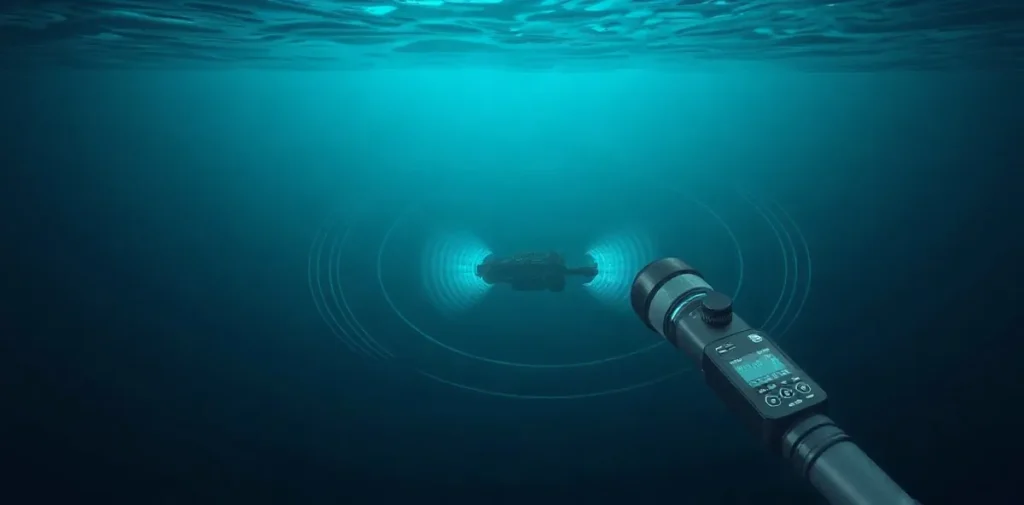
Diver-held sonar uses sound to image underwater features where visibility, lighting or access limits direct observation. Its research area asks how a compact acoustic instrument can produce useful, high-resolution images in a diver’s hands, and how those images support inspection, mapping and scientific work.
Why use sonar when a diver is already there?
Water absorbs and scatters light, and suspended particles can reduce visibility even close to an object. Sonar does not depend on a clear optical path: it sends out sound and detects echoes returning from boundaries and surfaces. That makes acoustic imaging useful when a camera cannot show enough detail.
A diver-held system brings the sensor close to the target and lets the operator choose where to look. The approach differs from imaging from a vessel or a remotely operated platform, which may cover a broader area but cannot always inspect a small feature at close range or follow a diver’s immediate observations.
For divers, the practical question is not simply whether an instrument can detect an object. It is whether its image is clear and interpretable enough to help identify a feature, document its position or guide a closer examination.
How does acoustic imaging form an image?
A sonar transducer emits sound and receives returning echoes. The time taken for an echo to return indicates range; changes in echo strength and pattern help represent the target and surrounding surfaces. The instrument processes these returns into an image rather than a visible-light photograph.
Resolution describes how well nearby features can be distinguished. It depends on factors such as the sound frequency, the sensor’s design, its distance and angle relative to the target, and how the system processes the returning signal. Higher detail can come with trade-offs in range, coverage or sensitivity to operating conditions.
- Range: how far the target is from the sensor.
- Resolution: whether small or closely spaced features can be separated.
- Orientation: the sensor’s angle and movement as the diver scans.
- Interpretation: whether echoes correspond to a real feature, surface texture or an imaging artefact.
These considerations matter because an acoustic image is a processed representation, not a direct view. Operators need to understand what the instrument can resolve and how scan geometry may alter the apparent shape or size of a target.
What makes a diver-held system difficult to use?
Underwater, the diver must manage the instrument while maintaining buoyancy, position and awareness of the surroundings. Hand movement changes the sensor’s orientation, and motion can complicate the image. A workable system therefore has to balance image quality with handling, stability and the demands of the dive task.
The target and environment matter too. Surface shape, material, distance and angle influence the returning echoes; nearby structures can create confusing reflections. An image that looks detailed may still be ambiguous if the operator cannot relate it to the target’s position and orientation.
Training and repeatable scanning procedures help make observations more useful. A survey may require consistent passes, recorded instrument settings and a way to connect the image with location or other observations. The appropriate method depends on whether the goal is a close inspection, a map or a record for later comparison.
Where does this work fit in diving research?
Underwater imaging sits at the boundary between sensing technology and field practice. Its questions overlap with equipment design, survey methods and the interpretation of observations made during dives. The broader challenge is to turn measurements collected in a difficult environment into information that can be checked and used.
That challenge connects acoustic tools with other forms of diver documentation, including charting and graphical display. Sonar can complement visual inspection, but it does not replace every other method: a diver may still need direct observation, measurements or another sensor to identify what an echo represents.
For scientific divers and inspection teams, the value of an image depends on the decision it supports. Researchers therefore consider not only technical image quality, but also whether the system fits the task, whether observations can be reproduced and how uncertainty is communicated to the people interpreting the record.
What should divers and clinicians keep in view?
Sonar is a tool for underwater observation, not a medical treatment or a substitute for dive planning. Handling additional equipment can affect workload, task timing and situational awareness. Teams should consider the instrument’s operating procedure and the demands of the dive before using it in the water.
The physiological concerns remain those of the dive itself: depth, duration, breathing gas, thermal conditions and exertion all shape risk. An imaging task should fit within the planned profile rather than encouraging a diver to remain underwater or work harder than the plan allows. Questions about an individual’s fitness to dive belong with a diving-medicine physician.
Frequently asked questions
Does sonar work when underwater visibility is poor?
Is a sonar image the same as a photograph?
Can diver-held sonar replace visual inspection?
An original research-library explainer written by the Rubicon editors. It is not a summary of a specific publication.
Related reading on Rubicon
- Why Divers Get Cold Faster Underwater
- Glossary of Essential Underwater Physiology Terms for Divers
- The Diving Reflex: What Happens Underwater
- Diving Safety: Key Insights into Underwater Exploration
- Divers and Underwater Sound at 800–2250 Hz
- The Effects of Underwater Blast on Divers
- More on Diving Science
- Browse the Research Library