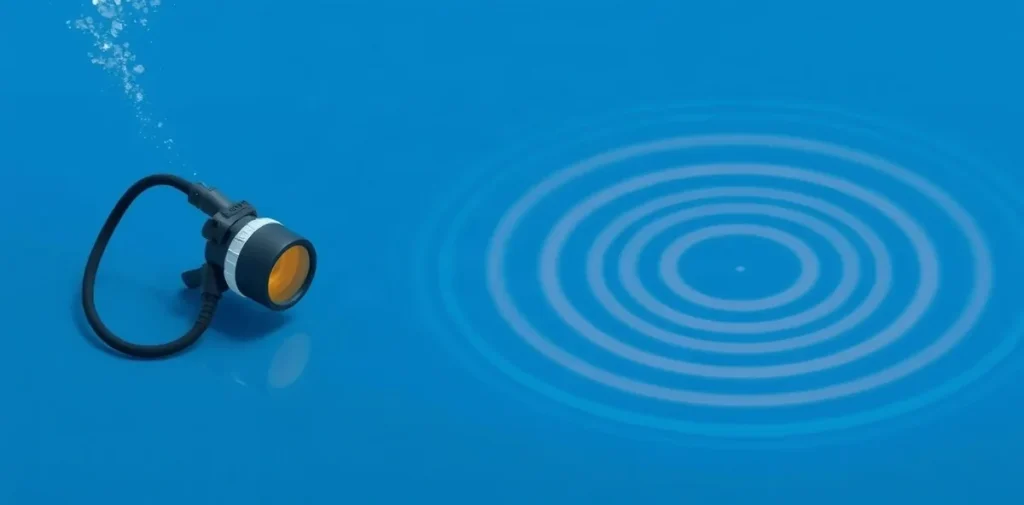
Exposure of Divers to Underwater Sound in the Frequency Range from 800 to 2250 Hz is a 2001 meeting abstract by Parvin and colleagues, published in Undersea & Hyperbaric Medicine. It addresses divers’ exposure to underwater sound within a defined frequency band, a subject relevant to how sound travels underwater and how it may affect communication, work and safety during dives.
What does underwater sound exposure mean?
Sound is pressure variation that travels through a medium. Underwater, its propagation differs from sound in air because water’s physical properties affect transmission, while a diver’s body and equipment create additional pathways for sound to reach the ear.
Exposure describes the sound reaching a diver over a period of time, rather than simply the presence of a noise. Its significance depends on characteristics such as frequency, intensity, duration and the listening environment. A study focused on a specified frequency range is therefore concerned with a particular part of the broader underwater acoustic environment.
Why focus on the 800–2250 Hz range?
Frequency describes how rapidly a sound wave repeats and influences how a sound is perceived and measured. The range named in the publication sets a defined scope for considering underwater sound exposure; it should not be taken to mean that sounds outside that range are unimportant to diving.
Divers may encounter sound from equipment, vessels, other divers or the surrounding environment. Depending on the task, sound can be useful for communication and situational awareness, or it can interfere with listening and concentration. Understanding exposure across defined frequency bands can help frame questions about the acoustic conditions in which diving takes place.
How can sound matter to divers and clinicians?
Underwater communication is often constrained by distance, equipment and environmental conditions. Noise can make acoustic signals harder to distinguish, while unexpected or persistent sound may affect comfort and attention. These are practical considerations for scientific divers and others whose tasks depend on coordination or awareness.
Sound exposure also connects diving science with hearing and occupational health. The possible significance of a sound depends on both its acoustic properties and the circumstances of exposure; a frequency range by itself does not establish whether a particular exposure is harmful. Questions about hearing symptoms or an individual’s fitness to dive require assessment by an appropriate diving-medicine physician.
What concepts shape research on underwater sound?
Studies of divers and sound typically need to distinguish the acoustic environment from the diver’s actual exposure. Measurement conditions matter: equipment, location, task and duration can all shape what is recorded and how it can be interpreted. The publication’s stated subject places it within this wider technical effort to characterise sound exposure during diving.
- Frequency: the part of the sound spectrum under consideration.
- Intensity and duration: features that help describe the exposure over time.
- Transmission: how sound reaches the diver through water, the body and equipment.
- Operational context: the task and environment in which sound is encountered.
- Measurement: the methods and conditions used to characterise the acoustic environment.
These concepts help researchers pose comparable questions and help readers understand why an exposure study is not interchangeable with a general description of underwater noise. They also connect acoustic measurement to practical concerns such as communication, hearing and safe task performance.
Where does this subject fit in diving research?
Diving research addresses more than pressure, breathing gases and decompression. It also examines the working environment around the diver, including sensory conditions that can influence communication and task performance. Underwater sound exposure belongs to this broader field of human interaction with the aquatic environment and diving equipment.
As a meeting abstract in Undersea & Hyperbaric Medicine, this publication sits within the professional exchange of topics relevant to underwater and hyperbaric practice. Its subject is useful to readers considering how acoustic conditions can be described and why exposure deserves attention alongside other environmental and operational factors in diving.
Frequently asked questions
What subject does the publication address?
Why is underwater sound relevant to diving?
Does a frequency range alone determine whether sound is harmful?
Citation details
- Title: Exposure of Divers to Underwater Sound in the Frequency Range from 800 to 2250 Hz
- Authors: Parvin, SJ; Searle, SL; Gilbert, MJ
- Year: 2001
- Published in: Undersea & Hyperbaric Medicine 2001
- Record type: Meeting abstract
- Repository record: Rubicon Research Repository, handle 123456789/984
This page is an original summary written by the Rubicon editors from the publication’s bibliographic record. It does not reproduce the paper, its abstract or its data; consult the publication itself for its methods and findings.
Related reading on Rubicon
- Why Divers Get Cold Faster Underwater
- Glossary of Essential Underwater Physiology Terms for Divers
- Scientific Diver vs. Recreational Diver
- Diving Safety: Key Insights into Underwater Exploration
- Brain Lesions and PFO in Sport Divers
- Brain Lesions in Professional Divers?
- More on Diving Science
- Browse the Research Library
