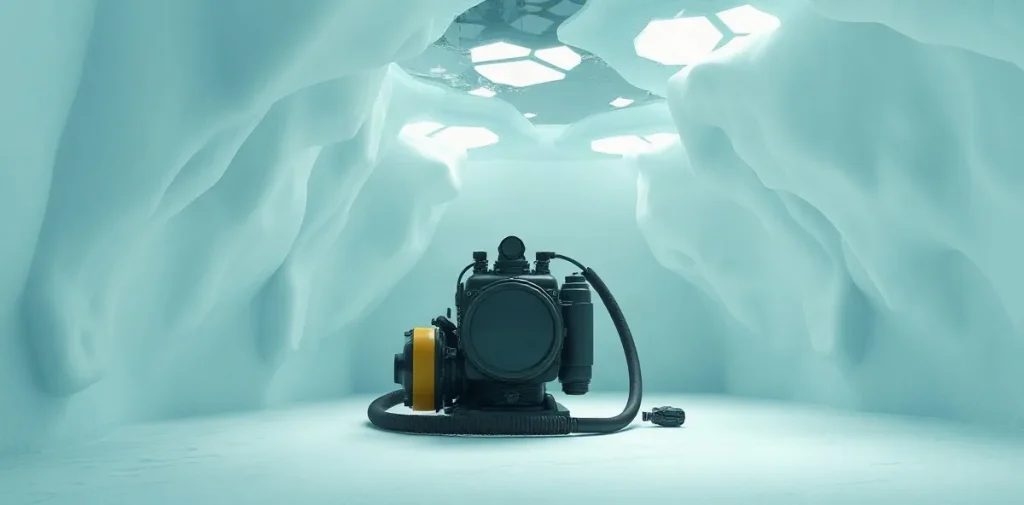
Antarctic lake diving with a semi-closed rebreather sits at the intersection of polar science, underwater life-support engineering and human physiology. It concerns how divers can work beneath ice in isolated freshwater environments, where gas supply, heat loss, restricted access to the surface and decompression all shape the research plan.
Why study lake diving beneath Antarctic ice?
Antarctic lakes can contain environments that are difficult to reach and observe directly. Scientific divers may provide close access to underwater habitats, sediments and features that instruments deployed from above cannot examine in the same way. The dive is both a means of collecting observations and a demanding environment in its own right.
Ice changes the meaning of an ordinary ascent. A diver below a solid ceiling cannot simply swim upward to open water, so the route back depends on a known access point and a reliable line or other planned navigation method. Cold water and remote conditions add pressure to preparation: equipment faults, lost orientation or an unexpectedly prolonged dive can become serious problems quickly.
What does a semi-closed rebreather change?
A rebreather recycles breathing gas rather than releasing every exhalation as bubbles. In a semi-closed system, some gas is vented while fresh gas is added to replace what the diver consumes and what leaves the loop. The exact arrangement depends on the unit; the central task is managing the breathing mixture throughout the dive.
Unlike a conventional open-circuit regulator, a rebreather requires the diver to monitor and manage a breathing loop. The diver’s oxygen use, gas addition, depth and workload all matter. A change in depth affects gas pressures, while oxygen consumption changes the loop mixture; a problem with gas supply or monitoring can therefore have immediate physiological consequences.
- Loop gas: the mixture the diver inhales after it has circulated through the breathing system.
- Oxygen partial pressure: the pressure contributed by oxygen in the breathing mixture; both too little and too much can be dangerous.
- Gas addition and venting: the processes that replenish the loop and remove excess gas.
- Work of breathing: the effort needed to move gas through the loop, which can vary with equipment configuration and depth.
Rebreathers can reduce bubble release compared with open-circuit diving, a useful property when divers need to observe sensitive underwater settings. That does not make the system simpler or inherently safer: it adds monitoring, maintenance and failure modes that require specific training and disciplined procedures.
Which physiological risks shape the dive?
Cold water increases heat loss, and a diver’s insulation and exposure time affect how well body temperature is maintained. Cold can also impair dexterity and make equipment handling more difficult. A scientific task that requires careful sampling or observation must be planned around those limits, not treated as separate from them.
Depth and time under pressure expose divers to inert-gas uptake and decompression stress. Rebreather gas management adds another layer: oxygen exposure must remain within safe limits, while the breathing system must continue supplying an appropriate mixture. These interacting demands make dive planning, monitoring and a controlled return to the access point essential.
Ice overhead also affects emergency response. Direct access to the surface is absent, and assistance may be constrained by the same cold, remoteness and access route as the dive itself. Scientific divers and their support teams must plan for equipment problems, separation and delayed recovery before entering the water.
How do researchers approach this kind of diving?
Research in this area spans underwater science and the practical conditions that make fieldwork possible. It asks how a diver and life-support system perform in a specific environment, how access and movement can be managed, and how scientific tasks fit within safe exposure and recovery plans. The equipment is part of the research setting, not merely a way to reach it.
Methods can include documenting the dive profile and environmental conditions, checking equipment configuration and gas-management procedures, and recording how the team maintains access beneath the ice. Scientific observations may focus on the lake itself, while diving-focused work considers the operational and physiological demands of reaching the research site. The questions depend on the objective and the conditions of each operation.
This field connects to broader work on scientific diving under overhead environments, rebreather operation, cold exposure and decompression. Its practical value lies in making the limits and demands of underwater fieldwork legible to researchers, diving teams and clinicians who assess risk and support expedition planning.
What should divers and clinicians take from the subject?
For divers, the key lesson is that an ice dive is not simply a cold-water dive with different equipment. The overhead removes a direct ascent option, while a rebreather requires continuing attention to the breathing loop. Both the access plan and the life-support plan must remain workable throughout the operation.
For diving physicians and hyperbaric clinicians, the setting highlights the importance of understanding the actual dive profile, gas system, thermal exposure and evacuation constraints when assessing an incident. Symptoms after a dive need clinical assessment rather than assumptions based on equipment type alone. Individual fitness and return-to-diving decisions should be discussed with a diving-medicine physician.
Frequently asked questions
What is a semi-closed rebreather?
Why does diving beneath ice require special planning?
Does a rebreather remove decompression risk?
An original research-library explainer written by the Rubicon editors. It is not a summary of a specific publication.
Related reading on Rubicon
- Open-Circuit vs Closed-Circuit Rebreathers: Which Suits You?
- The Diving Reflex: What Happens Underwater
- Scuba Diving Regulators: Balanced vs. Unbalanced
- Scuba Diving Buddy Checks: Catch Problems Early
- Mixed-Gas Closed-Circuit Rebreathers in Diving
- CNS Oxygen Toxicity in Closed-Circuit Diving
- More on Diving Science
- Browse the Research Library