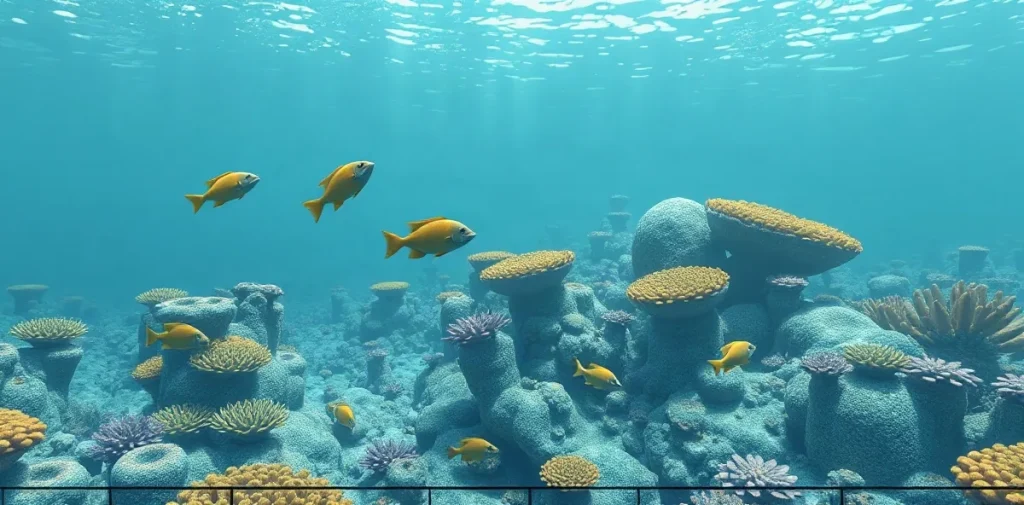
Coral-reef fish ecology examines how fish use reef habitats, interact with one another and vary across place and time. Underwater observation lets researchers study these relationships in context, while asking divers to account for how their presence, equipment and movement may affect what they see.
What questions guide reef-fish ecology?
At its core, the field asks which fish occur in a particular habitat, where they are found and what influences their behaviour. Researchers may consider shelter, feeding opportunities, competition, predation and the structure of the reef itself. These questions connect individual observations to the organisation of a community.
A fish count is only a snapshot unless its setting and method are clear. A difference between two observations might reflect a real ecological pattern, but it might also arise from visibility, observer position, time of day or the way fish respond to a diver.
Longer or repeated observation can help separate persistent patterns from short-lived changes. The central challenge is to describe the underwater community without mistaking the conditions of observation for the ecology being studied.
How can researchers observe fish underwater?
Scientific divers can record fish directly in their habitat, noting species, behaviour and the features of the surrounding reef. A survey may use a defined route or area so observations can be compared consistently. The method needs to fit the question: behaviour calls for attention to movement and interaction, while community composition requires orderly recording across the site.
Underwater work has practical constraints. A diver has limited time and attention, visibility can change, and identification may be difficult when fish move quickly or resemble one another. Buoyancy control, careful finning and disciplined observation help reduce disturbance and improve the quality of field notes.
- Habitat: record the reef features associated with the fish observed.
- Effort: use a repeatable route, duration or survey area where the question allows.
- Observer effects: consider whether fish alter their behaviour in response to a diver.
- Conditions: note visibility and other factors that may affect detection.
These considerations make underwater research a combined task of ecology and measurement. A sound observation protocol matters as much as the ability to identify what passes in front of the mask.
Why does the diver matter to the observation?
A diver is not an invisible window onto the reef. Bubbles, body position, lights, noise and movement can affect fish behaviour or visibility, while the diver’s route determines which parts of the habitat are sampled. Scientific diving therefore requires both safe water skills and awareness of how the method shapes the evidence.
Long-duration underwater research adds another layer: researchers must manage time underwater, equipment and the demands of sustained observation. The broader history of scientific diving includes efforts to make underwater work more systematic and to understand the constraints of human presence beneath the surface. Reef-fish ecology belongs to that tradition, though its main subject is the living community, not the diver’s physiology.
For divers, this distinction is useful. A fish behaving differently near a surveyor does not necessarily signal a wider change in the reef; the observer’s presence is one possible influence to consider.
What can fish communities tell us about a reef?
Fish communities link habitat structure with ecological processes. Their distribution and behaviour can help researchers frame questions about shelter, feeding and interactions among species. A community-level view is broader than a single sighting: it considers how the organisms present relate to one another and to the reef environment.
That perspective also matters to scientific divers who work across different kinds of underwater research. Reef ecology and studies of deep-sea organisms address distinct environments and questions, but both depend on careful observation in places that are difficult to access and where methods can shape what is recorded.
Interpretation should remain tied to the scale and design of the observation. A local survey describes a particular place under particular conditions; understanding broader ecological patterns requires comparisons that account for differences in habitat and observation.
Frequently asked questions
What does coral-reef fish ecology study?
Why is underwater observation useful?
Can a diver affect a fish survey?
An original research-library explainer written by the Rubicon editors. It is not a summary of a specific publication.
Related reading on Rubicon
- Scientific Diving Course: Curriculum, Skills, Certification
- The Diving Reflex: What Happens Underwater
- Scuba Diving Regulators: Balanced vs. Unbalanced
- Scuba Diving Buddy Checks: Catch Problems Early
- Tektite Program: Ecology of Coral-Reef Fishes
- Ecology of Fishes on Deep Boulder Reefs
- More on Diving Science
- Browse the Research Library