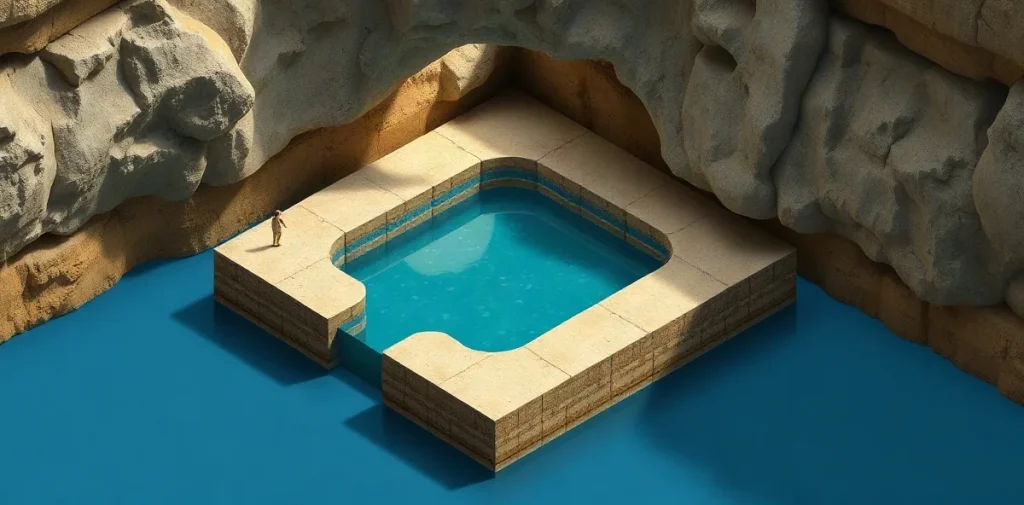
Speleogenesis of Zacatón and cenotes of Rancho la Azufrosa is a 2000 symposium proceedings paper by Gary M about the formation of these flooded cave features. Its subject connects geology with underwater exploration: understanding how a submerged cave develops helps frame the environments scientific divers enter and the constraints those environments impose.
What does speleogenesis mean in a flooded cave?
Speleogenesis is the process by which caves form and change over geological time. In a cenote setting, the subject includes the development of underground openings and the relationship between those openings and the water that occupies them.
That geological history shapes the physical environment encountered by divers. Passage geometry, openings, obstructions and connections between water-filled spaces can influence how a site is explored, mapped and documented.
Why does cave formation matter to divers?
Flooded caves are not simply open water with a roof overhead. Their confined passages can restrict movement and make route-finding dependent on careful observation, reliable procedures and a clear understanding of the environment.
Geological context helps scientific divers interpret what they see. The form and arrangement of passages provide the setting for observations, while changes in the cave can affect access and the practical design of an underwater investigation.
- Formation: the geological processes that create and alter cave spaces.
- Configuration: the shape, continuity and constraints of flooded passages.
- Access: how the cave’s physical structure affects entry, movement and exit.
- Documentation: recording underwater features in a way that supports later interpretation.
How does cave geology intersect with diving science?
Scientific diving brings methods from underwater observation into environments where access and working conditions are shaped by the site itself. In a cave, geology is not background scenery: it defines the space in which divers travel and carry out observations.
This subject sits at the meeting point of earth science and diving practice. Geological descriptions can give investigations a physical framework, while diving makes direct observation possible in places that are otherwise difficult to examine.
What practical constraints should scientific divers understand?
Overhead environments demand particular care because a direct ascent to the surface is not available from within a passage. Route awareness, team coordination, suitable equipment and disciplined planning are central considerations for cave-diving operations.
The environment also matters to diving medicine. Confined access, workload, stress and the consequences of an emergency can complicate a response. These are general features of overhead diving, not a substitute for training or site-specific procedures.
Diving carries health and safety risks, and the demands of cave environments are distinct from ordinary open-water diving. Divers with medical questions should consult a diving-medicine physician; operational decisions belong with appropriately trained teams and established safety procedures.
How does this subject fit the history of scientific diving?
The paper appeared in the proceedings of the 20th Annual Scientific Diving Symposium, a venue devoted to scientific diving. Its title places the work within a broader tradition of examining underwater environments through direct observation and geological interpretation.
For readers in diving science, the enduring relevance is the relationship between a site’s formation and the conditions of research within it. Cave geology helps explain the structure of the environment; diving science considers how that environment can be approached, observed and documented responsibly.
Frequently asked questions
What does “speleogenesis” refer to?
Why are cenotes relevant to scientific divers?
Is cave diving the same as open-water diving?
Citation details
- Title: Speleogenesis of Zacatón and cenotes of Rancho la Azufrosa
- Authors: Gary M
- Year: 2000
- Published in: In: Hallock, French (eds). Diving for Science 2000: Proceedings of the 20th Annual Scientific Diving Symposium. American Academy of Underwater Sciences
- Record type: Symposium proceedings paper
- Repository record: Rubicon Research Repository, handle 123456789/8991
This page is an original summary written by the Rubicon editors from the publication’s bibliographic record. It does not reproduce the paper, its abstract or its data; consult the publication itself for its methods and findings.