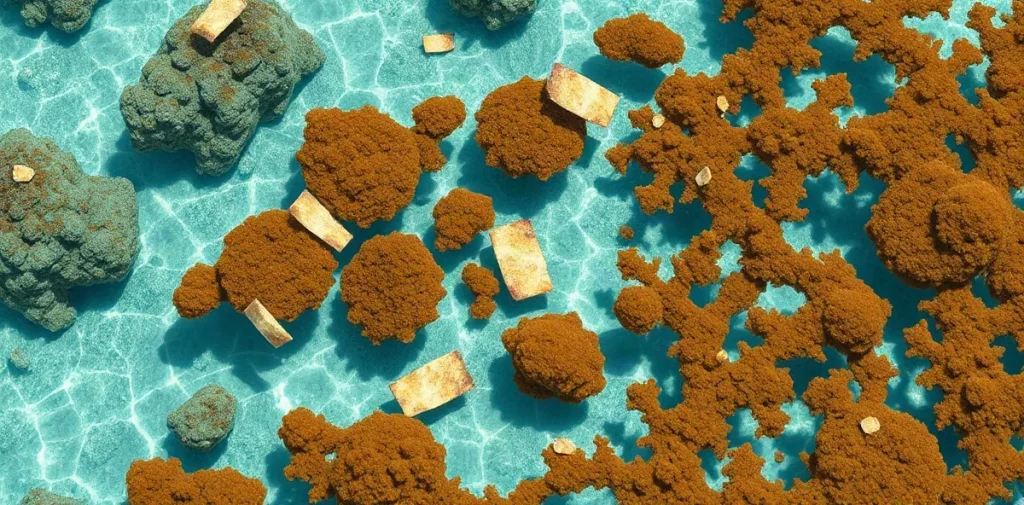
Research into Dictyota blooms and reef fouling examines how this seaweed spreads, attaches to underwater surfaces and interacts with marine habitats. In the Florida Keys, that work connects reef ecology with the conditions divers encounter: changes in benthic cover can affect the structure and character of a dive site, as well as the organisms living there.
What does a Dictyota bloom involve?
Dictyota is a genus of marine brown algae. A bloom describes an increase in its abundance or coverage, while fouling refers to organisms growing on a surface such as reef substrate, submerged structures or other organisms. These terms point to related but distinct questions: how much algae is present, where it grows, and how it becomes established.
Fragments matter because algae can reproduce or spread through pieces that break away and settle elsewhere. Movement by currents, contact with surfaces and local habitat conditions may all be relevant to understanding where fragments persist. The research area therefore considers not only the visible patch of seaweed, but also the pathways that can connect patches.
How do researchers study fragments and fouling?
Studies of algal growth commonly combine observations of reef surfaces with sampling or experiments that examine attachment and survival. Researchers may distinguish intact growth from detached fragments, record where algae occur, and compare settlement across different kinds of surfaces or environmental conditions. The method depends on the question: mapping distribution is not the same as testing how a fragment attaches.
Field observations put algae in their real habitat, where water movement, light, grazing and competition can interact. Controlled work can isolate one factor at a time, but may not capture every feature of a reef. Together, these approaches help separate the presence of a bloom from the mechanisms that could sustain or extend it.
- Coverage: where Dictyota grows and how much substrate it occupies.
- Fragment dynamics: how detached pieces move, settle and persist.
- Fouling: how algae attach to and grow over available surfaces.
- Habitat context: how physical conditions and other organisms shape growth.
Why does this matter to divers?
Reef algae are part of a changing underwater landscape. A shift in algal cover can alter what divers see and which surfaces are exposed, occupied or overgrown. For scientific divers, documenting those changes can contribute to habitat monitoring; for other divers, noticing changes at familiar sites can prompt useful questions about the reef rather than a quick assumption about their cause.
Algal growth can also affect submerged equipment and structures through fouling. That is a practical concern for scientific operations that use fixed instruments or revisit particular sites. Any maintenance or sampling plan has to account for the possibility that surfaces and their biological cover change between visits.
What makes reef observations hard to interpret?
A photograph or brief visit records a moment, not the full process. Algal abundance can vary with location and conditions, and a patch of Dictyota alone does not identify why it grew there. To interpret change, researchers need observations that can distinguish a lasting trend from local variation and connect patterns with plausible ecological processes.
Diving adds its own constraints. Time underwater, visibility, depth and the need to manage exposure can limit how much area a team can inspect during one dive. Repeated, carefully recorded observations are more useful than an isolated impression, especially when divers compare sites or return to the same reef over time.
How does this research fit into underwater science?
Marine ecology and scientific diving meet wherever researchers need direct access to submerged habitats. Work on algal blooms and fouling belongs to that wider effort: it asks how organisms occupy reef surfaces and how changes in their distribution relate to the surrounding environment. The same broad field includes studies of reef structure, habitat change and the effects of organisms on underwater substrates.
For divers who collect observations, the most useful record is precise and repeatable: location, depth, conditions and what was actually seen. Avoid treating an apparent bloom as a diagnosis of reef health. If a finding is being used to guide monitoring or site management, interpretation belongs alongside the full ecological context.
Frequently asked questions
What is Dictyota?
What does fouling mean in reef research?
Can divers tell what caused an algal bloom?
An original research-library explainer written by the Rubicon editors. It is not a summary of a specific publication.