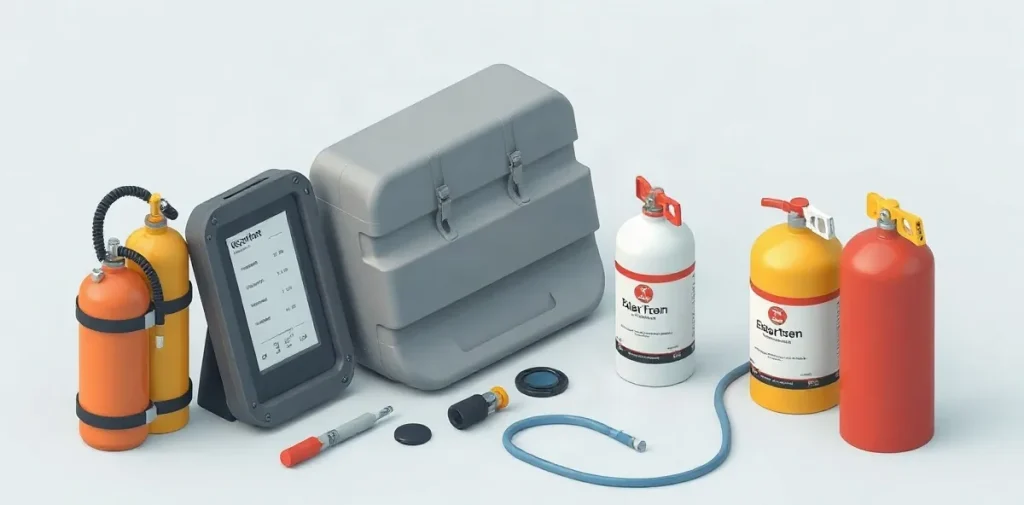
Technical diving for scientific exploration is the planning and use of dives beyond routine recreational limits to reach research sites and collect observations or samples. Its central question is how to make that work feasible while managing depth, time, decompression, equipment and diver risk as one operational problem.
What makes a scientific dive a technical operation?
A dive becomes technically demanding when its depth, duration, overhead environment or decompression obligations exceed the limits of ordinary recreational profiles. Scientific purpose adds another constraint: divers may need to locate, document or sample a target while following a planned task, rather than simply visit a site.
That task can compete with the demands of safe diving. Visibility, currents and complex terrain affect movement and navigation; collecting data can occupy both hands and attention. A plan therefore has to account for the work itself, not just the descent and return.
How is feasibility assessed before a dive?
Feasibility is a systems question. Planners consider whether the site can be reached, whether the scientific objective can be completed within the dive plan, and whether the team can respond if conditions change. A technically possible dive may still be unsuitable if the objective, equipment or available support cannot be matched safely.
- Exposure: depth, time, gas supply, thermal conditions and required decompression.
- Task demands: workload, navigation, sampling or documentation, and the time each activity requires.
- Team and equipment: diver roles, gas and life-support configuration, communications and redundancy.
- Contingencies: lost gas, equipment failure, separation, deteriorating conditions and delayed return.
- Support: access to the site, surface coordination and a workable response to an emergency.
These considerations are linked. More time on a scientific task can increase gas use and decompression obligation; additional equipment can support the task but add weight, complexity or failure points. A useful assessment tests the complete plan, including abort criteria, rather than treating each component in isolation.
Why do depth, gas and decompression matter?
As ambient pressure rises, the partial pressures of breathing gases rise too. Gas choice and depth affect inert-gas uptake and narcosis, while breathing-gas density and work of breathing can become important at depth. The consequences depend on the breathing mixture, exposure, workload and individual diver; a plan must not treat depth alone as a complete measure of risk.
During ascent, dissolved inert gas leaves tissues and is eliminated through the lungs. A sufficiently demanding exposure can require staged decompression, extending the time a diver must remain underwater and making a direct return to the surface unsafe. Decompression planning is therefore inseparable from gas reserves, task duration and procedures for an interrupted ascent.
These physiological constraints shape the research method as well as the dive plan. Teams may need to compare the scientific work required with the time, equipment and exposure needed to complete it, then decide whether the objective can be pursued within an acceptable operational envelope.
What methods make scientific diving more reliable?
Operational assessment starts by defining the scientific objective and the conditions at the site. The team can then map the task onto a dive profile, assign responsibilities, check equipment compatibility and specify how the dive will be shortened or abandoned. Practice and clear communication matter because a complex plan is only useful if each diver can carry it out under water.
For research, consistency is another concern. Navigation, recording and sample handling must be repeatable enough to produce usable observations, yet they cannot override gas limits or decompression requirements. Procedures should make clear which measurements are essential, how data are recorded, and what happens when conditions prevent the planned work.
Post-dive review closes the loop: teams can compare the intended task with what was completed, identify operational bottlenecks and revise later plans. This is a general approach to assessing scientific diving, not a substitute for training, site-specific planning or appropriate medical oversight.
Why does this work matter beyond the dive site?
Technical diving can make otherwise inaccessible environments available for scientific observation. Its value depends not only on reaching a site, but on bringing the diver and usable data back within a controlled plan. That makes feasibility a question shared by scientists, diving teams and those responsible for operational safety.
The same planning issues connect scientific exploration with broader diving research: decompression, gas management, equipment reliability, human factors and emergency response. Results from an individual project cannot automatically be transferred to another site or team; depth, conditions, task and support arrangements all change the assessment.
For divers and clinicians, the practical point is that a demanding research dive combines physiological exposure with workload and operational complexity. Medical fitness and return-to-diving questions belong with a diving-medicine physician, especially when a health condition or a recent incident is involved.
Frequently asked questions
What is technical diving for scientific exploration?
Why can’t a scientific task be planned separately from decompression?
Who should advise on medical fitness for a technical research dive?
An original research-library explainer written by the Rubicon editors. It is not a summary of a specific publication.
Related reading on Rubicon
- Diving Safety: Key Insights into Underwater Exploration
- Scientific Diving Course: Curriculum, Skills, Certification
- The Diving Reflex: What Happens Underwater
- NOAA Monitor Expedition: Technical Diving Research
- Scientific Diving and Underwater Research: Research Summary
- More on Diving Science
- Browse the Research Library