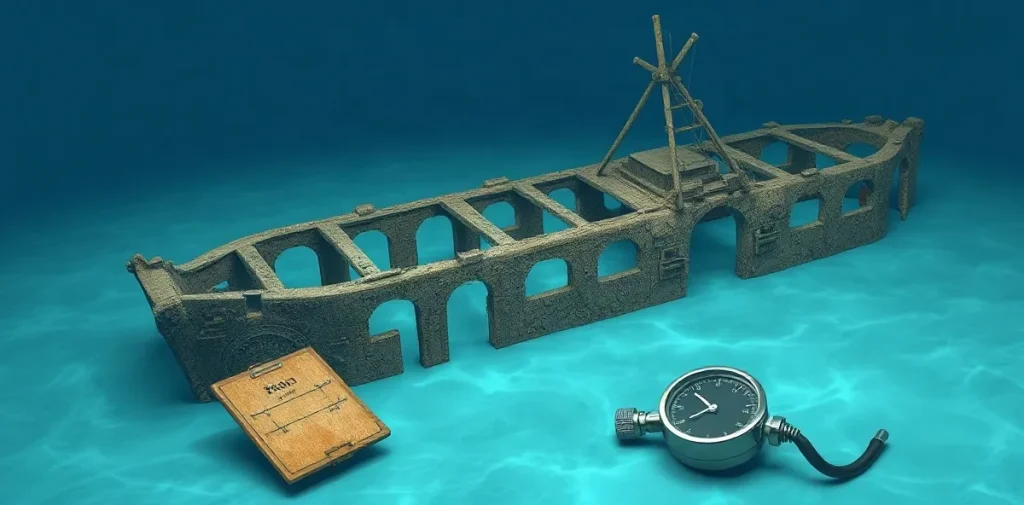
1998 NOAA Research Expedition to the Monitor National Marine Sanctuary is a 1999 publication by Dinsmore and Broadwater on an expedition at the intersection of scientific exploration and technical diving. Its subject matters because underwater research in demanding environments depends on matching mission goals with safe, capable divers, suitable equipment and careful operational planning.
What does the expedition title place in focus?
The title identifies a NOAA research expedition to the Monitor National Marine Sanctuary in 1998. The publication appeared in a volume concerned with assessing the feasibility of technical diving operations for scientific exploration, placing the expedition within a broader discussion of how diving can support research underwater.
Scientific diving is not simply recreational diving with a research task added. A mission may require divers to observe, document or work at a specific site while managing depth, time, equipment and environmental conditions. The scientific objective must be planned alongside the practical and physiological limits of the dive.
Why does technical diving matter to scientific exploration?
Technical diving describes operations that go beyond straightforward recreational profiles, often involving more complex gas planning, equipment configurations, decompression obligations or operational procedures. These capabilities may extend what divers can do, but they also add dependencies: the plan, equipment, team roles and emergency response must work together.
For an expedition, feasibility is therefore a question of more than reaching a location. It includes whether divers can complete the intended work, maintain adequate control of their exposure, and return safely under the conditions anticipated by the plan. Those considerations connect field science directly to diving safety and human physiology.
Which physiological and medical concepts shape the work?
As pressure increases with depth, the gases a diver breathes have effects that depend on the gas mixture and exposure. Inert-gas uptake and elimination influence decompression, while breathing-gas density and the work of breathing can matter during demanding dives. These mechanisms are central to planning and assessing technical operations.
Decompression illness can occur when a diver’s exposure and subsequent pressure reduction lead to harmful gas-bubble formation or related injury. Other concerns include oxygen toxicity, carbon-dioxide retention, cold stress, fatigue and the effects of workload. The relevant hazards depend on the dive profile, equipment, environment and individual circumstances; medical decisions require assessment by a diving-medicine physician.
What operational questions belong in an expedition assessment?
Assessments of technical diving for research commonly consider how the scientific task interacts with the dive plan. Work underwater can consume time and attention, and tools or sampling equipment may complicate buoyancy, movement and access. Plans need to account for the possibility that conditions or task demands change during the dive.
- Mission fit: whether the task can be completed within the planned exposure and available resources.
- Gas and decompression planning: how breathing-gas choices and ascent obligations shape the operation.
- Equipment and team coordination: whether configurations, procedures and diver roles support the task and emergency response.
- Environmental demands: how visibility, water movement, temperature and site access may affect execution.
- Contingencies: how the team will respond if equipment, health or operational conditions change.
These are general dimensions of expedition planning, not claims about particular procedures or events at the sanctuary. Their value is in making scientific objectives and diver safety part of the same operational assessment.
How does this publication fit into diving research?
The publication sits within the history of efforts to evaluate technical diving as a tool for scientific exploration. That field draws on decompression science, equipment design, human factors, dive medicine and practical experience from underwater operations. An expedition provides a setting in which these disciplines meet the demands of a real research mission.
For divers, clinicians and researchers, the subject highlights a recurring challenge: extending access underwater without treating greater capability as a substitute for risk management. For hyperbaric clinicians, understanding the nature of a dive operation can also help frame the exposures and hazards relevant to medical assessment. The expedition’s title and publication context make it a contribution to the discussion of technical diving’s role in scientific work.
Frequently asked questions
What is the publication about?
Why is technical diving relevant to scientific divers?
What medical issues are relevant to technical diving?
Citation details
- Title: 1998 NOAA Research Expedition to the Monitor National Marine Sanctuary
- Authors: Dinsmore, DA; Broadwater, JD
- Year: 1999
- Published in: Hamilton RW, Pence DF, Kesling DE, eds. Assessment and Feasibility of Technical Diving Operations for Scientific Exploration. Nahant, MA: American Academy of Underwater Sciences.
- Repository record: Rubicon Research Repository, handle 123456789/9000
This page is an original summary written by the Rubicon editors from the publication’s bibliographic record. It does not reproduce the paper, its abstract or its data; consult the publication itself for its methods and findings.
Related reading on Rubicon
- Scuba Diving Marine Biology: Key Species, Behavior, and
- Raja Ampat Diving: Marine Biodiversity and Dive Tips
- Google Scholar Research: Search and Assess Sources
- Ear Barotrauma in Diving: Pain, Risks and Care
- Thesis Research in Diving and Hyperbaric Medicine
- HPNS Suppression in Deep Human Dives: Research Summary
- More on Diving Science
- Browse the Research Library
