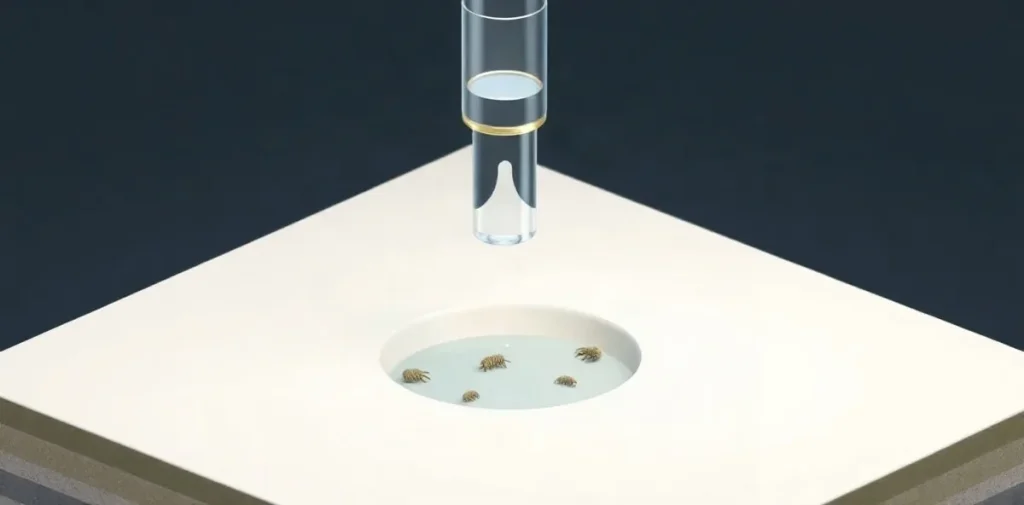
Sampling small invertebrates at the sediment–water interface means studying organisms living on, within or just above the boundary between seabed and water. This narrow zone connects sediment chemistry, water movement and animal life; careful sampling helps scientists understand how benthic ecosystems function and how diving research can observe them without obscuring the evidence.
Why focus on the boundary between sediment and water?
The interface is not a simple dividing line. It is a changing habitat where particles settle, organic matter accumulates, oxygen moves into sediment and organisms feed, burrow or shelter. Small invertebrates can occupy the surface film, the upper sediment or the water immediately above it.
These animals are part of benthic communities: the organisms associated with the bottom of a body of water. Their distribution and activity can help researchers investigate habitat conditions, food pathways and the exchange of material between seabed and water. The same patch of bottom may contain distinct communities across a very short vertical distance.
What questions can a sample address?
Research in this area asks where organisms occur, which kinds are present and how their abundance or composition varies between habitats or sampling periods. It can also examine how the animals relate to sediment properties, available food and physical disturbance. The precise question determines how the sampling boundary is defined.
Small organisms are easy to overlook during a visual survey, yet they can be central to the ecological picture. A diver may see the seabed’s larger features while missing animals that require close collection and examination. Sampling makes those less visible parts of the community available for identification and comparison.
- Habitat boundary: whether a method collects surface-dwelling, sediment-dwelling or immediately overlying organisms.
- Sample integrity: how collection and handling affect fragile animals and the arrangement of sediment.
- Comparability: whether the same area, depth within sediment and collection procedure are used across samples.
- Environmental context: what sediment and water conditions need to be recorded alongside the organisms.
How do scientific divers collect useful samples?
Underwater collection requires a method suited to the target organisms and the seabed. A sampler may isolate a defined patch or sediment layer so that material can be recovered for later sorting and identification. At the interface, small changes in how the sampler is placed, sealed or lifted can affect what enters the sample.
Divers also work in a setting where movement can disturb fine sediment. A poorly controlled approach may resuspend particles, blur the boundary being studied or move organisms away from the collection area. Planning the sequence of tasks, keeping equipment organised and recording the sampling location help preserve a clear link between a sample and its habitat.
Collection is only one part of the method. Researchers need consistent procedures for labelling, transport, separation and identification, because organisms can be damaged or difficult to distinguish. A result is only interpretable in light of what the sampling method could capture and how the material was processed.
What makes the work demanding underwater?
Scientific diving adds pressure, limited time, buoyancy control and equipment management to ordinary sampling challenges. Fine-scale work often calls for a stable position near the bottom, but contact with the seabed can disturb the very habitat under examination. Visibility may change if sediment is stirred, making careful movement and task order especially important.
The diver’s environment also shapes the data. Depth, current, water conditions and the time available for a task can affect how a sampling plan is carried out. These practical constraints belong in the research design: a method that works in one setting may need adjustment for another, while changes in procedure can complicate comparison.
Diving physiology is relevant because underwater work takes place under pressure and imposes workload, thermal and gas-management demands. Those factors do not determine which organisms are present, but they affect the conditions under which divers can safely complete fieldwork. Scientific objectives must fit within the dive plan, with medical concerns discussed with a diving-medicine physician.
Why does this research matter to divers?
For scientific divers, sampling at the seabed boundary is a way to connect direct observation with ecological evidence that cannot be assessed by looking alone. It also highlights a practical responsibility: a diver’s fin kick, hand placement or equipment can alter a small study area. Minimising disturbance is part of making the sample meaningful.
The broader value is methodological as well as ecological. Clear definitions of the sampled layer, consistent handling and careful recording make comparisons more useful across locations and projects. When you encounter a sampling study, the key question is not only which organisms were collected, but how the method distinguished the interface from the sediment beneath it and the water above.
Frequently asked questions
What is the sediment–water interface?
Why collect small invertebrates rather than rely on visual surveys?
How can divers reduce disturbance while sampling?
An original research-library explainer written by the Rubicon editors. It is not a summary of a specific publication.