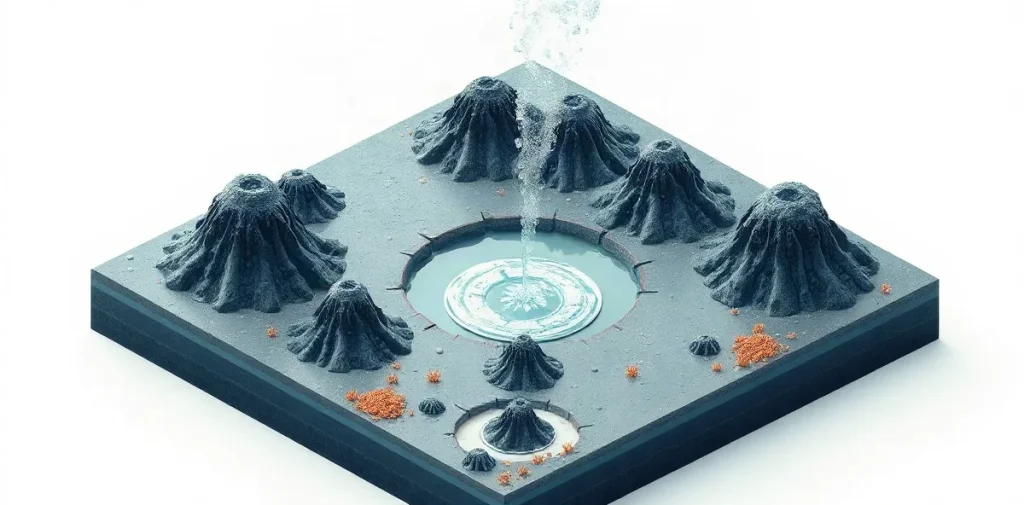
Hydrothermal-vent research examines how organisms colonise seafloor areas where hot, mineral-rich fluids emerge, and how those communities relate to geological change. At the East Pacific Rise, this means studying a dynamic environment where biology and geology meet—an important setting for scientific diving and for understanding the conditions that underwater teams must work in.
What makes hydrothermal vents distinctive?
Hydrothermal vents form where seawater circulates through hot ocean crust, becomes chemically altered, and returns to the seafloor. The emitted fluids can carry dissolved minerals and compounds that support microbial life, creating the basis for food webs unlike those dependent primarily on sunlight.
Vent fields are not uniform. Fluid chemistry, temperature, flow, and the shape of the surrounding seabed can vary over short distances and change over time. Organisms occupy conditions suited to their biology, so a community’s structure can reflect both the available habitat and the vent’s current activity.
How do researchers study community development?
Researchers ask which organisms appear, where they settle, and how their distribution changes as vent conditions and seafloor features evolve. “Development” in this context concerns ecological succession: the changing composition of a community as organisms establish, interact, and respond to local conditions.
Work in this area combines observation of living communities with measurements and mapping of their physical setting. Scientific divers and other researchers may examine organisms, fluid outlets, mineral deposits, and substrate—the surface on which life grows. Repeated observations are especially useful because a single visit cannot capture the sequence of change.
- Biological structure: which organisms are present, and how they are arranged.
- Geological features: the vents, deposits, and surfaces that form the habitat.
- Environmental conditions: heat, fluid flow, and chemistry that shape where life can persist.
- Change through time: how biological patterns relate to shifts in the vent environment.
Why connect ecology with geology?
Organisms do not develop independently of the ground beneath them. Geological processes create and alter the openings, mineral surfaces, and gradients that vent life depends on; biological activity, in turn, is part of the changing system researchers observe. Treating the two subjects together helps explain why nearby patches of seafloor can support different communities.
This combined approach also helps distinguish a temporary pattern from a lasting one. A dense gathering of organisms may reflect a particular flow or substrate rather than a stable feature of the entire vent field. Researchers therefore interpret biological observations in their physical and chemical context.
What does this mean for scientific divers?
Vent research is not a model for ordinary recreational diving: the deep seafloor presents pressures, temperatures, and access challenges very different from those encountered on typical dives. Its relevance to divers is broader. It shows how scientific questions underwater depend on carefully matching observations to environmental conditions and recording how a site changes.
For scientific diving, the setting also makes planning and exposure management central to the work. Heat, unstable or irregular terrain, limited visibility, and specialised access can complicate observation and equipment use. A scientific team must consider the environment and the task together; the exact procedures depend on the dive system and operating conditions.
How does vent ecology fit into diving science?
Research on vent communities sits at the intersection of marine ecology, geology, and underwater observation. It complements diving research on breathing systems, gas management, and human physiology, but asks a different primary question: how does life respond to an active seafloor environment? The shared concern is how to work underwater while accounting for conditions that cannot be treated as incidental.
For divers and clinicians, the distinction matters. Vent ecology does not itself provide medical guidance for an individual diver. If a dive or occupational exposure raises a health concern, consult a diving-medicine physician; ecological observations and clinical assessment answer different questions.
Frequently asked questions
What is a hydrothermal vent?
What does community development mean at a vent?
Is vent research directly relevant to recreational dive planning?
An original research-library explainer written by the Rubicon editors. It is not a summary of a specific publication.