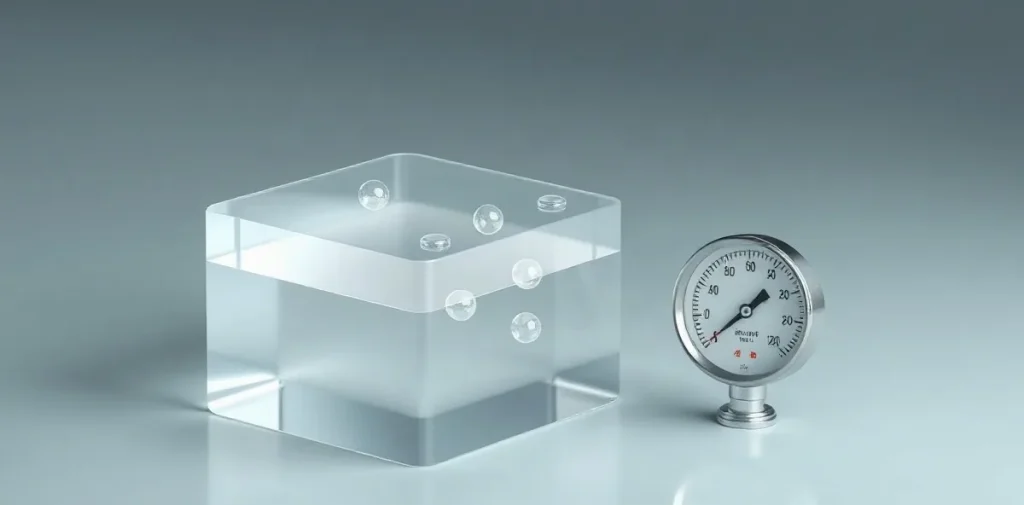
Gelatin-and-bubble research explores how gas bubbles form and behave in a tissue-like material during decompression. It matters because bubbles are central to decompression sickness, yet what can be observed in a model is not the same as what happens inside a diver. The work sits at the intersection of experimental physics and diving physiology.
Why study bubbles in a tissue-like material?
During a dive, elevated pressure increases the amount of inert gas, such as nitrogen, that dissolves in the body. As pressure falls during ascent, dissolved gas leaves tissues and returns to the circulation for removal through the lungs. If local conditions allow gas to come out of solution, bubbles may form or grow.
Gelatin offers a visible, controllable medium for investigating bubble behaviour in a material that can stand in, imperfectly, for soft tissue. Researchers can ask how bubbles nucleate, expand, move or interact with the surrounding material as pressure changes. The point is not that gelatin reproduces a human body, but that it can make processes difficult to observe in living tissue accessible to experiment.
What can a bubble model reveal?
At a basic level, the experiment links pressure changes to gas behaviour. A bubble’s growth depends on surrounding pressure and on how much gas can diffuse into it; its movement also depends on the properties of the medium. Those interacting processes help frame questions about why decompression stress is not simply a matter of depth or elapsed time.
A model can help separate variables that are entangled in a living diver. Investigators can control the medium and pressure history, then observe changes directly. But the result is a physical demonstration under specific experimental conditions, not a direct measurement of injury risk or a substitute for human physiology.
- Nucleation: the formation of a new gas bubble.
- Diffusion: movement of dissolved gas through a material and into or out of a bubble.
- Supersaturation: a condition in which more gas is dissolved than is stable at the current pressure.
- Mechanical effects: the ways bubbles may deform, displace or stress nearby material.
How does this relate to decompression sickness?
Decompression sickness can involve bubbles in blood or tissues, but bubble presence alone does not describe the whole clinical picture. Where bubbles form, how they behave, the diver’s exposure and individual physiology all matter. A gelatin model can illuminate possible mechanisms; it cannot diagnose a diver or establish that a particular bubble pattern will produce symptoms.
This distinction is important for both diving medicine and decompression planning. Models contribute to the broader effort to understand gas exchange and decompression stress, alongside physiological observations and clinical evidence. They can suggest mechanisms worth testing, while decisions about a diver’s symptoms require assessment by a diving-medicine physician.
What are the limits of translating a model to a dive?
Human tissues are not uniform blocks of gelatin. They differ in composition, blood supply and gas transport, and the body’s circulation continually carries inert gas between tissues and lungs. A laboratory model may not reproduce these features, nor the full sequence of depth, breathing gas, exertion and ascent that shapes a real dive.
So a useful reading asks what the model represents and what it leaves out. Does it isolate bubble formation, movement or tissue deformation? How are pressure and time controlled? The answers determine whether an observation offers a mechanism, a measurement method or a result that needs further testing in other settings.
Why does this research matter to divers?
Decompression procedures manage a biological process that is only partly visible while it is happening. Research on bubble behaviour helps explain why pressure reduction, gas transport and tissue response belong together, rather than treating ascent as a simple countdown. It also helps scientists identify which physical processes need better measurement.
For scientific divers, the topic connects experimental design with operational exposure: a study must control the dive or model conditions closely enough for its observations to mean something. For clinicians, the distinction between a plausible mechanism and a clinical outcome remains essential. If symptoms occur after diving, seek evaluation from a diving-medicine physician rather than using a laboratory model to judge their significance.
Frequently asked questions
Does finding bubbles mean a diver has decompression sickness?
Why use gelatin instead of living tissue?
Can a gelatin experiment change dive procedures?
An original research-library explainer written by the Rubicon editors. It is not a summary of a specific publication.
Related reading on Rubicon
- Decompression Sickness: Causes and Risk Reduction
- How Decompression Sickness Develops: Physiological
- Managing Suspected Decompression Sickness on a Dive Boat
- Safety Dive: Safety Stops vs Decompression Stops
- Decompression Sickness: Bubbles, Risk and Treatment
- Constrictive Postures and Decompression Sickness
- More on Diving Science
- Browse the Research Library