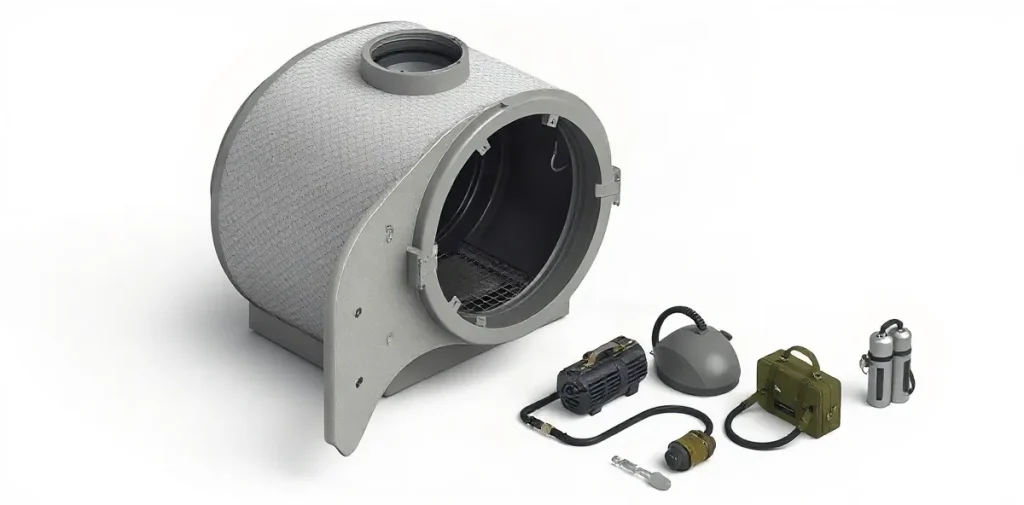
Hyperbaric oxygen therapy exposes a patient to oxygen at pressure above normal atmospheric pressure. In snakebite research, the central question is whether this treatment can help limit local tissue injury from venom, alongside urgent established care. The issue matters to divers because a venomous bite underwater or in a remote field setting combines a medical emergency with difficult evacuation.
What makes a venomous bite a hyperbaric-medicine question?
Puff adders are venomous snakes, and their bites can cause local injury as venom disrupts tissues and blood vessels. The clinical picture may include pain, swelling, bruising and damage around the bite; severity varies with the bite, the amount of venom delivered and the time to treatment.
Hyperbaric oxygen raises the oxygen available to tissues by increasing the oxygen dissolved in blood plasma. That mechanism makes it a possible subject of study when local tissue perfusion is impaired. It does not neutralise venom, so it cannot replace antivenom or other urgent medical management.
For diving medicine, the connection is not that a bite is a diving disorder. It is that hyperbaric clinicians may be asked to assess an additional treatment for a serious injury, while divers and scientific teams may encounter envenomation far from definitive care.
What does hyperbaric oxygen change in the body?
In a hyperbaric chamber, increased ambient pressure allows more oxygen to dissolve in plasma. The potential relevance to injured tissue lies in oxygen delivery: where circulation is compromised, increasing dissolved oxygen may alter the amount reaching tissue through the remaining blood flow.
That physiological rationale is not proof of clinical benefit. Venom can cause injury through several mechanisms, and oxygen pressure does not remove venom or reverse every process it triggers. A treatment’s value depends on the injury, its timing, the patient’s condition and the care provided alongside it.
Hyperbaric treatment also has risks and logistical demands. Clinicians must weigh the proposed benefit against chamber access, transport, pressure exposure and the possibility that treatment could delay more urgent care.
How do clinicians examine an adjunct treatment?
Research on a treatment used alongside standard care asks a different question from research on a replacement therapy. It examines whether the added intervention is feasible and safe, what outcome it is intended to affect, and how that outcome can be distinguished from the effects of antivenom, wound care and the natural course of injury.
Case reports can describe a clinical problem and the reasoning around an uncommon or emerging intervention. They can help frame questions for further study, but a single clinical account cannot establish that a treatment caused improvement or should be used routinely.
- Mechanism: whether increased oxygen availability could affect injured tissue.
- Timing: when treatment is considered relative to the bite and other care.
- Outcomes: how tissue injury, function, complications and safety are assessed.
- Confounding care: whether other treatments or the injury’s natural course explain change.
These questions sit within a broader hyperbaric-medicine problem: a plausible mechanism must be tested against clinical outcomes, not treated as evidence by itself.
Why should divers and remote teams care?
Divers working around reefs, islands or remote shorelines may face hazards that have little to do with decompression. A bite can become more difficult to manage when access to transport, medical assessment or antivenom is delayed. In-water first aid is also constrained: a casualty may need safe removal from the water before the injury can be assessed.
Hyperbaric oxygen is not a field treatment for snakebite. Chamber treatment requires specialist assessment and must not delay emergency evacuation or indicated antivenom. For an actual bite, seek emergency medical care and consult clinicians experienced in envenomation; a diving-medicine physician should be involved when the patient is a diver or the treatment plan raises diving-specific questions.
For scientific divers, the practical lesson is preparedness: identify the local emergency pathway before fieldwork, know how a casualty will be evacuated, and account for venomous wildlife in the site-specific risk assessment.
How does this topic fit into diving research?
Diving and hyperbaric research includes decompression illness, pressure effects, oxygen exposure and the clinical use of pressure chambers. Snakebite treatment belongs at the edge of that field, where chamber physiology is considered for conditions beyond injuries caused by diving itself.
That boundary is useful, but it calls for careful interpretation. A treatment may be physiologically plausible without being established for a particular condition; clinical decisions should rest on the full patient assessment and accepted emergency care, not on the chamber setting alone.
Frequently asked questions
Can hyperbaric oxygen neutralise snake venom?
Does a case report establish that a treatment works?
What should a diver do after a suspected snakebite?
An original research-library explainer written by the Rubicon editors. It is not a summary of a specific publication.
Related reading on Rubicon
- The Physiology Behind Oxygen Toxicity in Deep Dives
- Understanding Oxygen Toxicity Risks and Prevention in Diving
- Myth Busting: Clarifying Oxygen Toxicity Limits in Diving
- The Diving Reflex: What Happens Underwater
- Oxygen in Diving and Hyperbaric Medicine
- Oxygen Toxicity in Diving and Hyperbaric Medicine
- More on Dive Medicine
- Browse the Research Library