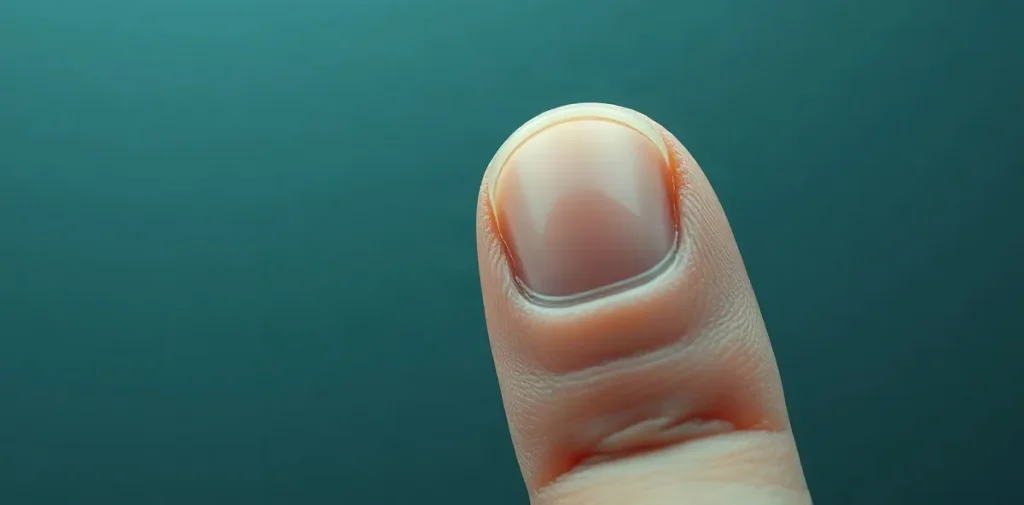
Beau’s lines are transverse grooves across fingernails that can form when nail growth is temporarily interrupted. In divers, their study raises a practical medical question: can a visible change in the nail record a period of physiological stress during or after deep saturation exposure, and how should clinicians interpret it?
What are Beau’s lines, and how do they form?
Fingernails grow from a matrix beneath the skin at the base of each nail. If matrix activity slows or stops temporarily, the nail plate formed during that interval may be thinner, leaving a groove that becomes visible as it grows towards the fingertip.
A line is therefore a delayed physical trace, not a real-time monitor. Its position can help estimate when nail growth was disrupted, but interpretation depends on growth rate and the distance between the groove and the nail base. A visible line alone does not identify its cause.
Why consider nail changes after saturation diving?
Deep saturation diving exposes people to a prolonged, controlled pressurised environment and the demands of an intensive working system. Researchers examining nail changes in this setting are interested in whether a bodily sign of interrupted growth can be related to an extended period of exposure or other stresses experienced during a dive.
The question belongs to a wider field that tracks how the body responds to diving, pressure, work and decompression. Nail changes are distinct from acute symptoms such as pain or neurological disturbance: they develop and become apparent over time, so they may prompt a retrospective clinical assessment rather than an immediate in-water decision.
How are these changes assessed?
Clinical observation begins with the nails themselves: whether grooves are present, which nails show them, and where each groove lies. A clinician may consider timing, nail growth, the diver’s exposure history and other health or environmental factors that could affect the nail matrix.
In a research setting, repeated observations and a clear record of dive and health history help distinguish a possible exposure-related pattern from a coincidental change. The appearance of a groove can raise a question; it cannot, by itself, establish decompression illness, diagnose a specific condition or identify a cause.
- Timing: nail growth makes a groove a delayed sign, not a measure of current pressure exposure.
- Pattern: distribution across nails and the groove’s position are part of clinical description.
- Context: dive history and other possible causes matter when interpreting a physical sign.
- Limits: an isolated nail finding is not a diagnosis of diving-related injury.
What can nail findings tell divers and clinicians?
For diving physicians and hyperbaric clinicians, visible changes may be one detail in a broader history of a diver’s health and exposure. Their value lies in careful observation and correlation with other clinical information, not in treating the nail as a stand-alone test for pressure injury.
Divers who notice new grooves after a demanding or unusual exposure should record when they appeared and seek medical assessment if they have symptoms or concerns. A diving-medicine physician can place the finding alongside the dive profile and the person’s overall clinical picture; urgent or worsening symptoms require prompt medical attention.
Frequently asked questions
Are Beau’s lines specific to diving?
Can a nail groove diagnose decompression illness?
When should a diver seek medical advice?
An original research-library explainer written by the Rubicon editors. It is not a summary of a specific publication.
Related reading on Rubicon
- Scuba Diving After Flying: How Long to Wait
- The Diving Reflex: What Happens Underwater
- Scuba Diving Fins: Split vs. Paddle Designs
- Scuba Diving Regulators: Balanced vs. Unbalanced
- Flying After Diving: Research Summary
- Taravana and Decompression Illness After Breath-Hold Diving
- More on Dive Medicine
- Browse the Research Library