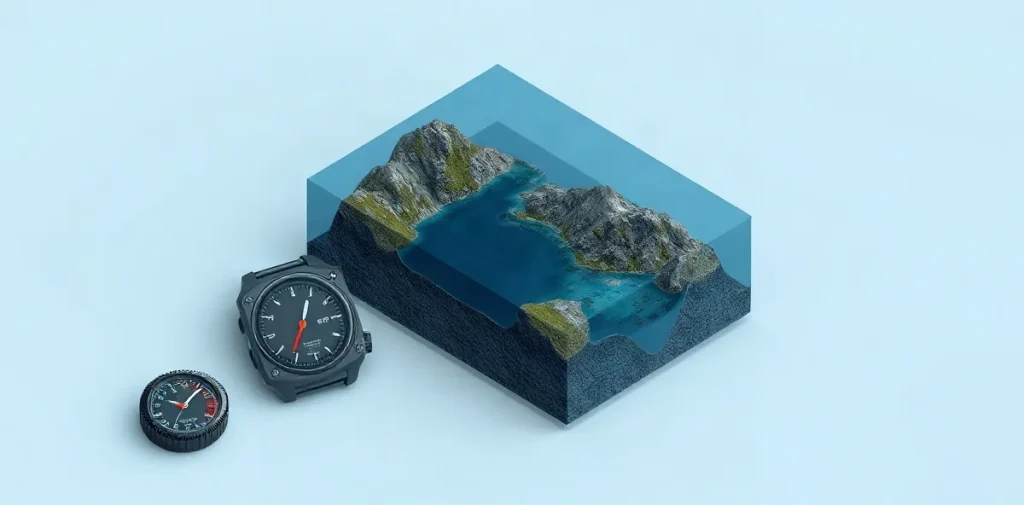
Altitude diving needs a different decompression plan from sea-level diving because lower atmospheric pressure changes the pressure gradient as you ascend. Use procedures designed for the altitude of the dive, not a sea-level plan unchanged.
The depth shown by a gauge is not the whole decompression picture: the pressure at the surface also matters. Altitude diving vs sea-level diving is therefore a question of how the ascent and decompression schedule account for the actual surface pressure.
Before you dive, check that your tables, computer or other planning method is suitable for the site’s altitude, and follow its instructions for the ascent and any required stops.
| Planning criterion | Sea-level dive | Mountain-lake dive |
|---|---|---|
| Surface pressure | Sea-level ambient pressure | Lower pressure at the lake surface |
| Decompression settings | Sea-level configuration | Altitude-aware configuration |
| Computer check | Confirm sea-level mode and profile | Verify altitude range and setting |
| When to seek guidance | When the dive profile or device requires it | When altitude procedures or decompression are unfamiliar |
- 1,500 metres Altitude in the model comparison for the 18-metre dive
- 62 minutes Modelled time for an 18-metre dive at the coast
- 53 minutes Modelled time for an 18-metre dive at 1,500 metres
- 3,812 metres Lake Titicaca elevation used in the model example
What changes when you dive above sea level?
At altitude, lower atmospheric pressure changes the pressure relationship between the lake surface and any given underwater depth, so a sea-level decompression schedule cannot be transferred unchanged to a mountain lake.
Altitude dive planning must account for the lake’s elevation before you enter the water. A depth gauge shows how far you have descended, but that reading alone does not describe the pressure change relevant to decompression.
The key planning comparison is between the pressure at your maximum depth and the actual surface pressure at the lake. Because surface pressure is lower than at sea level, the same displayed depth represents a different pressure relationship. Use a dive computer or plan that can account for altitude; check its instructions for the lake elevation and the settings required for that dive.
Altitude diving is not flying after diving
Both altitude diving and flying after a dive involve exposure to reduced ambient pressure, but they are separate planning problems. For a mountain-lake dive, first account for the lake’s elevation when setting the dive plan; flying after diving concerns a later pressure reduction after the dive has ended.
Do not treat a sea-level schedule as adequate simply because the depth reading matches. Confirm that the plan reflects the lake’s surface pressure.
How does altitude change a decompression schedule?
Altitude shortens allowable dive times and changes the depth used for decompression planning: a familiar sea-level depth-time plan cannot simply be carried over to a lake.
Depth is not the only input
Altitude-adjustment methods account for the lower surface pressure by changing the effective depth, ascent rate and stop depths. In one example, a 30-metre dive is planned as a 36-metre dive at 1,500 metres and as a 38-metre dive at Lake Tahoe; the same example also reduces ascent rates and stop depths by an inverse ratio.
- Actual lake elevation: the adjustment differs between 1,500 metres and Lake Tahoe.
- Computer decompression model: its altitude settings determine how depth, ascent and stops are calculated.
Model examples are not interchangeable
A historical model comparison gives an 18-metre dive 62 minutes at the coast, 53 minutes at 1,500 metres and 46½ minutes at 3,000 metres. These are outputs from that model, not universal limits.
In the same model, an 18-metre dive at Lake Titicaca’s 3,812 metres allows 43 minutes, while a 30-metre dive allows 13½ minutes. The comparison shows how sharply the schedule can change with both elevation and depth.
Before diving, check the actual lake elevation and confirm that your computer is set to an altitude-aware decompression model.
Which dive computer setting should you use at a mountain lake?
At a mountain lake, use a dive computer and planning procedure designed for altitude diving, set for the lake’s actual elevation, and follow the manufacturer’s decompression instructions.
Check the computer’s manual before the dive. Find its supported altitude range, how altitude is selected or detected, and any limits on using its decompression guidance at altitude. If the lake falls outside the stated range, do not treat the displayed plan as suitable.
An automatic altitude function still needs a check. Confirm that the computer’s displayed setting matches the lake’s elevation; do not assume automatic adjustment is active or appropriate for that site.
Build the dive plan for altitude conditions rather than entering a sea-level plan and trusting a display that merely looks conservative. A sea-level plan is not a substitute for the computer’s altitude procedure.
- Manual setting: select the altitude range or setting specified in the computer’s instructions for the site.
- Automatic setting: verify the displayed altitude against the lake’s actual elevation before relying on the computer.
Before entering the water, cross-check the plan against both the computer’s instructions and the site’s elevation. If the setting or the device’s altitude limits are unclear, resolve that with the manufacturer’s manual before diving.
When do sea-level settings fail, and when is specialist guidance needed?
Sea-level settings fail when they ignore the lake’s lower surface pressure; a familiar depth reading does not correct the mismatch in decompression planning. Seek altitude-diver training or specialist guidance if you have not planned an altitude dive before, cannot tell how your computer handles altitude, or face demanding decompression.
Common planning errors
A sea-level depth display can look familiar while the surrounding pressure conditions are not. The computer’s altitude function and the lake’s elevation both matter to the plan; checking the displayed depth alone cannot establish that decompression is appropriate.
Do not transfer a schedule between lakes or elevations. Examples for 1,500 metres, Lake Tahoe and Lake Titicaca differ materially, so a plan for one setting is not a substitute for planning the other.
- No prior altitude planning: get altitude-diver training or specialist guidance before relying on a sea-level plan.
- Unclear computer settings: check the manufacturer’s instructions or consult a qualified specialist before the dive.
- Demanding decompression: seek specialist guidance rather than adapting a schedule from another lake.
Altitude planning addresses the pressure difference, but it does not prove that a particular schedule is safe for your experience, computer or dive profile. Confirm the computer’s altitude procedure and have the full profile assessed before committing to the dive.
Which option suits your dive: sea-level planning or altitude planning?
For a sea-level dive, use a computer and plan set for sea-level conditions; for a mountain lake, use altitude-aware planning that accounts for lower surface pressure and its effect on decompression calculations.
- Sea-level site: Sea-level settings are the relevant choice. A deep dive alone is not a reason to select mountain-lake settings.
- Mountain lake: Altitude-aware planning is needed because the lower surface pressure changes the decompression calculation.
The right setup depends on the site’s elevation, your dive profile and the computer model. A depth or time example cannot determine the right settings for every dive; follow the computer’s instructions for altitude use.
Before travelling to a lake, confirm its elevation and check the altitude guidance for your specific computer. Also establish whether your plans call for an altitude-diver course or specialist advice; do not assume that sea-level settings will apply.
Frequently asked questions
Can I use my ordinary sea-level dive plan in a mountain lake?
Does the same depth allow the same bottom time at altitude?
What should I check on my dive computer?
When should I get specialist guidance?
Key takeaways
- Mountain-lake surface pressure changes the decompression plan; sea-level settings are not a safe default.
- A model example cuts an 18-metre dive from 62 minutes at the coast to 53 minutes at 1,500 metres.
- Check the computer’s altitude instructions and verify the setting against the lake’s elevation.
- Use altitude-diver training or specialist guidance when the computer or dive profile raises unresolved planning questions.
Sources
- Scuba Diving — “Altitude Diving: The Challenges and Benefits for”
- scubatechphilippines.com — “Altitude Diving Adventures: All You Need to Know”
- aboutdiving.com — “The Science of High Altitude Diving: Hypoxia Risk & Dive Planning”
- michaelbstrauss.com — “Altitude diving vs deep altitude medical precautions: Top 5 Risks”
- The Challengers of Altitude Diving — “Scuba Diving at Altitude”