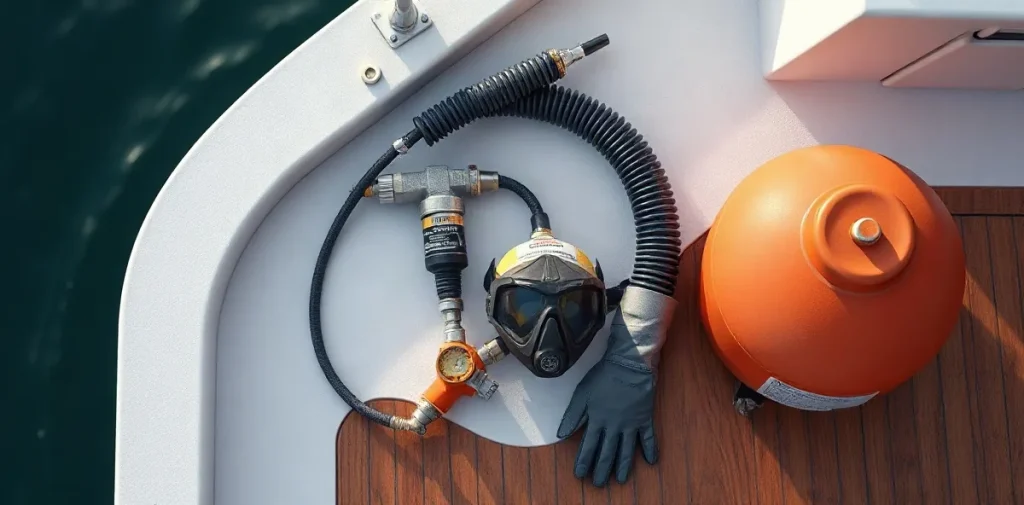
A dive boat’s oxygen kit should contain a suitable oxygen supply, delivery equipment and masks that let a responder give oxygen to an injured diver. The exact setup depends on the kit’s design and the oxygen-delivery methods it supports.
Oxygen can be an important part of first aid after a diving incident, but having a cylinder on board is not enough: the equipment must be ready to use and suited to the situation. A dive boat’s oxygen kit should also be checked and maintained, with crew familiar with its contents and operation.
| Setup | Equipment described | Main consideration |
|---|---|---|
| Boat or shore system | Cylinder, regulator, mask and tubing | Stage for prompt surface access |
| Dive 1st Aid Large Cylinder kit | Cylinder, regulator, safety gloves, non-rebreather mask and tubing | Check the contents of the selected package |
| Individual carry example | Multiple masks, two demand valves and a bag valve mask | Not a replacement for the staged cylinder system |
| Dive 1st Aid Double kit | Two oxygen tanks | Product states approximately 80 minutes of emergency oxygen |
- 125°F Maximum temperature DAN says oxygen units should not be exposed to
- approximately 80 minutes Emergency oxygen stated for the Dive 1st Aid Double Oxygen Rescue Kit
- 37 percent Injured divers who received oxygen first aid in a review of DAN dive accident data in 1987
What should a dive boat’s emergency oxygen kit contain?
A dive boat’s emergency oxygen kit should contain an oxygen cylinder, regulator, safety gloves, a non-rebreather mask and tubing for free-flow oxygen administration. These components let the crew set up surface oxygen delivery for a diver who needs it.
Dive 1st Aid’s Oxygen Rescue Kit (Large Cylinder) is one packaged option that includes those items. Check the exact contents of the kit you choose; packages can differ, so do not assume another model includes the same equipment.
Choose and stage the kit for the response
The cylinder and regulator are surface equipment. Keep the delivery system staged on the dive boat or with the shore response team, rather than putting it in a diver’s small carry bag. Individual carry kits serve a different purpose and may include masks, demand valves or a bag valve mask.
- Free-flow oxygen: Confirm the kit has a non-rebreather mask and the tubing needed for this delivery method.
- Other delivery options: If the crew plans to use a demand valve or bag valve mask, check that the equipment is included and that the crew is trained to use it.
- Cylinder size: Treat size as one part of the choice, not the deciding factor; match the kit’s delivery options to the planned response and crew training.
How should a boat team check oxygen equipment before a trip?
A boat team should check its oxygen equipment together before each cruise, confirm where every component is stored, and make sure someone can retrieve it.
Walk-through and access
The University-National Oceanographic Laboratory System recommends a pre-cruise equipment walk-through with the Master, Chief Engineer, Diving Safety Officer, On-Board Diving Supervisor, Marine Superintendent and Principal Investigator. On a dive boat, use that walk-through to locate the oxygen cylinder, regulator, mask and tubing, and identify who can retrieve them.
The walk-through should cover both the equipment and its storage. A complete kit that the team cannot reach when needed is not ready for use.
- Cylinder and regulator: Confirm both are present and stored in the agreed location.
- Mask and tubing: Check that the mask and tubing for oxygen delivery are available with the kit.
- Gloves: Confirm that safety gloves are packed.
- Access: Make sure the person expected to retrieve the kit knows where it is kept.
Repeat the check whenever the kit’s contents or storage location changes. If the cylinder is moved, for example, update the team’s understanding of where it is and who can get it.
How should a boat’s oxygen kit differ from a personal carry kit?
A boat’s oxygen kit should be a staged surface system, while a personal carry kit is a smaller arrangement built around what an individual can transport and use. The boat or shore team can keep the cylinder and delivery equipment together and ready for an emergency.
A personal-boat example includes more than free-flow equipment: two cylinders, two regulators, multiple non-rebreather masks, two demand valves and a bag valve mask. That is an example, not a universal packing standard; choose equipment to match the response plan and the training available.
- For free-flow oxygen: check that the staged system has a cylinder, regulator, non-rebreather mask and tubing.
- For demand delivery: if the response plan requires more than free flow, verify that a demand valve is included and that trained users can operate it.
- For assisted ventilation: check whether the plan calls for a bag valve mask, and confirm that trained users are available to use it.
Before departure, compare the equipment actually aboard with the response plan and the skills of the people expected to provide care.
Where should the oxygen kit be stored, and what can make it unsuitable?
Store the dive boat’s oxygen kit in a fixed, accessible place on the boat or with the shore team, and point it out during the crew walk-through. DAN says oxygen units should not be exposed to temperatures higher than 125°F, so they should not be stored in motorized vehicles on hot days.
Heat and access
- Heat: Keep the cylinder and delivery equipment away from locations where heat can affect them; a motorized vehicle on a hot day is unsuitable.
- Access: Choose a location crew can reach promptly, and include it in the walk-through so everyone knows where the kit is.
The Double Oxygen Rescue Kit from Dive 1st Aid contains two oxygen tanks and is described as providing approximately 80 minutes of emergency oxygen. That product figure is not a guarantee for every response: actual duration depends on how oxygen is delivered and used.
A kit stored where heat can affect it, or where crew cannot reach it promptly, does not meet the practical need. Check the storage location during the walk-through and confirm the crew can retrieve the kit quickly.
Why do crew readiness and training matter as much as the kit?
Crew readiness and training matter as much as the kit because emergency oxygen helps only when someone can bring the staged equipment to the diver and deliver it under a clear response plan. It is used in care for decompression illness, arterial gas embolism and drowning.
A review of DAN dive accident data in 1987 found that only 37 percent of injured divers received oxygen first aid; oxygen use in first aid dropped between 1987 and 1990. Owning a cylinder and delivery system does not prepare a crew to use them.
Match training to the boat’s plan
DAN’s Emergency Oxygen for Scuba Diving Injuries course is one training option. The crew’s response plan should make clear who retrieves the staged kit and how it reaches the diver. Which crew members are trained matters alongside the boat’s operating plan and the delivery equipment aboard.
The right configuration depends on those factors, so check that the kit’s delivery equipment matches the crew’s training and the boat’s plan. This section is not a substitute for formal training.
Frequently asked questions
What is the basic equipment in a boat oxygen kit?
How long does a two-cylinder oxygen rescue kit last?
Can an oxygen kit stay in a vehicle?
Should every diver carry the cylinder?
Key takeaways
- Stage the cylinder and regulator on the boat or with the shore team, not in a diver’s small carry bag.
- Check for gloves, a non-rebreather mask and free-flow tubing as well as the cylinder.
- Use a crew walk-through to confirm equipment location and access before departure.
- Keep oxygen units away from temperatures higher than 125°F.
- Match delivery equipment to crew training; a kit is not a substitute for formal instruction.
Sources
- divegearexpress.com — “Dive 1st Aid Oxygen Rescue Kit (Large Cylinder)”
- wms.org — “The Evidence-Based Dive Emergency Kit”
- dive1staid.com — “Oxygen Rescue Kit (Double)”
- Divers Alert Network — “All Oxygen Kits”
- Page 2 — “O2 Kit for Personal Boat — Questions!”