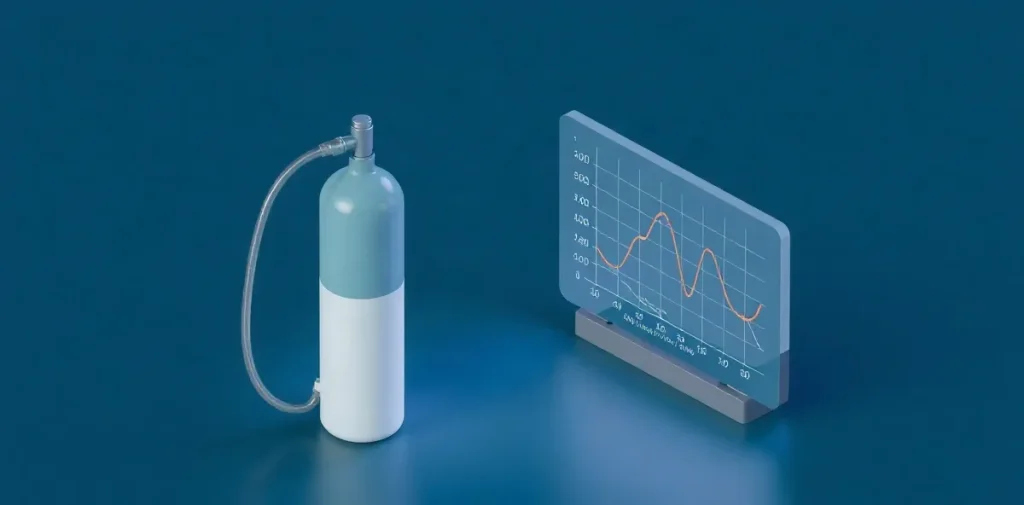
Pulmonary-function research in working divers examines how the lungs operate in people who dive as part of their work, including when they breathe nitrox, a gas mixture with more oxygen and less nitrogen than air. The subject matters because breathing-gas properties, pressure, exertion and repeated exposure all shape the demands placed on the respiratory system.
Why examine lung function in working divers?
Divers breathe through equipment that adds resistance and delivers gas at the surrounding pressure. At depth, gas density rises, which can increase the effort required to move air through the airways. Work underwater adds further demand, while cold, exertion and equipment configuration can affect breathing.
Pulmonary-function assessment provides ways to examine airflow, lung volumes and gas transfer. These measures can help describe respiratory status, but they are not interchangeable: a test of airflow does not by itself explain gas exchange, and a measurement taken on land does not reproduce every condition underwater.
For occupational diving, the central concern is not simply whether a diver can complete a test. It is how respiratory capacity relates to the tasks, exposure patterns and environmental conditions of the work—and whether changes warrant clinical attention.
What does nitrox change for the lungs?
Nitrox contains oxygen and nitrogen in proportions different from air. Its use changes the diver’s nitrogen exposure and oxygen exposure; the mixture does not remove the basic respiratory effects of pressure, dense gas or underwater exertion. The oxygen fraction is especially important because oxygen partial pressure rises with depth.
At sufficiently high oxygen partial pressure, oxygen can be toxic. Pulmonary oxygen toxicity is associated with substantial exposure and may irritate the respiratory tract; its risk depends on both oxygen pressure and exposure duration. That is distinct from the immediate mechanical work of breathing, which also depends on depth, gas density and equipment.
Research on divers using nitrox therefore sits at the intersection of respiratory physiology and gas-exposure management. A pulmonary measurement needs to be interpreted in the context of the breathing mixture and dive profile, rather than treated as a direct measure of nitrox safety.
How do researchers assess respiratory function?
Studies of this kind commonly use pulmonary-function tests to characterize different parts of respiratory performance. Spirometry measures how much and how quickly a person can exhale; other tests can assess lung volumes or the transfer of gas between the lungs and blood. Test choice depends on the question being asked.
Timing and conditions matter. A useful comparison must account for factors such as recent diving, physical effort, smoking history, respiratory symptoms and test technique. Repeated measurements can help distinguish a persistent pattern from ordinary variation, but interpretation belongs in the clinical and occupational context.
- Spirometry: assesses airflow and the volume expelled during specified breathing manoeuvres.
- Lung volumes: describe the air held in the lungs, including air not measured by a simple forced exhalation.
- Gas transfer: evaluates movement of gas from the lungs into the blood.
- Exposure context: connects test results with the breathing gas, depth, duration and work demands.
No single measurement captures the entire respiratory response to diving. Researchers and clinicians interpret a set of findings alongside symptoms, medical history and the diver’s actual exposure.
What makes occupational diving a distinct setting?
Working divers may have repeated exposures and perform tasks that require sustained effort, precise control or heavy equipment handling. Their respiratory demands can differ from those of a person making an occasional recreational dive. Occupational assessment consequently has to consider both health and the practical requirements of the job.
The wider diving-medicine field also examines related questions: how pressure and gas density affect ventilation, how breathing systems influence resistance, and how repeated exposure interacts with individual respiratory health. Nitrox adds a specific gas-composition dimension, but it does not replace attention to fitness, equipment or dive planning.
For a diver with breathing symptoms or an abnormal test, interpretation should be made by a clinician familiar with diving medicine. Fitness decisions depend on the full clinical picture and the demands of the planned work, not on one isolated result.
Frequently asked questions
Does nitrox make breathing easier underwater?
Can a normal spirometry test establish fitness to dive?
When should a working diver seek medical advice?
An original research-library explainer written by the Rubicon editors. It is not a summary of a specific publication.
Related reading on Rubicon
- The Diving Reflex: What Happens Underwater
- Scuba Diving Fins: Split vs. Paddle Designs
- Scuba Diving Regulators: Balanced vs. Unbalanced
- Scuba Diving Buddy Checks: Catch Problems Early
- Pulmonary Function and Deep Mixed-Gas Diving
- Pulmonary Function in Working Divers Using Nitrox
- More on Dive Medicine
- Browse the Research Library