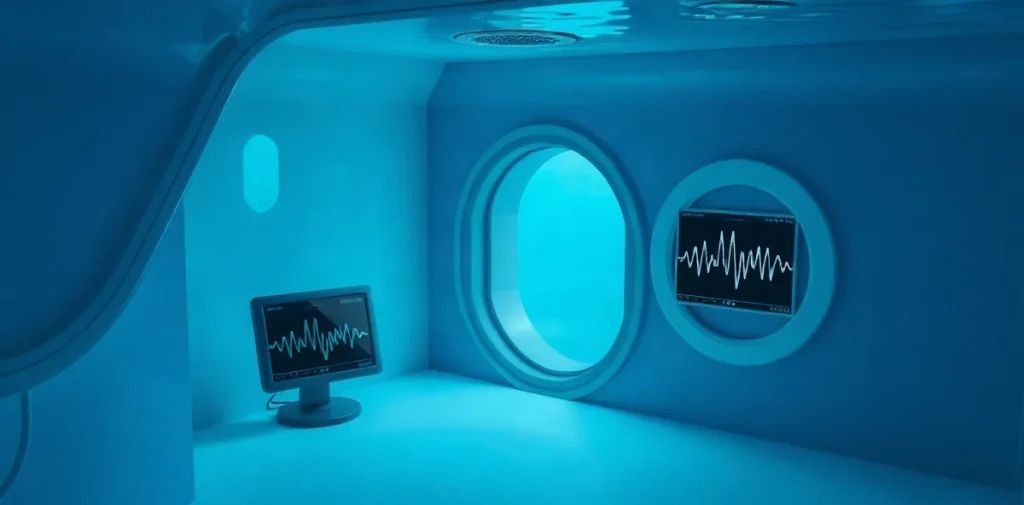
Electrocardiography in experimental diving examines how the heart’s electrical activity behaves during immersion and exposure to increased pressure. The subject matters because a diver’s cardiovascular system must respond to changing physical conditions while maintaining circulation, and an ECG can help researchers observe those responses over time.
What can an ECG tell researchers underwater?
An electrocardiogram (ECG) records electrical signals generated by the heart. Its tracing can reveal heart rate and rhythm, as well as changes in the timing and shape of electrical events that merit clinical interpretation. It does not, by itself, measure every aspect of cardiac function or explain the cause of a change.
In a dive study, the central question is not simply whether a tracing differs from one recorded on land. Researchers need to consider when a change occurs, how it relates to the dive profile and environment, and whether it is repeatable or clinically meaningful. A tracing is one measurement within a larger physiological picture.
Why might diving alter cardiovascular measurements?
Immersion changes the distribution of blood in the body. Water pressure and the movement of blood toward the chest can alter the heart’s loading conditions, while cold, exertion, breathing resistance and psychological stress may also affect cardiovascular responses. The combination varies with the person and the dive.
Increased ambient pressure adds another condition to examine. A pressure exposure may coincide with changes in gas density, breathing effort and the diver’s overall physiological workload. Separating these influences is difficult unless researchers record the exposure conditions alongside the ECG and other relevant measurements.
How are studies of this kind designed?
Researchers can compare ECG recordings taken before, during and after a controlled dive, then relate the timing of any observed changes to immersion and pressure exposure. Experimental settings allow specific conditions to be examined, but findings from one protocol do not automatically describe every kind of diving.
Recording a reliable signal underwater is itself a technical challenge. Movement, muscle activity, electrode contact and electrical interference can distort a tracing. Study design therefore needs to distinguish genuine cardiac signals from artefact and to establish when and how measurements were collected.
- Timing: whether ECG changes appear before, during or after exposure.
- Exposure: the pressure, immersion, temperature and activity conditions surrounding each recording.
- Signal quality: whether movement or equipment interference could affect interpretation.
- Context: how ECG observations fit with symptoms and other physiological measurements.
Why does this matter to divers and clinicians?
Heart rhythm and cardiovascular function are relevant to a diver’s capacity to tolerate immersion and complete a dive safely. ECG research helps characterize responses under conditions that differ from ordinary clinical testing, where a patient is generally not immersed or exposed to elevated ambient pressure.
For diving physicians and hyperbaric clinicians, the key is interpretation in context. A change in a tracing is not automatically a diagnosis, and an apparently unremarkable tracing does not answer every question about a diver’s health. Symptoms, medical history, exposure conditions and clinical assessment remain important.
Where does this research fit in diving medicine?
Diving physiology connects cardiovascular research with other questions about pressure exposure, gas exchange, decompression and human performance underwater. ECG monitoring addresses one part of that broader field: how the heart responds during a defined exposure, and how researchers can measure that response without confusing physiological change with recording artefact.
The experimental approach complements clinical assessment rather than replacing it. If you have a health concern related to diving or are considering whether a medical condition is compatible with diving, consult a physician experienced in diving medicine.
Frequently asked questions
What does an ECG measure?
Why record an ECG during a dive?
Can an underwater ECG diagnose a diving-related heart problem?
An original research-library explainer written by the Rubicon editors. It is not a summary of a specific publication.
Related reading on Rubicon
- The Diving Reflex: What Happens Underwater
- Scuba Diving Fins: Split vs. Paddle Designs
- Scuba Diving Regulators: Balanced vs. Unbalanced
- Scuba Diving Buddy Checks: Catch Problems Early
- NOAA Monitor Expedition: Technical Diving Research
- ECG Changes During the HYDRA 10 Experimental Dive
- More on Dive Medicine
- Browse the Research Library