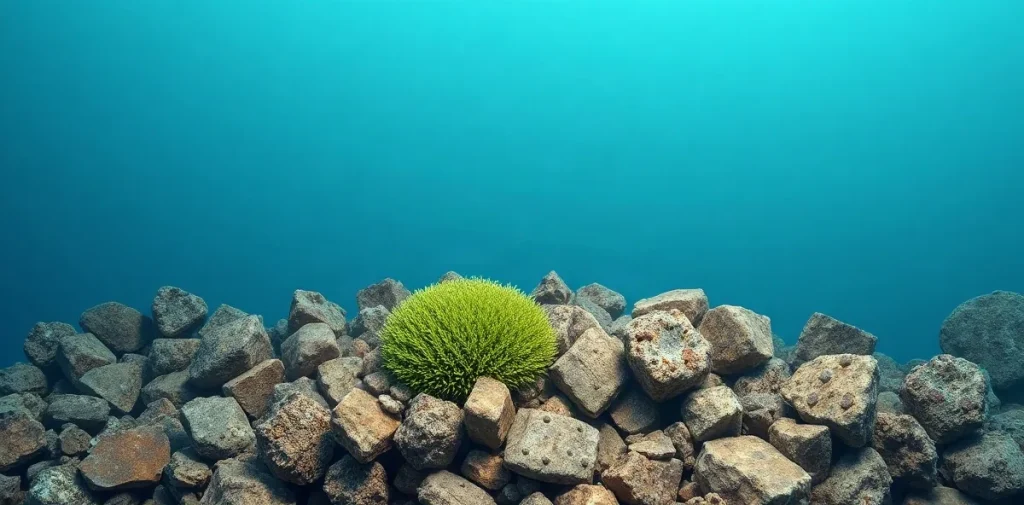
Algal Garden Cultivation and Guarding Behavior of Dusky Damselfish on Coral Rubble and Intact Reef in Dry Tortugas National Park is a 2009 publication by Di Santo and colleagues. It addresses how damselfish cultivate and guard algae in two reef settings, a subject linking animal behavior, habitat structure and the ecology encountered by scientific divers.
What does the study’s subject involve?
Some reef fishes maintain small areas where algae grow and defend those areas from other animals. In this publication’s subject, the focus is dusky damselfish and the relationship between algal gardening, guarding behavior and the physical setting: coral rubble or intact reef.
“Cultivation” here describes a behavioral and ecological process, not agriculture in the human sense. Grazing, territorial defense and the availability of suitable surfaces can all shape which algae persist in a fish’s territory and how that patch differs from surrounding habitat.
The comparison between rubble and intact reef makes habitat structure central to the question. A broken coral surface and a continuous reef can differ in shelter, attachment points and access, so observations of fish behavior need to be interpreted in relation to the place where they occur.
Why does reef structure matter to divers?
Coral reefs are living systems, and their physical structure affects the organisms that use them. Rubble is not simply a visually different version of intact reef: the arrangement of loose fragments can change available spaces and surfaces, while a continuous reef offers a different structure for animals and algae.
For divers, the distinction matters both as an ecological question and as a field-observation problem. A scientific diver documenting territorial behavior needs to recognize the habitat context, avoid disturbing the fish or substrate, and distinguish a stable observation area from a shifting or fragmented patch.
Rubble can also be vulnerable to movement from waves, currents or contact. That makes careful buoyancy and finning relevant when working near the bottom. Avoiding contact protects the habitat being observed and reduces the chance that a diver changes the very conditions under study.
What should researchers observe underwater?
Studies of gardening and guarding behavior can examine how fish use space, how they respond to intruders, and how algae are distributed within defended areas. The key is to treat behavior and habitat as connected observations rather than assuming that a fish’s actions have the same meaning in every setting.
- Territory: the area a fish uses and defends, assessed in relation to visible habitat boundaries.
- Algal patch: the type, distribution and condition of algae within the area of interest.
- Guarding: observable responses to other animals approaching or entering the area.
- Substrate: whether the observation is on coral rubble or intact reef, and how that structure may affect access and shelter.
- Disturbance: diver presence, contact, visibility and water movement that could influence observations.
Repeated observations are useful because a brief encounter may capture only one moment of territorial activity. Field notes should separate what is directly seen from an interpretation of why a fish behaved that way; that distinction is important in underwater behavioral research.
How does this fit into diving science?
The publication appeared in Diving for Science 2009, the proceedings of the American Academy of Underwater Sciences 28th Symposium, published in Dauphin Island, Alabama. Its setting places the subject within scientific diving: underwater research that depends on trained observation, controlled field methods and attention to the effects of diving on the study environment.
Scientific diving spans questions in marine ecology as well as human performance underwater. This topic is ecological rather than clinical: it does not concern decompression illness or treatment in a hyperbaric chamber. Still, it shares a practical foundation with other underwater research: divers must plan a task, manage exposure and equipment, maintain buoyancy, and collect observations without compromising safety or data quality.
The 2009 publication can therefore be read as a point of connection between behavioral ecology and the methods of underwater fieldwork. Its title identifies a focused comparison of fish behavior across reef structures in Dry Tortugas National Park, where interpretation depends on both animal activity and habitat.
Frequently asked questions
What is an algal garden?
Why compare coral rubble with intact reef?
Is this a diving-medicine paper?
Citation details
- Title: Algal Garden Cultivation and Guarding Behavior of Dusky Damselfish on Coral Rubble and Intact Reef in Dry Tortugas National Park
- Authors: Di Santo, V; Pomory, CM; Bennett, WA
- Year: 2009
- Published in: In: Pollock NW, ed. Diving for Science 2009. Proceedings of the American Academy of Underwater Sciences 28th Symposium. Dauphin Island, AL
- Record type: Journal article
- Repository record: Rubicon Research Repository, handle 123456789/10233
This page is an original summary written by the Rubicon editors from the publication’s bibliographic record. It does not reproduce the paper, its abstract or its data; consult the publication itself for its methods and findings.