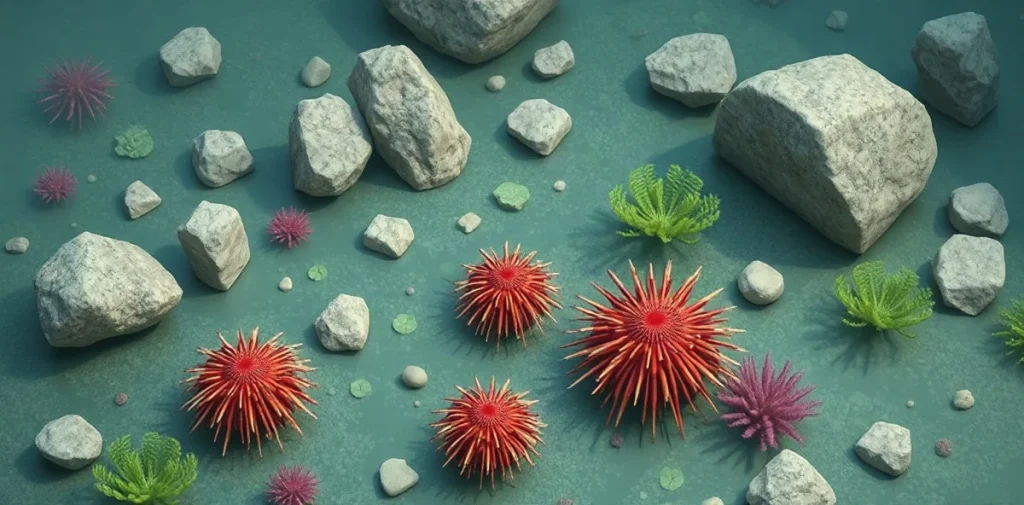
Habitat influences on sea urchin populations is a 2000 publication by Konar addressing the relationship between marine habitat and sea urchin populations. Presented in proceedings of a scientific diving symposium, the subject connects underwater observation with ecology: where organisms live can shape their distribution, abundance and interactions, making careful habitat study important to divers and marine research.
How can habitat influence sea urchin populations?
Habitat is more than a backdrop. Substrate, shelter, water movement, food availability and exposure to predators can affect where sea urchins occur and how they use their surroundings. The same species may occupy different parts of a reef or shore as local conditions change.
Population patterns are also linked to ecological relationships. Sea urchins graze on algae, while predators and competitors can influence their numbers and distribution. Examining habitat alongside the animals helps researchers frame questions about how physical conditions and living communities interact.
These relationships are not automatically simple cause and effect. A concentration of urchins in one habitat may reflect several overlapping influences, so field studies need observations that distinguish habitat features and account for the context in which organisms are encountered.
What does a scientific diver observe?
Underwater research can describe organisms in the places where they actually live. A diver may be able to inspect the substrate, shelter and surrounding community directly, linking observations of sea urchins to features that are difficult to interpret from a surface view alone.
Such work depends on consistent observation. Researchers need to consider where surveys take place, how habitat boundaries are recognised, and whether visibility, current or access affects what can be seen. These are general design concerns for underwater ecological studies, not claims about a particular survey method used in this publication.
- Habitat structure: the physical features and available shelter of a site.
- Population distribution: where organisms occur in relation to habitat.
- Ecological interaction: links among urchins, food resources, predators and other organisms.
- Observation conditions: visibility, water movement and the practical limits of underwater work.
Why does this subject matter to divers?
For scientific divers, habitat-focused research illustrates that an underwater observation is part of a larger ecological setting. Recording an organism without noting the surrounding habitat can leave important context out of the picture. Careful observations can help make comparisons between sites and support questions about change over time.
The topic also matters to diving operations because underwater research takes place in an environment that affects the diver as well as the study. Buoyancy control, situational awareness and disciplined survey procedures help reduce disturbance to the habitat and support reliable observation. The work is ecological rather than a study of diver physiology or treatment in hyperbaric medicine.
How does this work fit into diving research?
Scientific diving provides a way to investigate marine questions directly in the water, while proceedings bring together work presented within that research community. A study concerned with habitat and sea urchins sits within marine ecology and underwater field methods: it asks how organisms relate to their environment, rather than focusing on decompression illness, equipment performance or clinical care.
For readers in diving medicine and hyperbaric practice, the connection is chiefly through the demands of fieldwork. Underwater research requires attention to the conditions and procedures that make diving safe and observations useful. The biological question remains distinct from medical questions, even when both fields depend on understanding the underwater environment.
Frequently asked questions
What is the subject of the publication?
Why study sea urchins in relation to habitat?
Is this a diving-medicine study?
Citation details
- Title: Habitat influences on sea urchin populations
- Authors: Konar, B
- Year: 2000
- Published in: Hallock and French (eds). Diving for Science…2000. Proceedings of the 20th Annual Scientific Diving Symposium, American Academy of Underwater Sciences. St Pete Beach, Florida.
- Repository record: Rubicon Research Repository, handle 123456789/8990
This page is an original summary written by the Rubicon editors from the publication’s bibliographic record. It does not reproduce the paper, its abstract or its data; consult the publication itself for its methods and findings.
Related reading on Rubicon
- Liveaboard Diving: Essential Gear and Prep for Sea Trips
- More on Diving Science
- Browse the Research Library
