मानद इवैल्यूएशन ऑफ़ थे NCSC डाइवर थर्मल प्रोटेक्शन (DTP) पैसिव सिस्टम प्रोटोटाइप is a 1979 technical report by पितादोसि and colleagues, published in the US नवल एक्सपेरिमेंटल डाइविंग यूनिट Technical Report NEDU-13-79. Its subject is the evaluation of a passive thermal-protection prototype for divers—a practical problem because immersion can remove body heat and compromise comfort, performance, and safe task completion.
Why does a diver need thermal protection?
Water conducts heat away from the body much more effectively than still air, so a diver can become cold even when the surrounding water does not feel extreme at first. The rate of heat loss depends on conditions such as water temperature, exposure duration, movement, and the protection worn.
Cooling is more than a comfort issue. As body temperature falls, manual dexterity and concentration can deteriorate; more severe cooling affects normal physiological function. A diver who struggles to operate equipment or maintain a task may face added risk, especially when an exposure is long or demanding.
Thermal protection therefore has to be considered alongside the dive itself. The same garment may perform differently as water conditions, workload, fit, and time in the water change.
What does “passive” thermal protection mean?
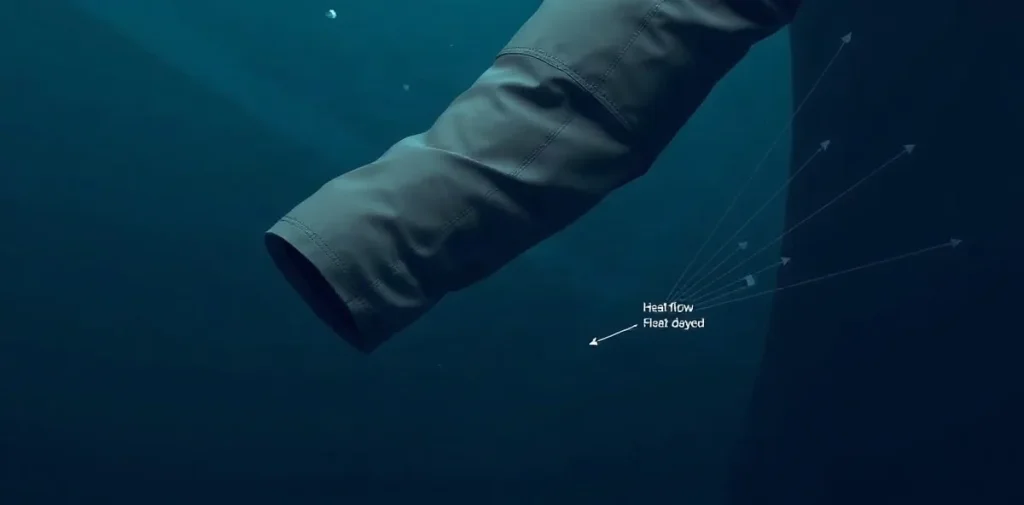
Passive protection limits heat loss without actively supplying heat to the diver. Its central design task is to slow the movement of heat from the body to the surrounding water, typically by using insulating layers and limiting the flow of water through the protection system.
In an immersed environment, insulation cannot be judged only by its material. Fit, seams, closures, compression, and water movement can all affect how well a system retains warmth. A design that works in one configuration may offer a different level of protection when worn with other diving equipment or used during sustained movement.
A prototype evaluation addresses how a proposed system performs as equipment, not simply whether a material is described as insulating. Relevant considerations include the conditions under which protection is assessed and whether the system can be used reliably in the intended diving setting.
How is thermal protection connected to diver physiology?
The body balances heat production against heat loss. Exercise produces heat, while immersion increases the route by which heat can leave the body; cold stress develops when heat loss exceeds the body’s ability to compensate. Clothing alters that balance but does not remove the influence of exposure time or workload.
Cold can also change how a dive feels and how well a diver can carry out physical tasks. A useful assessment of protective equipment therefore considers both thermal performance and the diver’s ability to move and work while wearing it. Protection that restricts movement or makes a task difficult presents a different practical trade-off from insulation alone.
These are general physiological principles, not an individual exposure plan. Divers with medical concerns, unusual cold sensitivity, or questions about fitness for diving should consult a diving-medicine physician.
What questions matter when evaluating a prototype?
Equipment evaluations of this kind sit at the intersection of engineering and human physiology. They ask whether a system’s design can reduce heat loss in a useful way while remaining compatible with the tasks and equipment required underwater.
- Thermal conditions: water temperature, exposure duration, and the diver’s level of activity affect heat exchange.
- Fit and water movement: gaps, compression, and circulation of water can change the protection a garment provides.
- Task performance: mobility, dexterity, and compatibility with other gear matter as well as insulation.
- Use conditions: an evaluation is most informative when its conditions resemble the intended diving application.
These factors help place a prototype assessment within a broader research problem: designing protection that is thermally useful without making underwater work less practical.
Where does this report fit in diving research?
Diver thermal protection is part of a long-running technical concern in diving: how to manage environmental exposure while preserving a diver’s capacity to work safely. The question connects equipment design with heat transfer, human performance, and operational planning.
The report’s title identifies a passive-system prototype and an evaluation, placing its subject within equipment-focused research rather than clinical diagnosis or treatment. For readers comparing thermal-protection approaches, the key is to distinguish the broad mechanism of insulation from the particular conditions in which any system is assessed.
Frequently asked questions
What is the publication about?
What does passive protection do?
Why does thermal protection matter to diving?
Citation details
- Title: मानद इवैल्यूएशन ऑफ़ थे NCSC डाइवर थर्मल प्रोटेक्शन (DTP) पैसिव सिस्टम प्रोटोटाइप
- Authors: पितादोसि, C. A; बॉल डी जे।; नुचकोलस म. ल; थाल्मन इ. डी
- Year: 1979
- Published in: US नवल एक्सपेरिमेंटल डाइविंग यूनिट टेक्निकल रिपोर्ट NEDU-13-79
- Record type: Journal article
- Repository record: Rubicon Research Repository, handle 123456789/3356
This page is an original summary written by the Rubicon editors from the publication’s bibliographic record. It does not reproduce the paper, its abstract or its data; consult the publication itself for its methods and findings.
Related reading on Rubicon
- Comparing Dive Suit Materials: Thermal Protection &
- Why Divers Get Cold Faster Underwater
- Scuba Diving Equipment: Essential Gear for Every Diver
- Effects of Cold Water Immersion on Diver Metabolism
- PADI Diver Rescue Training: Research Summary
- Lobster Divers of La Mosquitia: Research Summary
- More on Equipment
- Browse the Research Library