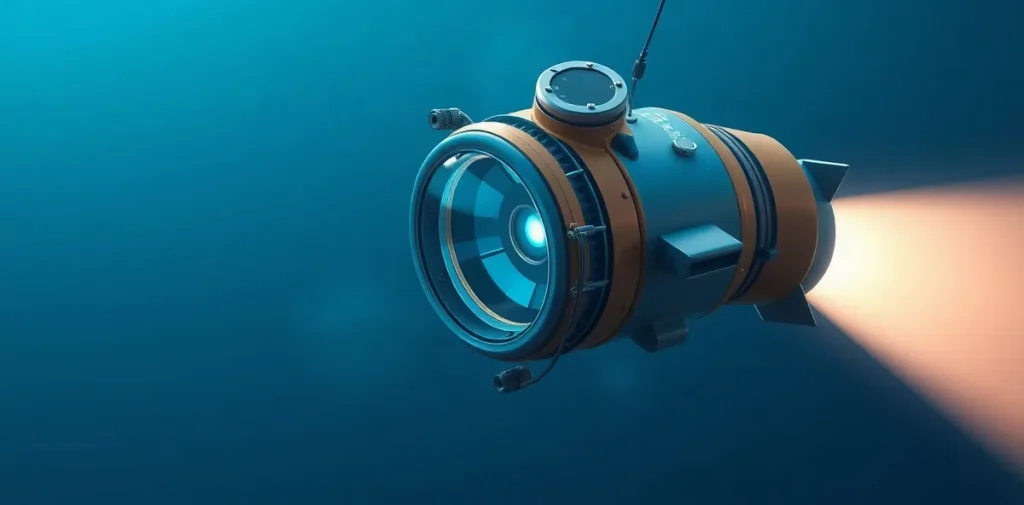
DEEP ROVER submersible operations for science is a 1987 symposium proceedings paper by English JG. Its subject is the use of a submersible in scientific work: a meeting point between underwater research, vehicle operations and the human demands of working beneath the surface.
Why use a submersible for scientific work?
Scientific diving and submersible operations are different ways of reaching and working in an underwater environment. A submersible can carry people and equipment while providing a pressure-resistant enclosure, making vehicle design and operating procedures part of the research setting.
The central questions raised by this subject include how a vehicle supports observation and data collection, how its systems are operated, and how a mission is planned around the limits of the environment. Those questions matter because reliable scientific work depends not only on instruments or research aims, but also on reaching the site and conducting operations safely.
What changes when people work inside a submersible?
Unlike an open-water diver, an occupant inside a pressure-resistant cabin is separated from the surrounding water by the vehicle. The cabin must maintain a suitable environment, while the vehicle and its life-support systems must function as a coordinated whole. Any failure can have consequences for both the crew and the mission.
Pressure remains fundamental even when the occupant is not directly exposed to it. The vehicle structure experiences the pressure difference between its interior and the surrounding water, while people outside the cabin may face the usual physiological effects of immersion, breathing gas and pressure change. This distinction helps explain why vehicle operations and diver medicine overlap without being the same discipline.
Which technical and human factors shape an operation?
Submersible work brings together engineering, navigation, communication, scientific task design and emergency planning. A mission needs clear operating roles and an understanding of how equipment, environmental conditions and the research objective interact. The details depend on the vehicle and task, but the underlying concern is to keep the operation controlled and the scientific work interpretable.
- Pressure and structure: the vehicle must withstand the surrounding water pressure and protect its occupants.
- Life support: the occupied space depends on systems that maintain conditions suitable for the crew.
- Communications: coordination between people in the vehicle and the wider operation supports both task execution and response to problems.
- Mission planning: navigation, research goals, equipment use and contingency arrangements need to fit together.
- Human factors: workload, visibility, confined space and decision-making can affect performance and safety.
These considerations are relevant to scientific divers as well as vehicle crews. Both must account for the environment, equipment reliability and the possibility that an unexpected event will require a change of plan.
How does this subject connect with diving medicine?
Diving medicine focuses in part on how pressure, breathing gases, immersion and exertion affect the body. A submersible cabin changes direct exposure to those conditions, but it does not make human physiology irrelevant: occupants still need a safe, supportable environment, and the operation still involves people who may have to respond under demanding circumstances.
For divers working alongside a vehicle, the medical concerns remain those of underwater exposure and the practical demands of scientific tasks. For vehicle occupants, attention shifts toward the cabin environment, life-support reliability, workload and emergency egress or recovery planning. These are general considerations, not a substitute for assessment by a diving-medicine physician when a health or fitness-to-dive question arises.
Why does a 1987 proceedings paper matter in the history of diving science?
The paper appeared in Coldwater Diving for Science, in proceedings of the American Academy of Underwater Sciences Annual Scientific Diving Symposium held in Seattle, Washington, on 31 October–1 November 1987. That setting places submersible operations within a broader conversation about conducting research in cold-water environments and organising scientific work underwater.
Research involving submersibles sits alongside work on scientific diving, underwater instrumentation, operational planning and human performance. It offers a useful lens on how scientific objectives depend on the capabilities and constraints of the means used to reach an underwater site. Read in that context, the subject is relevant to researchers, scientific divers, equipment specialists and clinicians concerned with underwater operations.
Frequently asked questions
What is the subject of this publication?
How is a submersible different from scientific diving?
Why should diving-medicine readers care about submersibles?
Citation details
- Title: DEEP ROVER submersible operations for science
- Authors: English JG
- Year: 1987
- Published in: In: Lang, MA (Ed). Coldwater Diving for Science … 1987. Proceedings of the American Academy of Underwater Sciences Annual Scientific Diving Symposium 31 October – 1 November 1987 Seattle, Washington, USA
- Record type: Symposium proceedings paper
- Repository record: Rubicon Research Repository, handle 123456789/10152
This page is an original summary written by the Rubicon editors from the publication’s bibliographic record. It does not reproduce the paper, its abstract or its data; consult the publication itself for its methods and findings.
Related reading on Rubicon
- Diving: Science, Practice, and Destinations
- Diving Science: Key Physiological and Environmental
- Diving: Exploring Underwater Activities, Science, and Safety
- The Science of Diving SSI: Education and Physiology Insights
- HPNS Suppression in Deep Human Dives: Research Summary
- Gastroesophageal Dynamics During Neck-Deep Immersion
- More on Diving Science
- Browse the Research Library