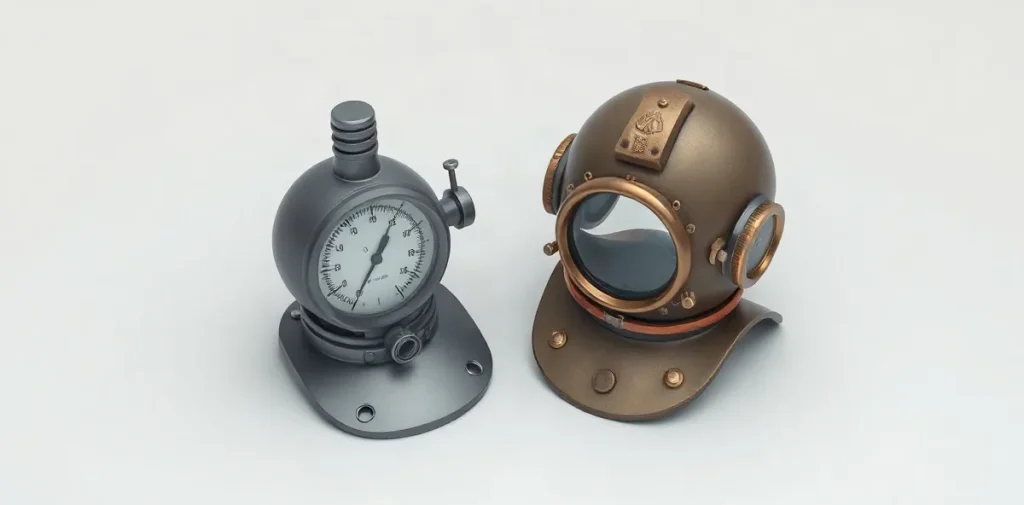
JS Haldane, JBS Haldane, L Hill, and A Siebe: A brief resume of their lives is a 1999 publication by CJ Acott in SPUMS Journal. Its subject is the lives of four figures associated with diving history, a topic that matters because modern understanding of underwater physiology and technology grew through accumulated work across generations.
Why do these lives matter to diving?
Diving places the human body in an environment where pressure, breathing gas and time interact. Making underwater work safer has depended not only on equipment, but also on understanding how the body responds to immersion and changes in pressure.
Historical accounts help readers see how those strands developed together. The people named in the title connect the history of diving to questions about physiology, medical risk and the practical means of remaining underwater.
What scientific ideas shape the history?
Pressure rises with depth, affecting the gases a diver breathes and the way those gases behave in the body. During ascent, the reduction in pressure makes controlled decompression important: dissolved inert gas must leave tissues without producing harmful bubbles.
These principles underpin the study of decompression illness and the planning of safe ascents. They also show why diving medicine draws on physiology, clinical observation and technical practice rather than treating underwater exposure as a simple extension of life at the surface.
- Ambient pressure: the surrounding water pressure changes with depth and affects breathing-gas conditions.
- Gas uptake and elimination: inert gases enter and leave body tissues as pressure and exposure change.
- Decompression: ascent must account for the body’s response to falling pressure.
- Life-support equipment: breathing systems make underwater activity possible while introducing their own design and operational considerations.
How are equipment and physiology connected?
Diving equipment is part of the physiological environment. A breathing apparatus must deliver gas under conditions that change with depth, while its design and use influence breathing effort and the diver’s ability to manage a task.
Equipment history therefore belongs alongside the history of medical and physiological inquiry. Understanding how people approached underwater breathing and pressure helps explain why present-day diving practice considers both the diver and the systems that support them.
Why does historical context matter in clinical practice?
Knowledge of earlier work provides context for the concepts used in diving medicine today. It helps clinicians and researchers understand how concerns such as pressure exposure, decompression and breathing systems became central to assessing risk and developing safer procedures.
For diving physicians and hyperbaric clinicians, history is not a substitute for current clinical judgment. It offers a wider frame for interpreting the field’s technical and physiological questions, while individual concerns about fitness to dive or symptoms after a dive call for assessment by a diving-medicine physician.
Frequently asked questions
What is the publication about?
Why is diving history relevant to physiology?
Who may find this subject useful?
Citation details
- Title: JS Haldane, JBS Haldane, L Hill, and A Siebe: A brief resume of their lives
- Authors: Acott, CJ
- Year: 1999
- Published in: SPUMS Journal 1999 Volume 29 Number 3
- Repository record: Rubicon Research Repository, handle 123456789/6016
This page is an original summary written by the Rubicon editors from the publication’s bibliographic record. It does not reproduce the paper, its abstract or its data; consult the publication itself for its methods and findings.
Related reading on Rubicon
- Ear Barotrauma in Diving: Pain, Risks and Care
- Scuba Diving: Why Immersion Can Dehydrate You
- Why Scuba Diving Tanks Feel Empty Before They Are
- Prescription Safety Glasses for Scuba Diving
- The Diving “Law-ers”: A History of Diving Law
- A Brief History of Diving and Decompression Illness
- More on Diving Science
- Browse the Research Library
