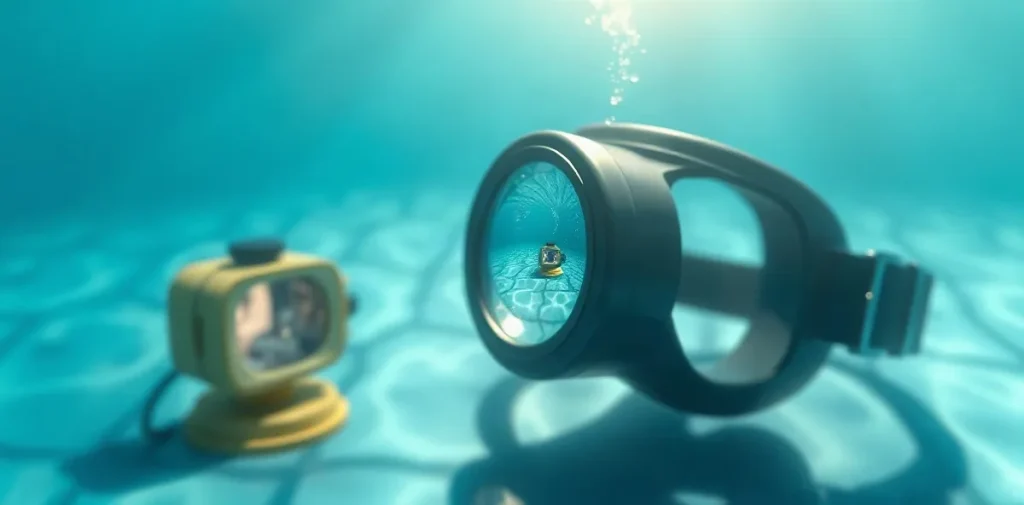
Underwater Vision is a 1970 technical report by Luria and Kinney addressing how people see beneath the water. Vision affects a diver’s ability to interpret surroundings, use instruments and respond to hazards, making underwater optics and visual perception important subjects for diving science and practice.
What changes when we look underwater?
Human vision is adapted to light passing through air before it enters the eye. Underwater, light travels through water and then encounters the eye’s optical surfaces, changing how the visual system focuses an image. The result is that objects can appear blurred or differently sized when the eyes are not protected by an air space, as provided by a diving mask.
A mask creates an air layer in front of the eyes, allowing them to focus more effectively, but it does not restore the view a person would have in air. The mask’s flat window and the transition between air and water alter the apparent position and size of objects. These effects matter when judging distance, reaching for equipment or navigating around a reef, wreck or other diver.
Why does underwater vision matter to divers?
Divers rely on visual information to maintain orientation, monitor equipment and communicate through gestures. Their surroundings can also limit what they can see: suspended particles scatter light, while depth and water conditions affect the amount and character of illumination. A clear understanding of vision underwater helps explain why an object may be difficult to detect or seem closer than it is.
These issues have practical importance in recreational, occupational and scientific diving. Visual tasks may include reading a gauge, inspecting an instrument, identifying a feature of the environment or coordinating with a team. Underwater vision is therefore not only a question of optical physics; it also concerns perception and the demands placed on divers in a changing environment.
Which concepts help explain the underwater view?
Several connected considerations shape what a diver can see and how reliably it can be interpreted:
- Refraction: Light changes direction as it passes between water, the mask’s air space and the eye.
- Apparent size and distance: A mask can make objects seem larger and nearer than their actual position suggests.
- Light and visibility: Scattering and absorption can reduce contrast and obscure detail.
- Visual adaptation: The eye’s response to available light influences the ability to distinguish objects and colours.
- Task and context: Perception depends on what the diver is trying to see, the equipment in use and the surrounding conditions.
These concepts are relevant to both equipment design and dive planning. A mask, lighting system or visual display must be considered in the optical environment where it will be used. Likewise, divers need to interpret visual cues with awareness that apparent position, contrast and colour may differ from familiar conditions on land.
How does this subject fit into diving research?
Underwater vision sits at the intersection of human physiology, optics and the practical study of diving. Research on the subject can examine how light reaches the eye, how visual perception changes underwater and how those changes affect performance on tasks. Such questions complement broader work on the human response to immersion and the demands of operating in an unfamiliar environment.
The 1970 date places this technical report within the development of modern diving research, when understanding the diver’s interaction with underwater conditions was an important technical concern. The subject remains relevant as equipment and diving applications evolve: any task that depends on seeing clearly must account for the distinct optical conditions underwater. This context makes the report’s topic useful to readers considering the history and scope of diving science.
What can diving professionals take from the topic?
For divers and scientific teams, visual limitations are part of situational awareness. Apparent closeness does not guarantee accurate distance judgement, and loss of contrast can make an otherwise familiar object harder to recognise. Planning tasks around visibility, lighting and the need to check instruments helps teams account for these conditions.
For diving physicians and hyperbaric clinicians, underwater vision is one aspect of a diver’s ability to function safely in the water. Changes in vision or difficulty performing a visual task may have several possible explanations, so a person with a health concern should consult a diving-medicine physician. General knowledge of underwater optics supports informed discussion, but does not replace individual medical assessment.
Frequently asked questions
What is Underwater Vision about?
Why can objects look different underwater?
Why is underwater vision important in dive medicine?
Citation details
- Title: Underwater Vision
- Authors: Luria, SM; Kinney, JAS
- Year: 1970
- Identifiers: AD0712595, NSMRL-630, NAVMED-M4306.03-2050D-1
- Record type: Technical report
- Repository record: Rubicon Research Repository, handle 123456789/8674
This page is an original summary written by the Rubicon editors from the publication’s bibliographic record. It does not reproduce the paper, its abstract or its data; consult the publication itself for its methods and findings.
Related reading on Rubicon
- Google Scholar Research: Search and Assess Sources
- Why Divers Get Cold Faster Underwater
- Diving Safety: Key Insights into Underwater Exploration
- Diving: Exploring Underwater Activities, Science, and Safety
- HPNS Suppression in Deep Human Dives: Research Summary
- Flying After Diving: Research Summary
- More on Diving Science
- Browse the Research Library
