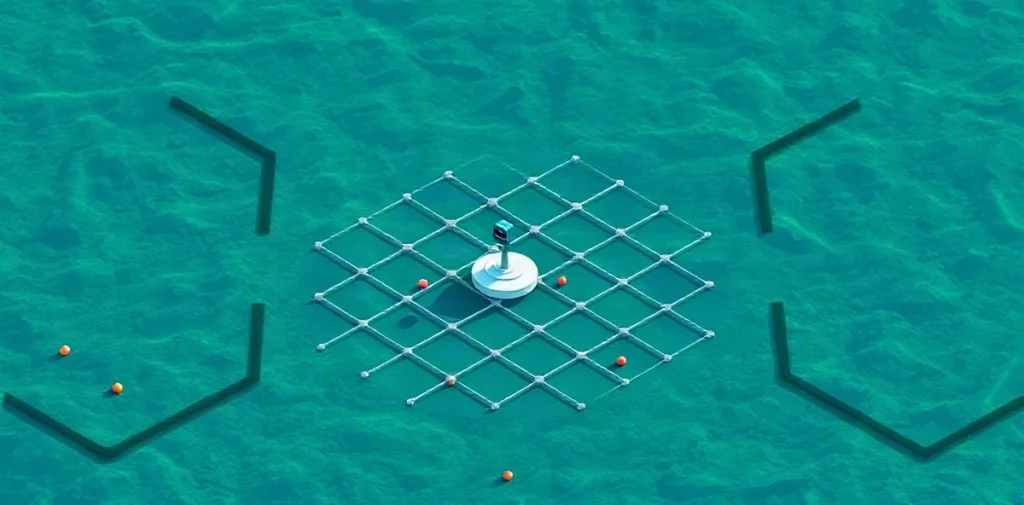
The Minerals Management Service’s Seafloor Monitoring Program is a 2009 publication by Ball in the proceedings of the American Academy of Underwater Sciences 28th Symposium. Its subject is monitoring the seafloor, a technical task relevant to understanding underwater environments and planning scientific diving and offshore work.
What does seafloor monitoring involve?
Seafloor monitoring means observing and documenting conditions at the seabed over time or across a defined area. Depending on the purpose, this can involve recording physical features, environmental conditions or changes to a site. The title places Ball’s work within that broad field, rather than within clinical research on diver health.
Underwater observations are harder to repeat than measurements made on land. Depth, visibility, currents, bottom type and the available survey methods all affect what can be observed and compared. A monitoring programme therefore depends on a clear question, repeatable methods and records that allow later observations to be interpreted in context.
Why does seabed observation matter to divers?
Scientific divers may work directly at the seabed to inspect, measure or document a site. Their observations can contribute to environmental surveys and other underwater research. The condition of the site also shapes the dive itself: poor visibility, unstable substrate, entanglement hazards or strong currents can change the task and its risks.
Monitoring is not the same as a dive-safety assessment. A programme focused on seabed conditions may inform knowledge of a location, but dive planning still needs to account for the actual work, depth, exposure, equipment, team capability and emergency arrangements. For you as a scientific diver, the operational plan should identify how observations will be made without compromising safe task management.
Which concepts help make monitoring useful?
Several practical concepts recur in seabed observation. They matter whether the work is conducted by divers, instruments or a combination of methods:
- Baseline: a documented starting condition against which later observations can be compared.
- Repeatability: using consistent locations, procedures and recording conventions so differences are less likely to reflect a change in method.
- Spatial coverage: understanding which parts of the seabed were examined and which were not.
- Environmental context: recording conditions such as visibility and currents that may affect observation quality.
- Uncertainty: recognising the limits of what a method can detect or distinguish.
These considerations are linked. A detailed observation at one point cannot automatically represent a larger area, and a difference between visits may reflect conditions or method as well as a genuine change. Clear records make those distinctions easier to assess.
How does this subject connect with diving science?
Seafloor monitoring sits at the intersection of underwater observation, environmental science and the practical methods of scientific diving. Research in this area must consider how observations are collected as well as what they describe. The underwater setting imposes limits on access, visibility, time and communication that do not apply in the same way to land-based surveys.
The proceedings venue identifies the publication with a scientific-diving audience. That context makes the work relevant to readers interested in how underwater projects are framed and carried out, while the title points to seabed monitoring as its central subject. It is not a medical study of decompression illness, hyperbaric treatment or physiological responses to diving.
What should readers consider when applying monitoring ideas?
Monitoring methods need to fit the question. A programme intended to document seabed features has different requirements from one intended to detect change, and neither can be judged without considering its observation method, coverage and timing. When comparing records, ask whether the same area and conditions were examined in a sufficiently consistent way.
Diving physicians and hyperbaric clinicians may encounter scientific divers whose work takes them to monitoring sites, but the monitoring subject itself is environmental and technical. Questions about fitness to dive, symptoms after a dive or treatment belong with a diving-medicine physician; environmental records do not replace an individual medical assessment.
Frequently asked questions
What is the publication about?
Is it a study of diver physiology or treatment?
Why does monitoring matter for scientific diving?
Citation details
- Title: The Minerals Management Service's Seafloor Monitoring Program
- Authors: Ball, DA
- Year: 2009
- Published in: In: Pollock NW, ed. Diving for Science 2009. Proceedings of the American Academy of Underwater Sciences 28th Symposium. Dauphin Island, AL: AAUS
- Record type: Journal article
- Repository record: Rubicon Research Repository, handle 123456789/10127
This page is an original summary written by the Rubicon editors from the publication’s bibliographic record. It does not reproduce the paper, its abstract or its data; consult the publication itself for its methods and findings.
Related reading on Rubicon
- Diving: Science, Practice, and Destinations
- Diving Science: Key Physiological and Environmental
- Diving: Exploring Underwater Activities, Science, and Safety
- The Science of Diving SSI: Education and Physiology Insights
- Rebreathers: Diving Science Research Summary
- NOAA Monitor Expedition: Technical Diving Research
- More on Diving Science
- Browse the Research Library