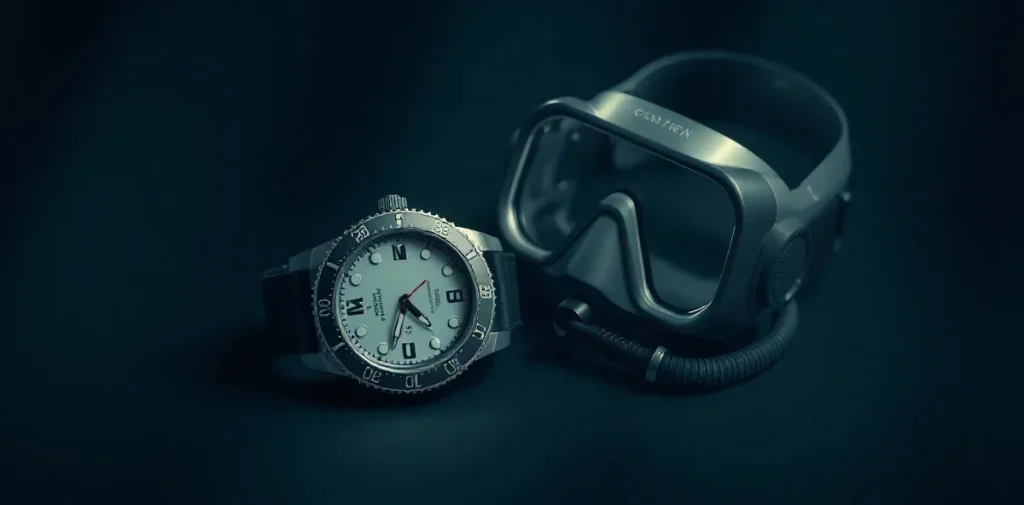
Miscellaneous Comments on Several Submersible Wrist Watches, by Prickett, CM, and Searle, Willard F, Jr, was published in 1959 as Navy Experimental Diving Unit Technical Report NEDU-Evaluation-24-59. It addresses wrist watches intended for underwater use—a practical equipment question because divers need timekeeping they can read and operate in a demanding environment.
Why does a diver need a watch underwater?
Time is part of dive planning and execution. A diver may need to track a planned interval, coordinate a task or team, and relate elapsed time to depth and decompression obligations. A watch is therefore more than a convenience: it is one component of the diver’s information and equipment system.
Underwater use changes the ordinary conditions of wearing a watch. Pressure increases with depth, while water, movement, limited visibility and the need to keep attention on the dive can all affect how easily an instrument is used. A timepiece that works on land may not remain sealed, readable or convenient underwater.
What does “submersible” require of a wrist watch?
For an underwater watch, the case and its seals must keep water out under the conditions for which the watch is intended. Pressure places loads on the case, crystal and closures; a defect or compromised seal can allow water ingress. The title’s focus on several watches places the subject in the practical territory of comparing equipment, rather than treating timekeeping as an abstract measurement problem.
Other considerations concern use rather than sealing alone. A diver must be able to see the dial, distinguish its hands or markings, and operate the watch without taking unnecessary attention away from the task. A secure fit also matters: the instrument should remain available when worn with diving equipment.
- Pressure resistance: the case and seals must withstand the intended underwater conditions.
- Water exclusion: sealing must remain effective during use, not merely in dry conditions.
- Legibility: the display must be usable in the available light and visibility.
- Operation and fit: controls and the strap must suit use while diving.
- Reliability: timekeeping and sealing are useful only if they continue to function as required.
How does pressure affect equipment?
Water pressure rises with depth. Any watch used underwater must therefore be considered in relation to its design and intended operating conditions; the word “submersible” by itself does not establish suitability for every depth or dive. Pressure can challenge seals and components, while changes in temperature and handling can add further demands.
That makes equipment assessment a question of performance under relevant conditions, not appearance or a general label. For divers, the practical concern is whether a device remains dependable throughout the planned use. A watch is not a substitute for established dive planning, timing procedures or appropriate decompression practices.
Why does this subject matter in diving research?
Diving research includes both physiology and the equipment that allows people to work underwater. Instruments support observation, coordination and adherence to procedures; their performance can affect the quality and safety of an operation even when the device does not directly alter the body’s response to pressure.
The 1959 report sits within this technical tradition through its subject and its Navy Experimental Diving Unit venue. Its title identifies several submersible wrist watches as the focus, linking a familiar personal instrument to the broader challenge of evaluating equipment for underwater use. That question remains relevant whenever a diver chooses a timekeeping device for a particular environment or task.
What should a diver consider when choosing a watch?
Start with the manufacturer’s stated limits and the actual conditions of use. Check the watch’s intended depth range, sealing instructions, maintenance requirements and compatibility with the way you wear diving equipment. A damaged case, worn seal or uncertain service history can make a previously suitable watch unreliable.
Legibility and ease of operation deserve attention before the dive, not during a task that already demands concentration. For questions about whether equipment is appropriate to a specific operation, consult the relevant equipment guidance and, where medical or decompression procedures are involved, a diving-medicine physician.
Frequently asked questions
What is the publication about?
Why is a watch relevant to diving?
Does “submersible” mean a watch is suitable for every dive?
Citation details
- Title: Miscellaneous Comments on Several Submersible Wrist Watches
- Authors: Prickett, CM; Searle, Willard F, Jr
- Year: 1959
- Published in: Navy Experimental Diving Unit Technical Report NEDU-Evaluation-24-59
- Record type: Journal article
- Repository record: Rubicon Research Repository, handle 123456789/3833
This page is an original summary written by the Rubicon editors from the publication’s bibliographic record. It does not reproduce the paper, its abstract or its data; consult the publication itself for its methods and findings.