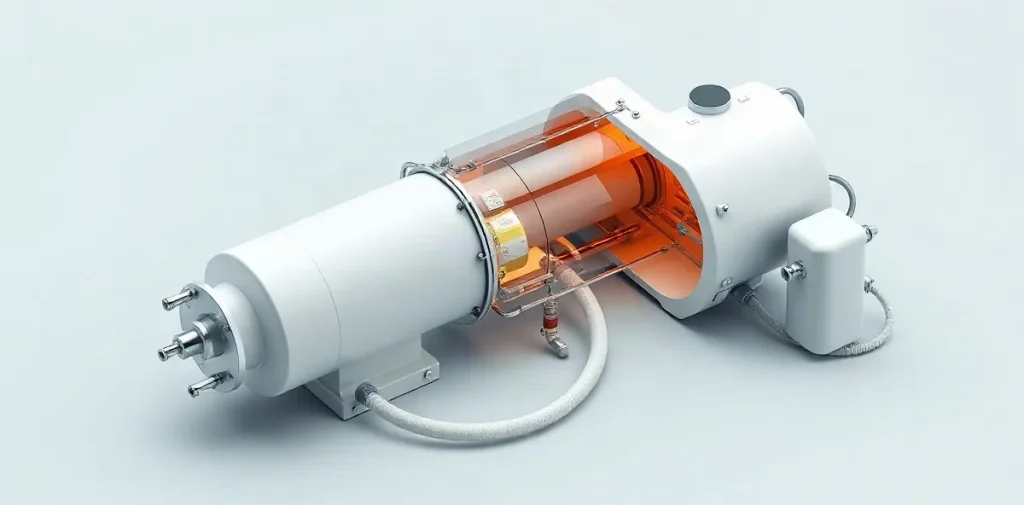
Measurement of oxygen concentration in delivery systems used for hyperbaric oxygen therapy is a 1996 publication by Stephenson and colleagues in Undersea & Hyperbaric Medicine. Its subject is the measurement of oxygen concentration in systems that deliver gas during hyperbaric treatment—a technical question with direct importance for treatment control and patient safety.
Why measure oxygen in a hyperbaric delivery system?
Hyperbaric oxygen therapy involves breathing oxygen in an environment where pressure is greater than the pressure at the surface. The gas reaching a patient is therefore part of a controlled treatment, not merely a background feature of the chamber. Knowing its oxygen concentration helps clinicians assess what the delivery system is supplying.
Oxygen concentration and pressure are distinct properties. Pressure describes the force exerted by the surrounding gas, while concentration describes the proportion of oxygen in the delivered mixture. Both matter when considering exposure: pressure affects the amount of oxygen available to the body, and the composition of the breathed gas determines its oxygen content.
What does oxygen concentration describe?
A gas mixture can contain oxygen alongside other gases. Its oxygen concentration expresses oxygen as a share of that mixture; it does not, by itself, describe the pressure at which the gas is breathed, the flow reaching a patient, or the duration of exposure. These are related but separate elements of treatment delivery.
Measurement is meaningful only in relation to the point being assessed. A reading taken at a supply or within part of a delivery pathway may not answer every question about the gas ultimately reaching the patient. In practice, clinicians and equipment specialists consider the measurement method, the location of sampling, instrument condition and the intended use of the result.
What makes measurement a technical challenge?
Oxygen analysers must be suited to the gas and operating conditions under examination. Their readings can be affected by calibration, sensor condition, sampling arrangements and the environment in which measurement occurs. A result is useful only when the instrument and procedure are appropriate and their limitations are understood.
Hyperbaric equipment also brings together a chamber, gas supplies and delivery components that must work as a system. Checking oxygen concentration is one part of equipment assurance; it does not replace inspection of the delivery pathway or clinical oversight. Sound measurement practice connects instrument performance with the practical question of what gas the system is intended to provide.
- Concentration: the oxygen proportion in a gas mixture.
- Pressure: the surrounding force under hyperbaric conditions, distinct from gas composition.
- Sampling point: the location in the delivery system where a reading is taken.
- Calibration and sensor condition: factors that influence whether an instrument reading can be trusted.
Why does this matter beyond the chamber?
Reliable gas delivery is central to hyperbaric medicine because treatment depends on controlled exposure. Clinicians need to understand the difference between what a system is designed to deliver and what a measurement at a particular point can establish. This is a shared concern for hyperbaric practitioners, equipment specialists and diving physicians involved in assessing oxygen use.
The topic also connects with wider diving-medicine questions about oxygen exposure. Oxygen is essential to life, but elevated oxygen availability under pressure can have harmful effects if exposure is not appropriately controlled. Understanding gas composition and delivery helps frame those risks, although an oxygen-concentration reading alone cannot determine an individual patient’s clinical risk or establish a treatment plan.
How does the subject fit into diving and hyperbaric research?
Hyperbaric research spans physiology, clinical practice and the engineering of systems that provide treatment gases. Measurement sits at the interface of these areas: physiological questions depend on knowing the exposure, while clinical and technical decisions depend on trustworthy equipment checks. The 1996 publication addresses this enduring interface through the specific subject of oxygen concentration measurement in hyperbaric delivery systems.
For divers, scientific divers and diving physicians, the underlying lesson is broader than any one treatment setting: gas composition should not be confused with pressure, and measurements should be interpreted in context. Questions about oxygen exposure or hyperbaric treatment are clinical matters; a diving-medicine physician should be consulted for individual medical assessment.
Frequently asked questions
What is oxygen concentration?
Why measure oxygen in a hyperbaric system?
Does an oxygen reading alone establish whether treatment is safe?
Citation details
- Title: Measurement of oxygen concentration in delivery systems used for hyperbaric oxygen therapy
- Authors: Stephenson, RN; Mackenzie, I; Watt, SJ; Ross, JA
- Year: 1996
- Published in: Undersea & Hyperbaric Medicine
- Identifiers: PMID 8931286
- Repository record: Rubicon Research Repository, handle 123456789/2245
This page is an original summary written by the Rubicon editors from the publication’s bibliographic record. It does not reproduce the paper, its abstract or its data; consult the publication itself for its methods and findings.
Related reading on Rubicon
- Hard Hat Dive: Gear, Team and Safety Systems
- How Dive Hoses Ensure Reliable Air Delivery and Diver Safety
- The Science Behind Dive-Induced Immune System Modulation
- The Physiology Behind Oxygen Toxicity in Deep Dives
- Hyperbaric Oxygen Therapy for Lyme Disease
- Erythromelalgia and Hyperbaric Oxygen
- More on Equipment
- Browse the Research Library
