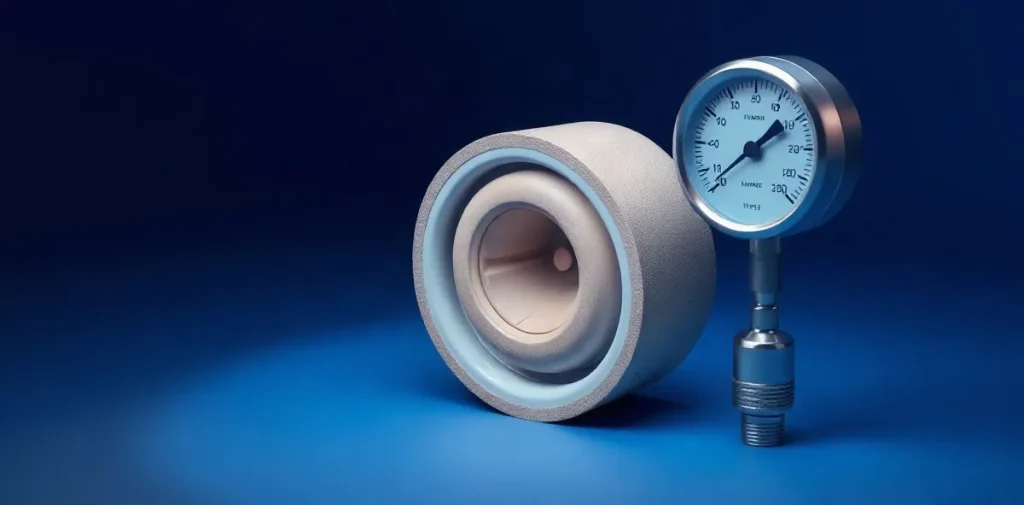
Research on tympanostomy tubes in hyperbaric oxygen treatment sits at the intersection of ear physiology, pressure exposure and clinical decision-making. It asks how the reason a patient needs hyperbaric oxygen may relate to the likelihood of requiring a tube to ventilate the middle ear—a practical issue wherever treatment involves repeated pressure changes.
Why does the middle ear need to equalise?
The middle ear is an air-filled space behind the eardrum. Its pressure must remain close to the pressure in the surrounding environment; the Eustachian tube, which connects the middle ear to the back of the nose and throat, normally allows air to pass and helps maintain that balance.
During descent underwater or compression in a hyperbaric chamber, ambient pressure rises. If the Eustachian tube does not open sufficiently, pressure in the middle ear lags behind, pulling the eardrum inward. The resulting pressure difference can cause pain and, if it is substantial, tissue injury known as middle-ear barotrauma.
Equalisation is therefore not a minor comfort issue during a treatment or dive. A person may be alert to ear discomfort, but illness, nasal congestion, anatomy or difficulty performing an equalising manoeuvre can complicate pressure changes. The relevant concern is whether the ear can safely accommodate the planned exposure.
What does a tympanostomy tube change?
A tympanostomy tube is a small tube placed through the eardrum to ventilate the middle ear. It provides a route for pressure to equalise between the middle ear and the external ear canal, bypassing the usual route through the Eustachian tube. In hyperbaric care, this may be considered when pressure changes pose a problem for middle-ear ventilation.
The tube does not remove the need to assess the patient or the treatment. Clinicians still need to consider the ear’s condition, the reason for hyperbaric oxygen and the demands of the planned pressure profile. The procedure also introduces its own clinical considerations, so the choice is a balance rather than an automatic response to ear symptoms.
Research asking whether the indication for hyperbaric oxygen predicts tube placement is examining a relationship between two clinical decisions: why treatment is being given, and whether middle-ear ventilation needs intervention. That question matters because different underlying illnesses and treatment circumstances may shape how a patient tolerates compression.
How are questions like this studied?
Studies in this area typically examine clinical records or patient groups to compare features such as the reason for hyperbaric oxygen treatment with subsequent management of pressure-related ear problems. The central methodological task is to distinguish an association from a cause: a link between a treatment indication and tube placement would not, by itself, prove that the indication caused ear injury.
Interpretation also depends on how clinicians define the outcome and make the decision to place a tube. Symptoms, examination findings, treatment urgency and local clinical practice can all affect whether a patient receives an intervention. These factors matter when considering whether an observed pattern would apply in another setting.
The broader field of hyperbaric medicine studies how pressure exposure interacts with illness, treatment benefit and adverse effects. Ear barotrauma belongs to that wider work on treatment tolerance: a therapy delivered under pressure has to be assessed not only for its intended purpose but also for the patient’s ability to undergo compression and decompression.
What does this mean for divers and clinicians?
Divers face the same basic pressure problem, although the setting differs. On descent, a diver who cannot equalise may develop middle-ear barotrauma; continuing downward despite pain can worsen the injury. A history of ear disease, difficulty equalising or ear surgery is relevant to dive fitness and should be discussed with a diving-medicine physician.
Hyperbaric treatment and recreational diving are not interchangeable exposures. A chamber treatment is clinically supervised and follows a prescribed pressure profile, while a dive involves its own environmental and operational risks. Still, research on middle-ear ventilation can help clinicians think clearly about a shared physiological constraint: pressure must be managed across the eardrum.
Useful concepts to keep distinct include:
- Middle-ear barotrauma: injury caused by a pressure difference across the eardrum.
- Eustachian tube function: the usual route for middle-ear ventilation and equalisation.
- Tympanostomy tube: a procedural route for ventilating the middle ear through the eardrum.
- Prediction and causation: a clinical association may help identify patterns without explaining why they occur.
When should ear symptoms change the plan?
Ear pain, a blocked sensation or difficulty equalising during pressure exposure should not be treated as a challenge to overcome by force. For a diver, stopping descent and addressing the problem is safer than continuing through pain. For someone receiving hyperbaric oxygen, symptoms should be reported to the treating team before or during treatment.
Whether a tube is appropriate depends on the individual’s ear examination, medical indication and planned exposure. A diving-medicine physician or hyperbaric clinician can assess those factors; general information about pressure physiology cannot determine an individual’s fitness to dive or suitability for treatment.
Frequently asked questions
Why can pressure changes hurt the ears?
Does a tympanostomy tube make diving safe?
Is chamber pressure the same as underwater pressure?
An original research-library explainer written by the Rubicon editors. It is not a summary of a specific publication.
Related reading on Rubicon
- First Aid Essentials for Diving Ear Barotrauma
- Scuba Diving Ear Equalization: Why Valsalva Fails
- The Physiology Behind Oxygen Toxicity in Deep Dives
- Understanding Oxygen Toxicity Risks and Prevention in Diving
- Hyperbaric Oxygen Therapy for Lyme Disease
- Erythromelalgia and Hyperbaric Oxygen
- More on Dive Medicine
- Browse the Research Library