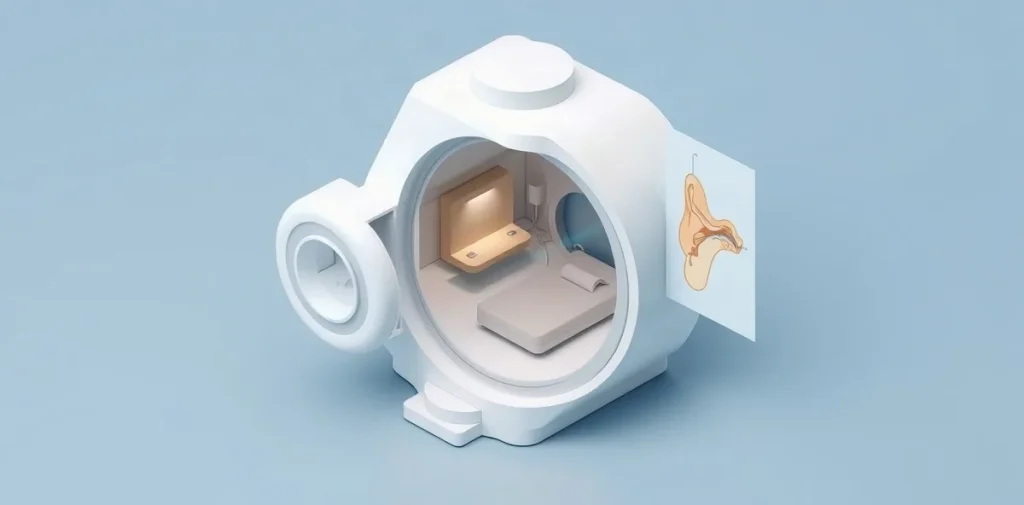
Risk factors for symptomatic otic and sinus barotrauma in a multiplace hyperbaric chamber is a 1999 journal article by Fitzpatrick DT and colleagues. It addresses pressure-related injury to the ears and sinuses during hyperbaric chamber treatment—a clinical concern because patients must equalise gas-filled spaces as ambient pressure changes.
What do otic and sinus barotrauma involve?
Barotrauma is tissue injury associated with a pressure difference across an air-containing space. In the ear, the middle ear is connected to the back of the nose by the Eustachian tube, which helps equalise pressure. If pressure changes faster than the tube can open, or it does not open effectively, discomfort and injury may occur.
The paranasal sinuses are air-filled cavities that communicate with the nasal passages through narrow openings. Congestion, inflammation or an obstructed opening can interfere with pressure equalisation. The resulting pressure imbalance may cause pain or tissue injury, particularly during compression or decompression.
“Symptomatic” barotrauma refers to pressure-related problems that produce symptoms, rather than a pressure change alone. The distinction matters in clinical settings, where symptoms can affect comfort, treatment continuity and decisions about whether a pressure exposure can safely proceed.
Why examine risk during chamber treatment?
A multiplace hyperbaric chamber is a pressurised environment used to deliver treatment to more than one occupant. Although chamber exposure differs from an underwater dive, both involve changes in ambient pressure and the need for gas spaces in the body to equalise. The same basic physical relationship applies: as surrounding pressure changes, trapped gas spaces must adjust.
Hyperbaric clinicians need to recognise factors that may make equalisation difficult before and during treatment. A patient may be unable to communicate discomfort as readily as a diver in an open-water setting, and pressure exposure is part of a prescribed clinical session. Understanding potential risks therefore supports careful assessment and monitoring.
For divers, the subject has a related but distinct relevance. Ear or sinus problems can complicate descent and ascent, interrupt a dive, or make pressure exposure unsafe. The chamber setting offers a clinical context for examining a familiar pressure-related problem under controlled treatment conditions.
What kinds of risk factors are relevant?
Studies of pressure injury commonly consider whether anatomy, airway condition, health status or the circumstances of pressure change could affect equalisation. These are useful categories for understanding the research question, not a diagnosis of risk for any particular person.
- Upper-airway condition: nasal congestion or inflammation can affect the routes through which the sinuses and middle ear equalise.
- Equalisation function: difficulty opening the Eustachian tubes can leave a pressure difference across the eardrum.
- Pressure exposure: the direction and pace of ambient pressure change can shape the demands placed on gas-filled spaces.
- Symptoms and communication: discomfort is clinically relevant and should be recognised during treatment rather than dismissed.
These considerations help frame how risk-factor research is designed and interpreted. A risk factor is not necessarily a direct cause, and the presence of one does not mean that injury will occur.
How does this topic fit into diving and hyperbaric medicine?
Pressure-related ear and sinus problems are longstanding concerns in diving medicine because they can arise whenever a person enters an environment where ambient pressure differs from surface pressure. Hyperbaric medicine shares this physiological challenge, while adding the demands of clinical treatment and chamber operation.
Research on barotrauma sits alongside broader work on pressure exposure, equalisation, patient selection and treatment safety. Its practical value lies in clarifying which features may warrant attention, helping clinicians think systematically about prevention and helping researchers identify questions for further study.
The article appeared in Undersea & Hyperbaric Medicine in 1999, placing its subject within a field concerned with both underwater physiology and medical use of elevated pressure. For present-day practice, the general physiology remains relevant, but clinical decisions should follow current protocols and an individual assessment.
What should patients and divers do with this knowledge?
Pressure-related ear or sinus discomfort should be taken seriously. A person receiving hyperbaric treatment should tell the clinical team about symptoms, while a diver should not force equalisation or continue a pressure change through significant pain.
Whether a particular symptom or health condition changes someone’s suitability for treatment or diving depends on individual circumstances. A diving-medicine physician or hyperbaric clinician should be consulted when pressure equalisation is difficult, symptoms persist, or there is concern about a previous injury.
Frequently asked questions
What does otic barotrauma mean?
Can sinus barotrauma occur in a chamber?
Is this article a guide to personal treatment decisions?
Citation details
- Title: Risk factors for symptomatic otic and sinus barotrauma in a multiplace hyperbaric chamber
- Authors: Fitzpatrick DT; Franck BA; Mason KT; Shannon SG
- Year: 1999
- Published in: Undersea & Hyperbaric Medicine 26(4): 243–7
- Identifiers: PMID 10642071
- Record type: Journal article
- Repository record: Rubicon Research Repository, handle 123456789/2316
This page is an original summary written by the Rubicon editors from the publication’s bibliographic record. It does not reproduce the paper, its abstract or its data; consult the publication itself for its methods and findings.
Related reading on Rubicon
- Ear Barotrauma in Diving: Pain, Risks and Care
- How Hyperbaric Chambers Aid Recovery from Dive Injuries
- Diving Safety: Training, Gear, Sites, Risk
- Decompression Sickness: Causes and Risk Reduction
- Catalina Hyperbaric Chamber Diving Accidents
- Thesis Research in Diving and Hyperbaric Medicine
- More on Dive Medicine
- Browse the Research Library