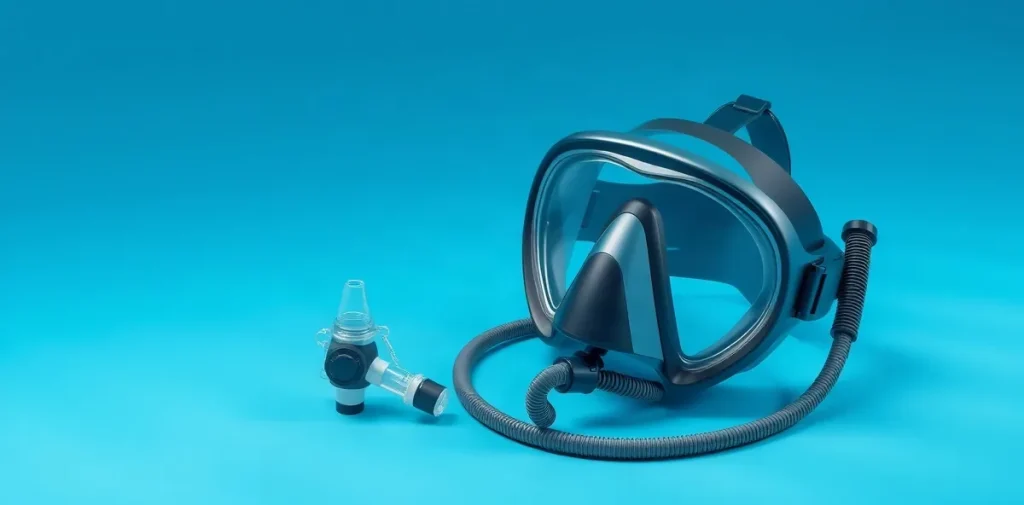
A comparison of respiratory function in divers breathing with a mouthpiece or a full face mask is a 1987 journal article by Norfleet WT and colleagues, published in Undersea Biomed Res 14(6). Its subject is how breathing function relates to two ways of delivering breathing gas underwater—a question with practical consequences for diver workload, equipment choice and physiological testing.
Why compare a mouthpiece with a full-face mask?
A diver’s breathing system includes more than the lungs. The regulator, hose, mouthpiece or mask, and their position relative to the water all influence the route and effort of ventilation. Comparing configurations can help isolate how equipment interfaces relate to respiratory function.
A conventional mouthpiece is held between the teeth and lips, while a full-face mask encloses the nose and mouth. That changes the diver’s contact with the breathing apparatus and may affect fit, comfort, communication and the mechanics of breathing. The mask itself does not determine respiratory performance on its own: regulator design, depth, posture, exertion and individual physiology also matter.
What does respiratory function mean underwater?
Respiratory function includes moving air into and out of the lungs, exchanging oxygen and carbon dioxide, and sustaining ventilation as the body’s demand changes. Underwater, breathing takes place through equipment and against conditions unlike those at the surface. The gas is denser at depth, and the diver may need to overcome resistance in the breathing circuit.
Breathing resistance is the pressure needed to move gas through the system. A diver who is working harder may need more ventilation, while an added load can make each breath more demanding. The relation between effort, gas flow and respiratory response is therefore central to evaluating diving equipment, especially when a task involves sustained exertion.
- Ventilation: movement of gas into and out of the lungs.
- Breathing resistance: opposition to gas flow from the breathing system and surrounding conditions.
- Equipment interface: how the diver’s mouth or face connects with the breathing apparatus.
- Workload: physical effort that changes the body’s demand for ventilation.
How can the equipment interface affect breathing?
A mouthpiece and a full-face mask differ in how they seal to the diver and how the breathing gas reaches the airway. With a mouthpiece, the diver breathes through the mouth; a full-face mask encloses both the nose and mouth. These distinctions make the comparison relevant to breathing mechanics as well as equipment use.
Equipment should be considered as a complete system. The position and performance of a regulator, the breathing loop and the diver’s posture can alter the pressure needed to inhale or exhale. A comparison of respiratory function is meaningful only in relation to the conditions under which breathing is assessed; a configuration that behaves one way at rest may impose a different demand during work or at depth.
Why does this question matter in diving medicine?
Respiratory load is relevant to diver safety because breathing difficulty can increase effort and fatigue, and can complicate a task that already requires attention and physical control. Diving physicians and equipment specialists need to distinguish discomfort from a physiological limitation, while recognising that symptoms can have more than one cause.
Full-face masks also have applications where enclosing the face serves operational purposes, while mouthpieces remain a familiar breathing interface in diving. The comparison belongs to a wider research field concerned with gas delivery, respiratory mechanics, workload and the human factors of underwater equipment. Its value is in framing a question that connects device design with the diver’s response.
What should readers keep in mind when evaluating such comparisons?
Respiratory measurements depend on the protocol: the equipment configuration, the diver’s activity, depth and other test conditions shape what is being assessed. A measurement made in one setting should not automatically be treated as a prediction of performance in every dive. The relevant question is which conditions the evaluation represents.
Equipment decisions also involve fit, training, task requirements and emergency procedures, not respiratory measurements alone. If a diver has breathlessness, chest symptoms or concerns about fitness to dive, an individual assessment by a diving-medicine physician is appropriate; a research comparison is not personal medical advice.
Frequently asked questions
What equipment does the article compare?
Why can breathing feel different underwater?
Does a general equipment comparison determine what is suitable for an individual diver?
Citation details
- Title: A comparison of respiratory function in divers breathing with a mouthpiece or a full face mask
- Authors: Norfleet WT; Hickey DD; Lundgren CE
- Year: 1987
- Published in: Undersea Biomed Res 14(6)
- Identifiers: PMID 3120386
- Record type: Journal article
- Repository record: Rubicon Research Repository, handle 123456789/2456
This page is an original summary written by the Rubicon editors from the publication’s bibliographic record. It does not reproduce the paper, its abstract or its data; consult the publication itself for its methods and findings.
Related reading on Rubicon
- Full-Face vs Traditional Dive Masks: Usability and Safety
- Scuba Equipment: Stop Your Mask Fogging
- Why Divers Get Cold Faster Underwater
- Scuba Diving Equipment: Essential Gear for Every Diver
- Brain Lesions and PFO in Sport Divers
- PAO2 and PACO2 During Breath-Hold
- More on Diving Science
- Browse the Research Library