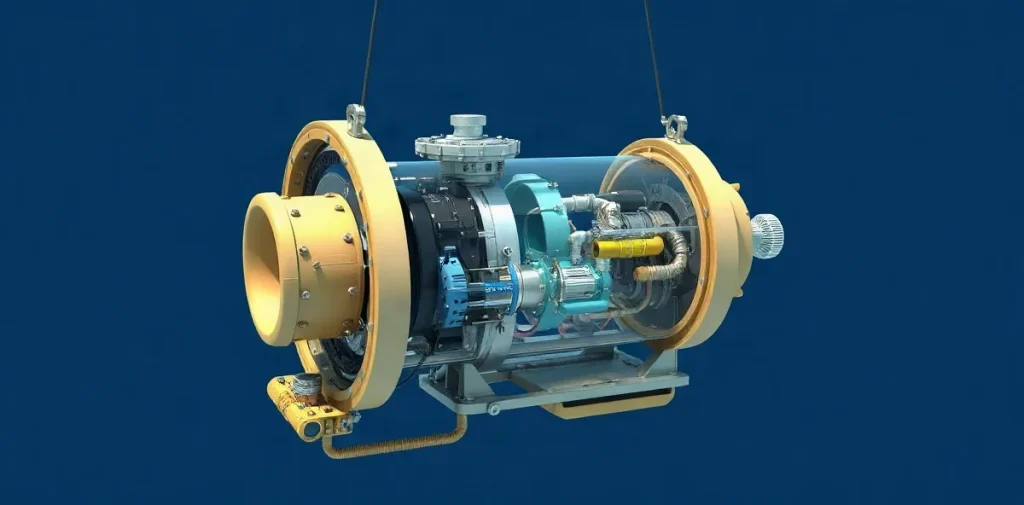
Redundant autonomous life support is the design and study of diving systems that preserve a breathable gas supply and essential functions if a primary component fails. It matters because underwater, a fault can become an emergency before a diver can reach the surface; backup equipment must work, remain usable and fit the dive plan.
What does redundancy mean underwater?
Redundancy means providing an independent or alternative means of sustaining a critical function. In diving life support, that may concern breathing gas, gas delivery, power or other components needed to keep a diver alive. A second component is not automatically an effective backup: it must be available when needed and the diver must be able to use it.
Autonomous systems carry their own life-support resources rather than relying continuously on a surface supply. This makes them useful for mobile diving, but places more responsibility on the equipment, its configuration and the diver’s response to failure. The design question is not simply whether a spare exists, but whether it can cover the relevant failure without creating a new hazard.
Which failures does a backup need to address?
Life-support systems contain interacting components. A failure can interrupt gas delivery, compromise the gas supply, or make an otherwise functioning system difficult to use. Redundancy planning therefore begins by identifying critical functions and considering how their failure could affect the diver and the rest of the system.
- Independence: whether the backup can still function when the primary component fails.
- Accessibility: whether the diver can locate and operate it under the conditions of the dive.
- Capacity: whether it can support the required response and ascent, as defined by the dive plan.
- Common-cause failure: whether one event could disable both the primary and backup systems.
- Human factors: whether procedures and equipment layout support a clear, practiced response.
These considerations apply across different equipment configurations. The details depend on the system, dive environment, depth, task and available assistance; redundancy cannot be judged apart from those conditions.
How do researchers evaluate life-support systems?
Research in this area combines engineering analysis with testing of equipment and operational procedures. Investigators can examine component reliability, failure pathways, backup independence and whether a diver can recognize and manage a fault. Testing under controlled conditions helps assess specific behaviours; it does not remove the need to consider how equipment performs in actual diving conditions.
Human performance is part of the system. Stress, workload, visibility, cold, restricted movement and task demands can affect whether a diver notices a problem and switches to a backup correctly. For this reason, studies of life support often sit alongside research on training, interface design and underwater human factors rather than treating hardware as an isolated object.
Why does redundancy matter to divers and clinicians?
For divers, a backup can provide time and options during a failure, but only if its limits are understood and the response is rehearsed. A poorly matched or inaccessible backup may add complexity without providing dependable protection. Equipment configuration, maintenance and emergency procedures need to work together.
Diving physicians and hyperbaric clinicians encounter the consequences of equipment-related emergencies, including interrupted breathing-gas supply and the injuries that can follow a distressed ascent. Understanding life-support design helps place an incident in context, though clinical assessment must address the individual diver and circumstances. For scientific divers, whose work may require sustained attention to a task, the interaction between mission demands and emergency capability is especially relevant.
How does this research fit into diving science?
Life-support redundancy connects equipment engineering with decompression practice, gas management, human physiology and safety planning. It complements research on depth instruments and technical-diving procedures: reliable measurement and sound planning matter, but neither can substitute for a functioning breathing system when a critical component fails.
The central challenge is to balance resilience with complexity. Additional equipment can create more connections, checks and opportunities for confusion, so a robust system needs clear roles for each component and a workable response to foreseeable faults. For a particular dive, the relevant questions are whether the backup is independent, suitable for the planned exposure and supported by practiced procedures.
Frequently asked questions
Is carrying a second breathing system enough?
Does redundancy eliminate diving risk?
Who should assess a diving-related medical concern?
An original research-library explainer written by the Rubicon editors. It is not a summary of a specific publication.
Related reading on Rubicon
- The Diving Reflex: What Happens Underwater
- Scuba Diving Fins: Split vs. Paddle Designs
- Scuba Diving Regulators: Balanced vs. Unbalanced
- Dive Computer Battery Life: What Drains It?
- Redundant Autonomous Life Support: Research Summary
- Newtsuit Life Support Evaluation: Research Summary
- More on Equipment
- Browse the Research Library