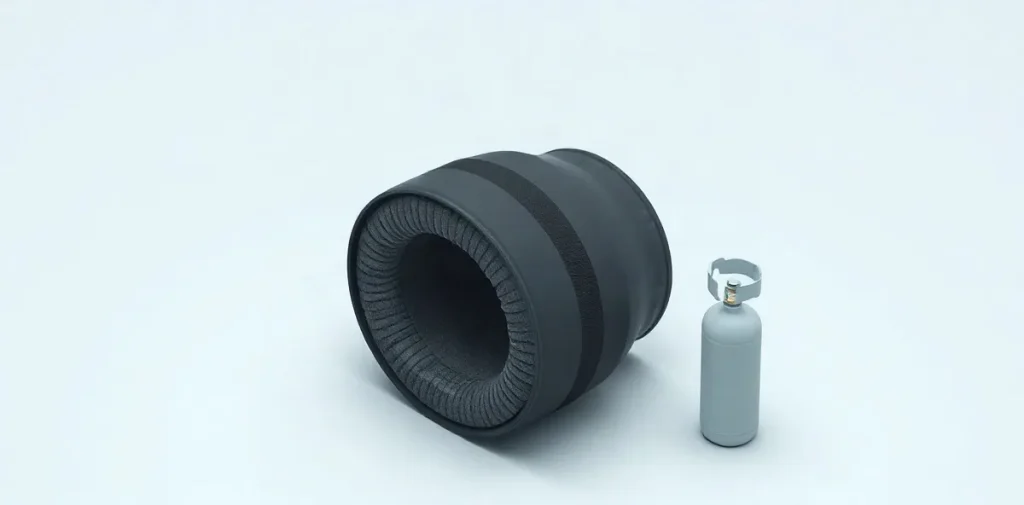
Thermal Characteristics of Diving Garments When Using Argon as a Suit Inflation Gas addresses how argon relates to the thermal performance of diving garments. The subject matters because divers in cold water depend on insulation to limit heat loss, while suit inflation gas is part of the equipment system that must be managed underwater.
Why consider argon in a diving suit?
In a dry suit, gas is introduced into the suit to counter water pressure and help maintain the garment’s shape around the diver. The gas also occupies space within the clothing system, so its thermal properties are relevant to how the suit performs as insulation.
Argon is considered in this context as an alternative inflation gas. The central technical question implied by the publication’s title is how diving garments behave thermally when argon is used for inflation, rather than treating the suit, its undergarments and its gas as unrelated components.
How does a diving garment help manage heat loss?
The body continually exchanges heat with its surroundings. In water, heat can be lost rapidly, and the diver’s thermal state depends on the surrounding conditions as well as insulation, exposure time, activity and individual physiology.
A dry suit is one part of a layered thermal system. Undergarments trap insulating layers, while the suit and its inflation gas affect the space and conditions around those layers. Compression at depth can alter garment loft and fit, making thermal performance a question of the complete system rather than fabric alone.
- Insulation: clothing layers slow the transfer of body heat to the surrounding water.
- Gas within the suit: inflation supports suit volume and is part of the thermal environment around the diver.
- Depth and fit: pressure and garment configuration influence how insulation behaves.
- Exposure: water temperature, duration and workload shape the diver’s thermal demands.
What does thermal performance mean for divers?
Thermal performance is not simply a question of whether a diver feels warm at one moment. It concerns how well a garment system limits heat loss during a particular exposure, and how consistently it does so as depth, workload and conditions change.
Cold stress can impair comfort, attention and physical function. For working divers and scientific divers, maintaining thermal protection can therefore matter to both wellbeing and the ability to carry out a task. In diving medicine, thermal strain is considered alongside other demands of immersion and exposure.
How does this subject fit into diving research?
Diving equipment research often examines how separate components interact under conditions that differ from those at the surface. Thermal studies of garments sit alongside wider work on exposure protection, suit design and the physiological consequences of immersion in cold environments.
Comparing suit configurations or inflation gases is a way to frame questions about heat transfer and practical equipment use. Such work is relevant to equipment development and to the choices made when planning cold-water dives, but thermal protection remains only one part of dive planning and risk management.
What should readers keep in mind about suit gas and cold exposure?
Choosing an inflation gas cannot be separated from the diver’s training, equipment configuration and operating procedures. A gas that is considered for thermal reasons still has to be handled within the broader requirements of dry-suit diving and the dive plan.
There is no single garment arrangement that suits every diver or exposure. Divers should follow appropriate training and equipment guidance; anyone with a medical concern about cold exposure or thermal tolerance should consult a diving-medicine physician.
Frequently asked questions
Why is suit inflation gas relevant to thermal insulation?
Does a dry suit alone prevent cold stress?
Who may find this research subject useful?
Citation details
- Title: Thermal Characteristics of Diving Garments When Using Argon as a Suit Inflation Gas
- Repository record: Rubicon Research Repository, handle 123456789/7962
This page is an original summary written by the Rubicon editors from the publication’s bibliographic record. It does not reproduce the paper, its abstract or its data; consult the publication itself for its methods and findings.
Related reading on Rubicon
- Diving Physics: Gas Laws, Pressure Effects, and Safety
- Gas Laws Every Diver Must Know for Safe Diving Practice
- Choosing the Right Exposure Suit: Balancing Thermal
- Primer on Gas Laws Crucial to Understanding Diving Physics
- Pulmonary Function and Deep Mixed-Gas Diving
- Thesis Research in Diving and Hyperbaric Medicine
- More on Equipment
- Browse the Research Library
