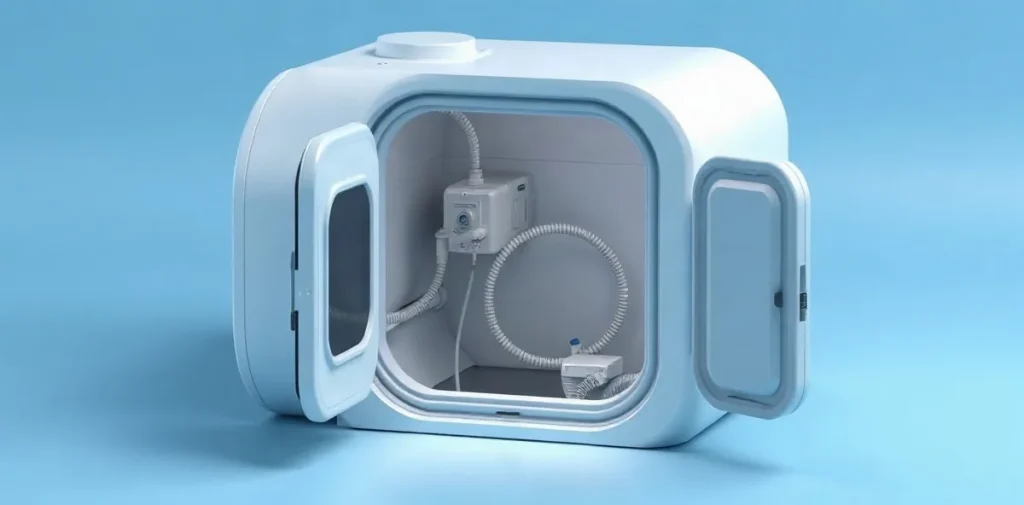
Performance of the Seachrist 500A Hyperbaric Ventilator in a Monoplace Hyperbaric Chamber is a 1988 journal article by Weaver LK and colleagues. Published in Journal of Hyperbaric Medicine 3(4), it addresses how a ventilator performs inside a single-occupant pressurised chamber—a practical question where breathing support must work in a changed pressure environment.
Why assess a ventilator inside a hyperbaric chamber?
A ventilator moves gas into and out of a patient’s lungs, supporting or controlling breathing when illness or injury prevents adequate ventilation without assistance. In hyperbaric treatment, the device operates within a chamber whose ambient pressure is raised above surface pressure. Equipment designed for ordinary clinical settings therefore needs consideration in the environment where it will actually be used.
Pressure can affect the behaviour of gases and the operation of mechanical systems. A ventilator’s delivery of gas, sensing and control functions, and interaction with its breathing circuit all matter to care. A performance assessment in a monoplace chamber addresses the combined setting rather than treating the device as if it were operating at surface pressure.
What does “monoplace” mean for ventilation?
A monoplace chamber is designed to accommodate one patient. Its enclosed configuration shapes how clinicians provide care and how equipment is arranged: a ventilator used for a patient inside must be compatible with the chamber’s pressurised environment and the clinical task.
The title places the Seachrist 500A Hyperbaric Ventilator at the centre of that equipment question. The relevant subject is not simply whether a ventilator can move air, but how its intended performance relates to pressure, patient breathing support and the practical constraints of chamber treatment. Those questions are important whenever a patient needs ventilatory assistance during hyperbaric care.
Which technical concepts help frame the question?
Ventilation is the movement of gas between the environment and the lungs; it is distinct from oxygenation, the transfer of oxygen into blood. A ventilator’s operation must be understood in relation to the pressure surrounding the patient, the gas delivered and the breathing circuit connecting device and patient.
- Ambient pressure: the pressure surrounding the equipment and patient inside the chamber.
- Delivered ventilation: the gas movement the device is intended to provide through its breathing circuit.
- Device function: the operation of controls, sensing and mechanical components under chamber conditions.
- Clinical integration: whether equipment can support care within the chamber’s physical and operational limits.
These are general considerations for assessing respiratory equipment in a pressurised environment. They do not, by themselves, establish how a particular model behaves; that requires device-specific evaluation.
Why does this matter to diving and hyperbaric medicine?
Hyperbaric treatment may involve patients whose medical condition makes breathing support necessary. Clinicians must consider both the therapeutic environment and the equipment used within it. Ventilator compatibility is therefore part of safe treatment planning, alongside patient assessment and the chamber’s operating procedures.
The topic also connects to a broader challenge in diving and hyperbaric research: physiological principles and medical devices must be considered under pressure, not assumed to behave exactly as they do at the surface. For diving physicians and hyperbaric teams, device-specific performance questions are practical as well as technical. Individual treatment decisions belong with the responsible clinical team and a diving-medicine physician where relevant.
What should readers take from the article’s subject?
The article is a focused equipment topic: the performance of the Seachrist 500A ventilator in a monoplace hyperbaric chamber. Its place in the literature is the intersection of respiratory support and chamber operation, rather than a general account of ventilation or diving physiology.
Readers assessing a ventilator for current clinical use should consult its current manufacturer documentation and the chamber provider’s requirements. A publication from 1988 is a historical reference point, not a substitute for confirming present-day equipment compatibility, maintenance status and clinical protocols.
Frequently asked questions
What is the publication about?
Why does chamber pressure matter to ventilators?
Can this article guide present-day equipment selection?
Citation details
- Title: Performance of the Seachrist 500A Hyperbaric Ventilator in a Monoplace Hyperbaric Chamber
- Authors: Weaver LK; Greenway L; Elliot CG
- Year: 1988
- Published in: Journal of Hyperbaric Medicine 3(4)
- Record type: Journal article
- Repository record: Rubicon Research Repository, handle 123456789/4377
This page is an original summary written by the Rubicon editors from the publication’s bibliographic record. It does not reproduce the paper, its abstract or its data; consult the publication itself for its methods and findings.