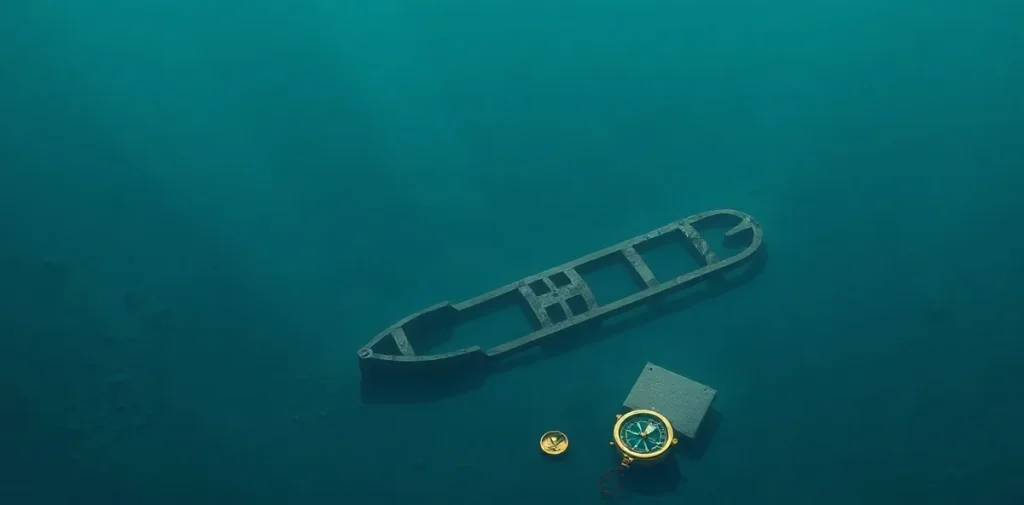
Diving on the Queen Anne’s Revenge is a 2003 publication by Southerly and Gillman-Bryan addressing scientific diving at the historic shipwreck named in its title. Its subject brings underwater research together with the practical demands of working at a submerged archaeological site, where careful documentation, environmental conditions and diver safety all matter.
What does scientific diving at a shipwreck involve?
Shipwreck diving for research is not simply a visit to an underwater site. Divers may need to observe, record and relate features in place, while avoiding disturbance to the remains and maintaining an accurate picture of their position and condition.
The Queen Anne’s Revenge setting connects diving practice with maritime archaeology: the study of human activity through material remains associated with vessels and their underwater surroundings. Such work depends on systematic observation and on treating the wreck as both a historical resource and a demanding dive environment.
Why does the wreck setting matter to divers?
A wreck can create physical obstacles, restrict movement and complicate navigation. Visibility, currents, depth, exposure and the layout of the site can shape what a diver can safely accomplish, while loose or fragile material raises additional concerns about contact and disturbance.
These demands make task planning part of the research method. A dive team must consider how to accomplish the work without allowing an archaeological objective to override limits on safe exposure, workload or environmental conditions.
- Site context: recording where objects and features occur in relation to one another.
- Navigation: maintaining orientation around an irregular underwater structure.
- Workload: accounting for equipment, task demands and conditions that can increase exertion.
- Conservation: minimising contact and avoiding unnecessary disturbance to submerged remains.
- Safety planning: matching the dive plan and team procedures to the site and the work.
What physiological and medical issues shape underwater work?
Immersion changes how the body handles pressure, breathing and heat. With increasing depth, ambient pressure rises and the gas a diver breathes is delivered at a higher pressure; breathing gas and dive duration therefore matter to decompression planning. Cold water and physical effort can also add strain, while equipment and task loading may affect a diver’s ability to respond to changing circumstances.
Decompression illness is a general hazard of diving, arising when pressure changes allow inert gas to form bubbles in tissues or circulation. Its risk depends on the dive profile and individual factors; it cannot be assessed from the historical subject of a dive alone. Medical concerns or fitness-to-dive questions call for assessment by a diving-medicine physician, rather than a general account of wreck research.
How does this subject fit into diving research?
Scientific diving sits between field research and operational diving practice. Researchers need methods that yield useful observations, but the work also depends on training, equipment, communication, risk assessment and procedures appropriate to the underwater setting. These considerations apply across disciplines, including archaeology and environmental science.
A proceedings contribution about diving on a named wreck belongs to this practical tradition: it places the conduct of underwater work at the centre of attention. The broader questions are relevant wherever divers investigate submerged places—how to document them consistently, preserve what is being studied and complete tasks within safe operating limits.
What should readers take from a research-library entry?
The bibliographic record places the publication in Diving for Science…2003, the proceedings of the 22nd Annual Scientific Diving Symposium, published in Greenville, North Carolina. That venue identifies its context as scientific-diving literature rather than a general guide to recreational wreck diving.
For diving professionals, the subject is a useful reminder that field objectives and dive safety are inseparable. Physiological principles, site conditions and the demands of observation all inform how underwater research is planned and carried out.
Frequently asked questions
What is the publication about?
Why is wreck research relevant to dive medicine?
Who may find this subject useful?
Citation details
- Title: Diving on the Queen Anne's Revenge
- Authors: Southerly, C; Gillman-Bryan, J
- Year: 2003
- Published in: SF Norton (ed). 2003. Diving for Science…2003. Proceedings of the 22nd Annual Scientific Diving Symposium, American Academy of Underwater Sciences. Greenville, North Carolina.
- Repository record: Rubicon Research Repository, handle 123456789/4760
This page is an original summary written by the Rubicon editors from the publication’s bibliographic record. It does not reproduce the paper, its abstract or its data; consult the publication itself for its methods and findings.
Related reading on Rubicon
- Google Scholar Research: Search and Assess Sources
- Ear Barotrauma in Diving: Pain, Risks and Care
- Scuba Diving: Why Immersion Can Dehydrate You
- Why Scuba Diving Tanks Feel Empty Before They Are
- HPNS Suppression in Deep Human Dives: Research Summary
- Flying After Diving: Research Summary
- More on Diving Science
- Browse the Research Library
